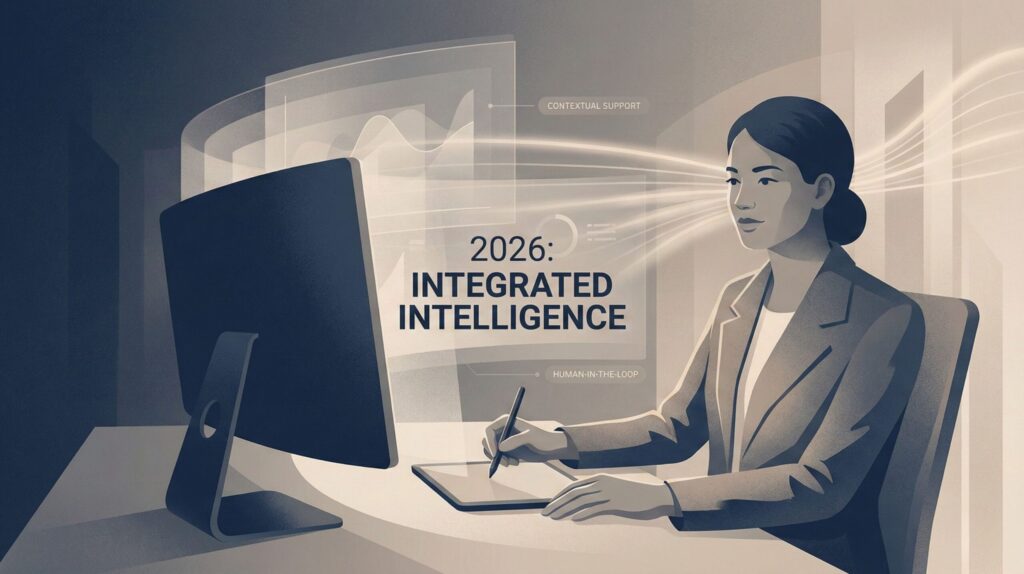

Published on: January 1, 2026
Disclosure:
Some links in this post are affiliate links. If you click and purchase, we may earn a small commission at no extra cost to you. Thank you for supporting AIDigitalSpace.com and helping us keep this content free and useful.
1. What Really Changed With AI in 2025
At some point in 2025, many of us noticed the same thing — without a big announcement.
AI didn’t arrive with a dramatic moment.
It didn’t suddenly replace everything.
Instead, it settled in.
Emails became easier to draft.
Long texts were quicker to understand.
Ideas appeared with less friction than before.
Nothing felt revolutionary — and that’s exactly why it mattered.
AI in 2025 didn’t change our routines overnight. What changed was the effort required to get value from it. Tasks that once felt experimental started to feel… normal. This shift reflects one of the most overlooked AI trends 2025 revealed: usefulness beat novelty.
We didn’t have to think about “using AI” as much anymore.
It began working inside tools we already relied on, quietly supporting real world AI use through email, documents, notes, and other everyday AI tools.
That said, the experience wasn’t universally smooth.
Many of us also felt a subtle contradiction:
some things improved a lot
others barely moved at all
a few frustrations kept repeating themselves
This tension sits at the center of the ongoing AI hype vs reality conversation.
So the natural question became: what actually changed — and what just sounded new?
This article helps us sort that out.
We’ll look at the real improvements people experienced, the limits that remained, and how to read the signals heading into 2026 without exaggeration or fear.
If you’ve ever thought “AI feels more useful now, but not as magical as promised”,
you’re not missing anything — you’re seeing AI in 2025 clearly.
2. The Biggest AI Improvements People Actually Used

What made 2025 feel different wasn’t a single breakthrough — it was how often AI helped without asking for attention. That pattern sits at the core of many AI trends 2025 discussions.
Most of us didn’t wake up excited about “new models.”
We noticed changes because everyday tasks became lighter, more predictable, and easier to complete.
The biggest improvements shared a common trait: they reduced friction.
Not by doing more — but by removing steps we no longer needed.
Instead of pushing us to work harder, AI helped us think less about the process.
That’s where real world AI use became noticeable.
Here’s where that progress was most visible.
| Area | What Improved | Why It Mattered |
|---|---|---|
| Writing & Summaries | More accurate, shorter outputs | Less editing, faster decisions |
| Search & Answers | Context-aware responses | Fewer follow-up questions |
| Images & Visuals | Better realism and consistency | Usable results, not just demos |
| Planning & Organization | Smarter suggestions | AI felt supportive, not intrusive |
What connects all these improvements is subtle but important.
AI in 2025 stopped trying to impress us.
It started trying to stay out of the way.
Features became more integrated into tools we already used — email, documents, notes, calendars — instead of forcing us into new platforms or habits. This shift toward background assistance is widely recognized as a key reason why everyday AI adoption accelerated (as also highlighted by recent analysis from MIT Technology Review).
That’s why many people say AI felt “more useful” in 2025, even though nothing felt dramatic.
Progress showed up in time saved, mental energy preserved, and fewer interruptions.
In the next section, we’ll look at the other side of the story —
the areas where expectations didn’t match reality, and why some frustrations refused to disappear.
3. What Didn’t Change (Despite All the Hype)
For all the progress we saw, 2025 also made one thing clear: not everything moved forward at the same pace. This contrast sits at the heart of many discussions around AI trends 2025.
Some promises sounded familiar by the end of the year, even as tools improved in small but meaningful ways.
That doesn’t mean progress stopped — it means certain limits proved harder to remove than expected.
Accuracy improved, but certainty didn’t.
AI made fewer obvious mistakes in short tasks, yet struggled when context became layered or ambiguous. The practical lesson many of us learned was simple: AI is useful for speed, but still unreliable for judgment — a recurring theme in real world AI use.
Creativity became faster, not deeper.
Models got better at generating options, variations, and drafts. What didn’t change was the need for direction. Without clear intent, results often felt generic, reminding us that taste, framing, and originality still come from people — a key point in the ongoing AI hype vs reality debate.
Trust remained selective, not automatic.
Even with better performance, questions around data sources, privacy, and transparency didn’t disappear. We used AI more often, but rarely without hesitation — a sign of experience, not fear.
Jobs didn’t vanish, responsibility stayed human.
Despite dramatic predictions, most roles weren’t replaced. Instead, AI handled preparation and repetition, while people remained accountable for decisions, nuance, and consequences. That redistribution of work mattered more than replacement ever would.
By the end of 2025, a clear pattern emerged: AI progress isn’t linear. Some capabilities advanced quickly, others barely moved, and a few may need limits to remain in place. Understanding that difference helps us approach 2026 with fewer illusions — and better expectations.
4. How AI Fit Into Everyday Life by the End of 2025
By the end of 2025, AI didn’t feel like something we used — it felt like something that quietly supported our routines.
It showed up in small moments rather than big workflows, often without requiring a conscious decision to “turn it on.” This shift is a key reason why AI in 2025 felt more present without becoming intrusive.
AI became part of the background.
Instead of opening a dedicated tool, we saw assistance appear inside emails, documents, search, notes, and calendars. The shift wasn’t about power — it was about availability at the right moment, a pattern increasingly described as “ambient AI” by researchers and analysts (see overview from Harvard Business Review talking about what’s lost when using AI).
Everyday tasks benefited more than complex ones.
Planning, summarizing, rewriting, organizing, and idea-generation improved noticeably. These weren’t glamorous use cases, but they saved time and mental energy where it mattered most.
Usage turned into habits, not experiments.
People stopped testing AI out of curiosity and started relying on it for repetitive or low-friction tasks. Once AI proved reliable enough, it earned a place in daily workflows — even if it wasn’t perfect.
Control stayed with the user.
AI suggested, assisted, and accelerated — but rarely acted alone. The most comfortable experiences were those where humans stayed in charge of context, tone, and final decisions.
This is why AI felt more present in 2025 without feeling overwhelming.
It didn’t demand attention. It respected it.
Understanding this shift helps explain why expectations for 2026 are changing too — less about dramatic breakthroughs, more about better integration, fewer interruptions, and tools that know when to stay quiet.
5. What We’re Likely to See Next in 2026
Looking ahead, the most important changes won’t feel dramatic. They’ll feel incremental, quieter, and more structural — a direction already visible in AI trends 2025.
Instead of guessing wildly, here’s what the signals from AI in 2025 realistically point to.
1. Fewer AI apps, deeper integration
Standalone tools will matter less. AI will continue moving inside software we already use — email, documents, search, design, planning — reducing the need to switch contexts. This kind of real world AI use favors continuity over novelty.
2. More autonomy, tighter boundaries
AI systems will handle longer chains of actions, but with clearer guardrails. Expect more emphasis on approval steps, editable outputs, and human-in-the-loop controls rather than full automation — a practical response to the AI hype vs reality gap.
3. Better defaults, fewer prompts
The biggest usability gain will come from smarter starting points. Instead of crafting perfect prompts, users will rely on context-aware suggestions that adapt automatically, especially inside familiar, everyday AI tools.
4. AI that knows when not to act
Silence will become a feature. Tools that interrupt less, suggest only when relevant, and stay passive by default will feel more trustworthy than those that constantly intervene.
5. Trust as a differentiator
Performance alone won’t be enough. Transparency, data handling, and clarity around limitations will increasingly influence which tools people stick with long term.
Taken together, 2026 looks less like a leap forward and more like a refinement phase.
The focus shifts from what AI can do to how comfortably we can live with it.
That change in expectations may matter more than any single technical upgrade.
6. Ethical Reflection: What 2025 Taught Us About Using AI Well
If 2025 taught us anything, it’s that ethical AI isn’t about stopping progress — it’s about steering it.
The real challenge wasn’t power, but pace. Systems became more capable faster than our habits, rules, and understanding evolved.
Comfort increased, awareness lagged.
As AI blended into daily tools, it became easier to forget when we were relying on it. Convenience reduced friction — but also reduced reflection. That trade-off matters.
Responsibility never disappeared.
Even when AI drafted, summarized, or suggested, accountability stayed human. Decisions, consequences, and judgment never fully transferred — and likely shouldn’t.
Transparency became a trust signal.
Tools that clearly showed limits, sources, or uncertainty felt safer than those that simply sounded confident. In practice, honesty proved more valuable than perfection.
Ethics showed up in small choices.
What data we shared. When we double-checked. When we slowed down instead of automating. Responsible use wasn’t dramatic — it was incremental and personal.
Looking ahead, the goal isn’t to use more AI.
It’s to use it deliberately.
The systems that will matter most in 2026 won’t just be powerful.
They’ll respect context, preserve human agency, and make it clear when not to rely on them.
That balance — between assistance and awareness — is where meaningful progress actually lives.
7. The Most Reliable AI Tools People Actually Used in 2025
By the end of 2025, a clear pattern emerged: people stopped chasing novelty and stuck with tools that simply worked.
Reliability mattered more than raw power. The tools that earned trust were those that showed up consistently, integrated smoothly, and respected human control.
Below are the AI tools that proved dependable across everyday use cases — not because they were perfect, but because they were predictable.
| Tool | Best For | Why It Stayed Relevant | Try It |
|---|---|---|---|
| ChatGPT | Thinking, drafting, explaining | Flexible across many tasks, predictable improvements | Try ChatGPT |
| Notion AI | Notes, planning, documentation | AI embedded directly into daily workflows | Try Notion AI |
| Grammarly | Writing clarity and tone | Subtle improvements without changing voice | Try Grammarly |
| Canva | Design, visuals, presentations | Lowered friction without removing creativity | Try Canva |
What these tools have in common isn’t cutting-edge novelty.
It’s trust earned through repetition.
They don’t try to replace judgment.
They assist, suggest, and accelerate — while leaving final decisions to people.
If 2025 showed us anything, it’s this:
the AI tools that last aren’t the loudest ones, but the ones that respect how we already work.
As we move into 2026, reliability will continue to beat experimentation — especially for tools we rely on every day.
If this article helped you reflect on how AI really evolved in 2025, these deeper reads explore how AI works under the surface and how it affects everyday decisions.
→ How Voice Assistants Actually Understand You
→ AI Hallucinations Explained: Why AI Gets Things Wrong
→ Avoid These 5 Dark UI Tricks Used by Popular AI Apps