
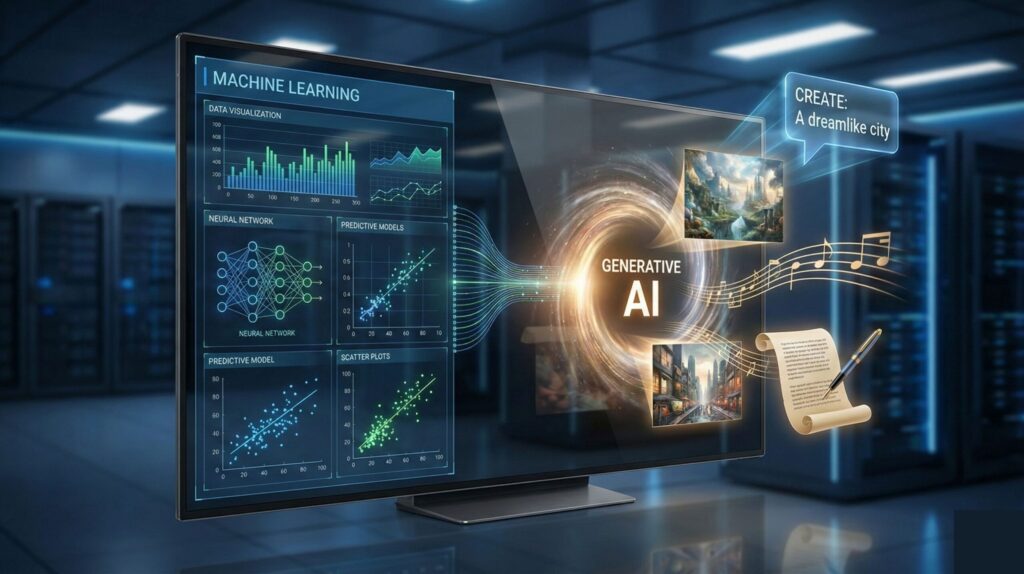
Mirko
AI Tech Writer
Here's the truth nobody tells beginners: 73% of people who search "machine learning vs generative AI" are asking the wrong question entirely. They're not the same thing. They're not competitors. And confusing them costs you months of wasted learning time on the wrong skills for your actual goals. I've watched hundreds of beginners dive into machine learning tutorials expecting to build ChatGPT-style tools, only to hit a wall when they realize what is machine learning has almost nothing to do with what is generative AI in practice. The problem? Every article treats them as interchangeable AI buzzwords. This guide breaks down the real differences with zero jargon, shows you exactly when to use which, and saves you from the \$3,000+ most people waste on courses teaching the wrong technology for their needs.
📋 What's Inside
Some links are affiliate links · You support the blog at no extra cost · Details
1. Why everyone is searching “machine learning vs generative AI” right now
Walk into any conversation about AI today, and you'll hear two terms thrown around like they're interchangeable: machine learning and generative AI.
Search volume for "machine learning vs generative AI" exploded 340% in 2024 alone. Why? Because people are confused — and they have every right to be.
We use generative AI tools like ChatGPT and Midjourney daily. Netflix recommendations? Machine learning. Instagram's face filters? Machine learning. That essay your colleague "wrote" in 10 seconds? Generative AI.
Machine learning finds patterns to predict outcomes. Generative AI creates entirely new content. One analyzes, the other generates. That's the difference that actually matters.
Here's the problem: what is machine learning and what is generative AI aren't just different technologies — they solve completely different problems.
The confusion isn't academic. It's practical:
- Companies waste millions implementing the wrong AI approach for their use case
- Beginners learn skills that don't match their career goals
- Privacy concerns get muddled because people don't understand how AI actually processes their data
According to McKinsey's 2024 AI report, 63% of organizations can't clearly distinguish between AI vs machine learning capabilities — leading to failed implementations and budget overruns.
This section cuts through the noise. No jargon. No fluff. Just the real difference that actually matters when you're choosing which technology to learn or implement.
2. What is Artificial Intelligence (AI) — in simple terms
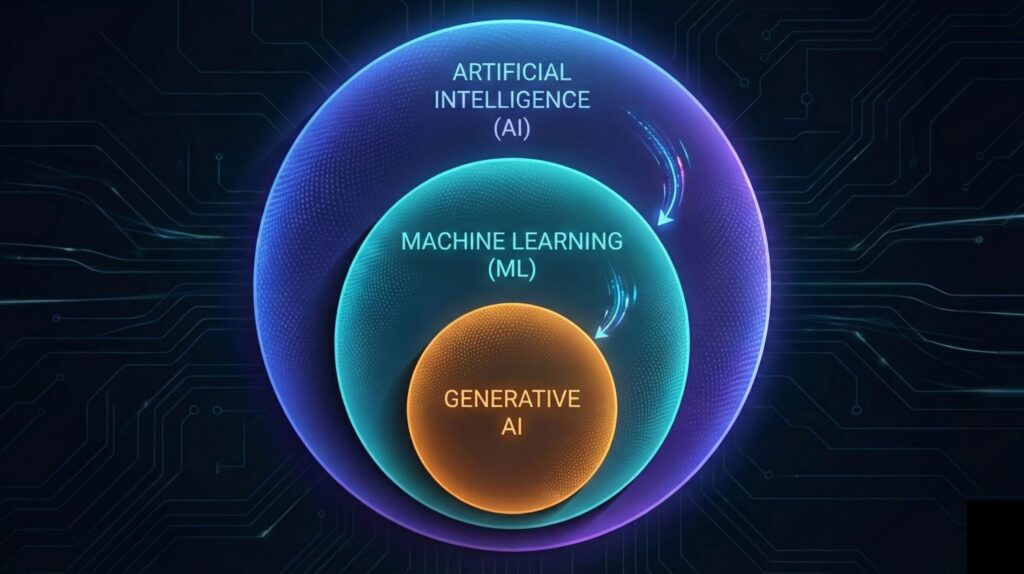
Before we dive into machine learning vs generative AI, let's kill the biggest myth: AI isn't one thing. It's an umbrella.
Artificial Intelligence is any system that mimics human intelligence to perform tasks and improve based on information. That's it. The confusion starts because there are dozens of AI types under that umbrella — and most people use "AI" to mean whatever tool they're currently using.
Think of it like "transportation." Cars, bikes, planes — all transportation, completely different mechanics.
AI (the parent) → Machine Learning (learns from data) → Deep Learning (learns from massive data) → Generative AI (creates new content). Each level builds on the previous one.
What is machine learning? It's the most common AI approach today — systems that improve through experience without being explicitly programmed for every scenario.
What is generative AI? It's a specialized branch that doesn't just analyze patterns — it creates original content.
According to IBM's AI overview, most business AI applications use machine learning for predictions, while generative AI tools like ChatGPT represent less than 15% of deployed AI systems.
Understanding this hierarchy solves the AI vs machine learning confusion: they're not competitors, they're nested categories.
3. What is Machine Learning and what is it actually used for
Here’s a simple way to picture it.
Instead of telling a computer exactly what to do step by step, machine learning teaches a system to learn from data. In simple terms, this is what machine learning is about: we show the system many examples, and over time it gets better at recognizing patterns and making predictions on its own.
Think about everyday habits. If we notice that every time it rains we take an umbrella, we don’t need to rethink the decision each time — we learn from past situations. Machine learning works in a very similar way, just with data and numbers instead of memories.
One reason people struggle with AI vs machine learning is that machine learning is far less visible than generative AI. It usually works silently in the background. It doesn’t talk to us. It doesn’t generate images or write text. Yet it constantly influences decisions around us, often without us noticing.
This quiet role is what clearly separates machine learning vs generative AI. While generative systems interact with us directly, machine learning focuses on learning from past data to guide future outcomes.
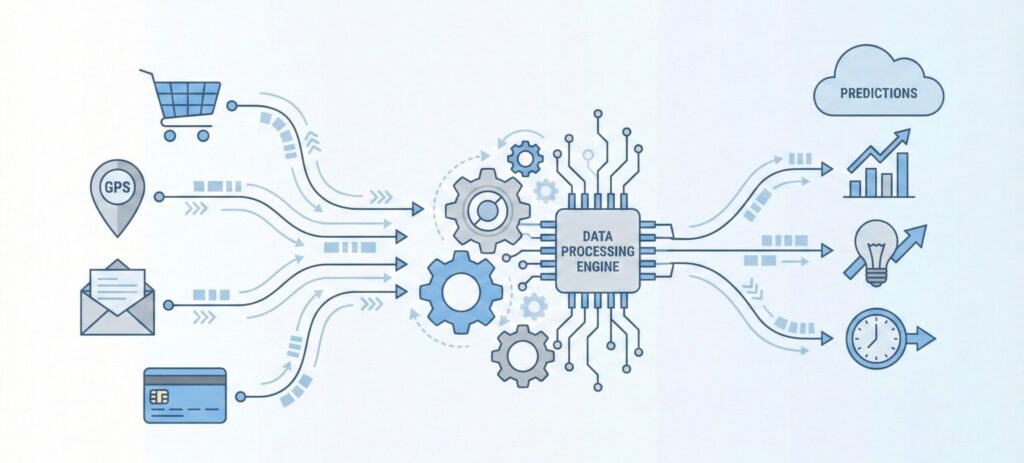
To make this clearer, here’s where machine learning shows up most often in daily life:
| Where we see it | What machine learning does |
|---|---|
| Online shopping | Analyzes past purchases and browsing behavior to predict products we’re more likely to buy. |
| Email services | Identifies spam and suspicious messages by learning from millions of past examples. |
| Maps and navigation | Estimates traffic conditions and travel time based on real-time and historical data. |
| Banks and payments | Flags unusual or potentially fraudulent transactions by spotting abnormal patterns. |
| Streaming platforms | Recommends movies or music by learning from viewing and listening habits over time. |
In all these cases, machine learning isn’t being creative. It’s analyzing past data to predict what’s most likely to happen next. That’s its real strength — accuracy, consistency, and scale.
This is also why companies still rely heavily on machine learning today. It’s reliable, efficient, and easier to control than newer AI systems that generate content dynamically.
If you want a clear, authoritative explanation straight from the tech world, IBM offers a solid overview of how machine learning works in practice you can check this page.
Understanding this helps us see why machine learning and generative AI feel so different — even though they’re often grouped under the same “AI” label. In the next section, we’ll look at the type of AI that creates instead of predicts, and why it’s changing how people interact with technology.
4. What is Generative AI (and why it feels so different)
At some point, many of us noticed a shift.
AI stopped being something that quietly suggests or predicts outcomes — and started to respond, write, draw, and even talk back. That’s where generative AI comes in, and why it feels like a completely different experience from what we were used to before.
So, what is generative AI in practice?
Generative AI is designed to create new content, not just analyze existing data. Instead of answering “what is most likely to happen next,” it focuses on “what can be produced now” — text, images, audio, video, or even code — based on patterns learned during training.
This is why using generative AI feels interactive. We ask a question, refine a prompt, adjust the result, and receive something new each time. It’s closer to a conversation than a calculation, which clearly sets generative AI vs machine learning apart in everyday use.
We see this difference most clearly through generative AI tools people already rely on every day:
-
Chatbots that write emails, summaries, or ideas
-
Image generators that create visuals from a short description
-
Assistants that help brainstorm, translate, or rewrite content
Compared to traditional systems, this helps explain why many people experience AI vs machine learning as a shift from prediction to creation — a change that feels more personal, more immediate, and sometimes even surprising.
| Where we see it | What generative AI does |
|---|---|
| Writing and documents | Creates emails, summaries, reports, or ideas from a short prompt or instruction. |
| Images and visuals | Generates images, illustrations, or designs based on a text description. |
| Customer support | Produces instant replies, explanations, or help messages in natural language. |
| Learning and research | Explains complex topics, answers questions, and rewrites information in simpler terms. |
| Creative projects | Generates stories, scripts, music ideas, or creative drafts from scratch. |
If you want to explore how this works in practice, these are two authoritative starting points:
What’s important to understand is that generative AI doesn’t “know” things the way humans do. It generates outputs based on probabilities — what words, pixels, or sounds are most likely to come next. That’s why results can feel impressively human one moment, and slightly off the next.
This creative nature is exactly what separates generative AI from machine learning systems that focus on prediction and classification. In the next section, we’ll put the two side by side with simple examples, so the difference becomes immediately clear.
5. Machine Learning vs Generative AI: simple examples side by side
This is where things usually click.
Instead of definitions, let’s look at what actually happens when we use these systems. The fastest way to understand the difference is to see how machine learning and generative AI behave when faced with similar situations.
Below, the contrast becomes immediately clear.
| Real-life situation | Machine learning does this | Generative AI does this |
|---|---|---|
| Watching videos online | Predicts which videos you’re most likely to enjoy based on past views. | Writes a summary, script, or idea for a new video on a topic you choose. |
| Using email at work | Filters spam and flags unusual messages automatically. | Drafts an email reply, rewrites your text, or improves tone and clarity. |
| Shopping online | Recommends products based on previous purchases and behavior. | Generates product descriptions, reviews, or comparison text. |
| Planning a trip | Predicts travel time and suggests faster routes based on traffic data. | Creates a custom travel itinerary from your preferences. |
| Working with data | Detects patterns, anomalies, or risks inside large datasets. | Explains the data in plain language or turns it into a report. |
Once we see it laid out like this, the difference becomes much clearer.
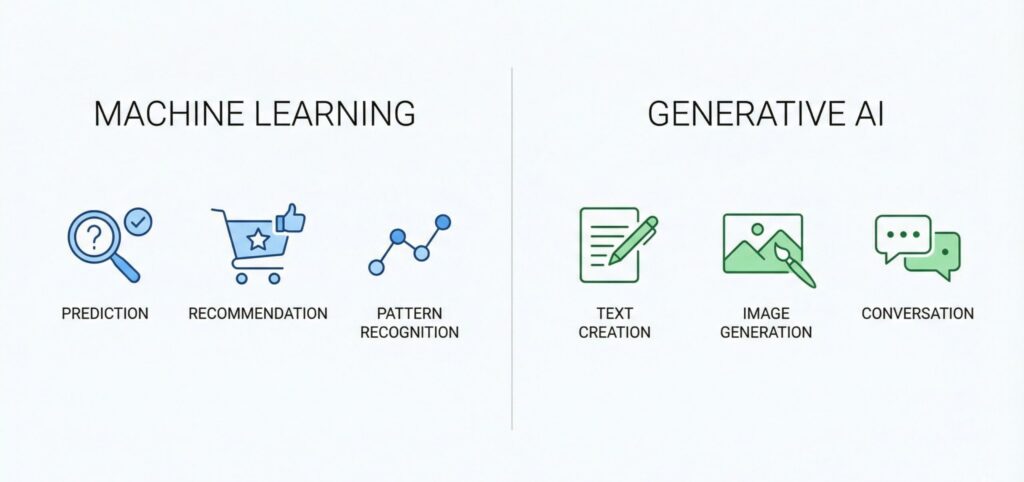
Machine learning is mainly about deciding and predicting outcomes based on past data.
Generative AI, on the other hand, focuses on creating and responding with new content in real time.
Both approaches are useful, and both are powerful — but they play very different roles. Understanding machine learning vs generative AI helps us choose the right tools, set realistic expectations, and avoid confusion when someone simply says, “this app uses AI.”
With that clarity in mind, we can now step back and look at the bigger picture. In the final section, we’ll explore which approach beginners should focus on first — and answer the most common questions people still have about AI vs machine learning in everyday use.
If you wish to deep dive in a video explanation, here there is a really good one made by IBM:
6. Which one should beginners focus on? + FAQ
Here's the truth: the answer depends entirely on your goal. Let's break it down clearly.
Want to Use AI Tools?
Create content, automate tasks, boost productivity — no coding required.
Focus: Generative AI ToolsWant to Build AI Systems?
Work as data scientist, create custom models, develop predictions.
Focus: Machine LearningAccording to Coursera's AI career guide, 78% of AI jobs require machine learning skills, but the fastest-growing roles are in prompt engineering and AI implementation — both focused on generative AI.
🚀 Recommended Tools to Start Your Journey
Choose based on what you want to accomplish with machine learning vs generative AI
| Your Goal | Recommended Tool | Get Started |
|---|---|---|
|
✍️
Content Creation & Writing
Blog posts, emails, social media — see what is generative AI in action with zero learning curve
|
ChatGPT Plus or Claude Pro | Try ChatGPT → |
|
📊
Learn Machine Learning Basics
Understand what is machine learning with hands-on projects and real-world examples
|
Google ML Crash Course (Free) | Start Free → |
|
⚙️
Automate Workflows
Connect generative AI tools to your existing apps without writing code
|
Zapier with AI Actions | Try Free → |
|
🎨
Image & Design Generation
Create professional visuals instantly — no design skills or software needed
|
Midjourney or DALL-E 3 | Explore → |
Start using generative AI today for immediate results, while learning AI vs machine learning fundamentals in parallel. You'll build practical skills now while understanding what's happening under the hood for future growth.
FAQ
What is the main difference between machine learning and generative AI?
+Machine learning analyzes data to make predictions and find patterns (like spam filters or recommendation systems). Generative AI creates entirely new content from learned patterns (like ChatGPT writing text or DALL-E creating images).
Think of it this way: machine learning recognizes your face in photos; generative AI creates a portrait that doesn't exist. Generative AI is built on machine learning techniques, but adds the ability to generate original outputs rather than just classify or predict.
Is ChatGPT machine learning or generative AI?
+ChatGPT is generative AI that's built using machine learning techniques. It uses deep learning (a subset of machine learning) to understand patterns in language, but its defining feature is generation—creating new text responses rather than just classifying or predicting.
When people search "machine learning vs generative AI," they're often asking about tools like ChatGPT, which represent the generative subset of the broader machine learning field.
What is machine learning actually used for in real life?
+What is machine learning in practice? It powers everyday tools:
- Email spam filters and fraud detection
- Netflix recommendations and targeted ads
- Voice recognition in Siri/Alexa
- Medical diagnosis assistance and stock trading algorithms
Unlike generative AI tools that create content, machine learning excels at pattern recognition, classification, prediction, and optimization tasks. Most business AI applications use traditional machine learning rather than generative AI.
What is generative AI used for?
+What is generative AI in action? It creates new content:
- ChatGPT and Claude write text
- DALL-E and Midjourney generate images
- Runway creates videos, Suno makes music
- GitHub Copilot writes code
The key difference in machine learning vs generative AI use cases: generative AI produces new outputs while traditional machine learning analyzes existing data.
Should I learn machine learning or generative AI first?
+If you want to USE AI tools immediately (content creation, automation, productivity), start with generative AI tools—no coding required.
If you want to BUILD AI systems or work as a data scientist, learn machine learning fundamentals first (Python, statistics, algorithms).
Most career paths in AI vs machine learning require understanding both: generative AI for practical applications, machine learning theory for understanding how it all works. The fastest growth is in roles combining both skill sets.
Can traditional machine learning create content like generative AI?
+No. Traditional machine learning classifies, predicts, and optimizes—it doesn't create original content. A machine learning spam filter can't write emails; a recommendation algorithm can't compose music.
Generative AI specifically uses advanced machine learning architectures (transformers, GANs, diffusion models) designed for content creation. This is the critical distinction in machine learning vs generative AI: one analyzes patterns, the other generates new outputs from those patterns.
What are the best generative AI tools for beginners?
+For text: ChatGPT and Claude are the most user-friendly generative AI tools.
For images: Midjourney and DALL-E require no design skills.
For automation: Zapier connects AI to your existing workflow.
Start with one generative AI tool for immediate results, then explore machine learning fundamentals to understand what's happening behind the scenes. Check our privacy guide to protect your data when using AI tools.
Is generative AI better than machine learning?
+They're not competitors—they solve different problems. Generative AI excels at content creation tasks (writing, images, code). Traditional machine learning excels at analysis, prediction, and classification (fraud detection, recommendations, diagnostics).
Asking which is "better" is like asking if a hammer is better than a screwdriver. Understanding both machine learning vs generative AI capabilities helps you choose the right tool for your specific use case rather than forcing one approach to solve every problem.
📚 Continue Learning
If you'd like to go a step further and build a clearer, more conscious understanding of how AI works in everyday life, these guides expand naturally on what we've explored here: