
 Published on: December 27, 2025
Disclosure:
This post may contain affiliate links. If you purchase through them, we may earn a small commission — at no extra cost to you. This helps support our research and keeps AI Digital Space running. Thank you!
1. Why Skills-Based AI Is Changing How Talent Is Evaluated

Hiring has been broken for a long time. CVs look polished, job titles sound impressive, and interviews often reward confidence more than competence. What’s missing is a reliable way to see real skills in action before decisions are made.
This is where skills-based AI platforms enter the conversation.
Instead of asking where someone studied or how many years of experience they claim, these systems focus on what a person can actually do. Tasks, scenarios, and problem-solving exercises replace static credentials — offering a clearer signal of ability in an era shaped by ai skill development.
In this Skillfully AI review, we looked closely at how this shift works in practice. Not as a promise of “better hiring through automation,” but as a practical response to a real problem: too many decisions are still made without evidence of real-world performance, even as ai learning tools become more common in the workplace.
The rise of skills-first evaluation isn’t about speed.
It’s about accuracy, fairness, and relevance — especially as roles evolve faster than job descriptions can keep up, requiring more ethical AI learning and human-centered judgment.
2. The Problem With Traditional Hiring and Skill Signals
Traditional hiring relies heavily on proxies: degrees, previous employers, certifications, and self-reported experience. While these signals are convenient, they often fail to reflect how someone will perform in a real role — especially in environments shaped by ai skill development and fast-changing requirements.
This creates several issues.
First, skills decay and skills mismatch. A qualification earned years ago may say little about current ability. Second, bias creeps in easily — not always intentionally, but through familiarity, background, or presentation rather than capability. Third, hiring teams are forced to make early decisions with limited, indirect information, even as ai learning tools increasingly influence how work is done.
The result is a system that filters quickly, but not accurately.
This is why skills-based assessment is gaining traction. By asking candidates to engage with realistic tasks, platforms like Skillfully — as explored in this Skillfully AI review — aim to reduce guesswork and surface meaningful differences in how people think, decide, and execute, often with the support of AI acting as a productivity assistant rather than a final judge.
The challenge isn’t finding talent.
It’s recognizing it correctly.
Understanding this problem makes it much easier to evaluate whether Skillfully is a good fit — and what it can realistically improve within a framework of ethical AI learning and human oversight.
3. What Skillfully AI Is and How It Works
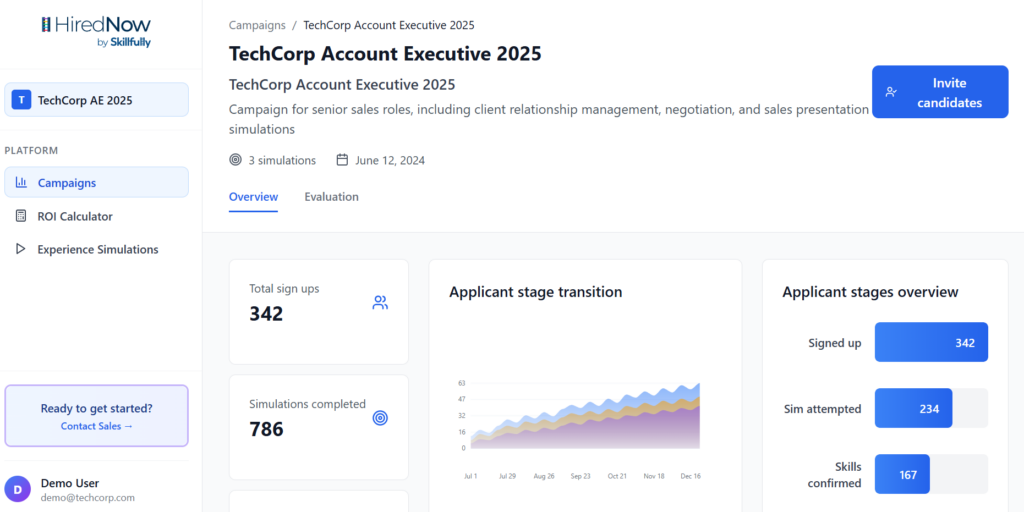
Skillfully is not a traditional learning platform — and it’s not just a hiring tool either.
It’s a skills-first AI platform designed to evaluate, surface, and support real abilities through practical, task-based assessment.
Instead of relying on CVs, titles, or self-reported experience, Skillfully focuses on what people can actually do. Users complete structured tasks tied to specific skills, while the system evaluates performance, patterns, and decision-making — a clear shift toward ai skill development grounded in evidence.
This is where learning happens — through doing, not consuming content.
Unlike many ai learning tools, improvement here is not driven by lessons or prompts, but by execution and feedback.
In this Skillfully AI review, what stands out is that skill growth is a byproduct of assessment. As users work through challenges, they receive feedback highlighting strengths, gaps, and areas for improvement. Over time, this builds a clearer picture of real capability, not just theoretical knowledge — with AI acting as a productivity assistant, not a final judge.
From a company perspective, Skillfully supports skills-based hiring, helping teams identify candidates based on demonstrated ability rather than credentials alone. From an individual perspective, it becomes a way to practice, validate, and prove skills in realistic scenarios.
Skillfully AI adapts tasks and evaluation based on context and performance, making assessments more relevant and less static than traditional tests. This adaptive approach aligns with research on skills-first hiring highlighted by the World Economic Forum, which emphasizes demonstrated capability over formal qualifications.
Understanding Skillfully as a skills assessment and development system — not a course platform — is key to evaluating where it fits and who it’s actually useful for, especially within a framework of ethical AI learning and human oversight.
4. How to Use Skillfully AI to Improve Your Skills Step by Step
Skillfully is most effective when it’s approached as a skills validation tool, not a learning app in the traditional sense. The goal isn’t to study — it’s to perform, reflect, and improve through real tasks, a core principle behind modern ai skill development.
A typical Skillfully workflow looks like this:
1. Select a skill to demonstrate
Users begin by choosing a specific skill area, often linked to a real role or responsibility. This immediately shifts the focus from theory to application — something many ai learning tools struggle to achieve.
2. Complete practical, task-based challenges
Instead of lessons or videos, Skillfully presents realistic tasks designed to surface how a person thinks, decides, and executes. This is where true skill levels become visible, with AI supporting the process as a productivity assistant, not a shortcut.
3. Receive structured evaluation and feedback
As tasks are completed, Skillfully analyzes responses and patterns. Feedback highlights strengths, gaps, and inconsistencies — helping users understand how they perform, not just what they know. This feedback-driven loop is a key element highlighted in this Skillfully AI review.
4. Reflect and improve through iteration
Skill development happens naturally through repetition. Users can revisit similar challenges, apply feedback, and gradually refine their approach, turning assessment into measurable improvement.
What makes this approach different is that learning is embedded in assessment. Progress doesn’t come from consuming more material, but from engaging with increasingly relevant tasks — an approach aligned with research on experiential learning and skills validation discussed by the OECD.
This task-driven model is also why Skillfully fits naturally into skills-based hiring — and why it appeals to individuals who want to prove and sharpen real abilities, not just list them, within a framework of ethical AI learning and human oversight.
5. Skillfully AI vs Real Skills-Based Hiring Platforms (And Common Mistakes)
Skillfully should be compared only with platforms that operate in the skills-based hiring and assessment space, not learning apps or generic AI assistants. This comparison focuses on how skills are evaluated, demonstrated, and interpreted — which is where the real differences matter.
How Skillfully AI Compares to Other Skills-Based Hiring Platforms
| Platform | Core Focus | How Skills Are Evaluated | Best For |
|---|---|---|---|
| Skillfully AI | Skills validation & development | Task-based, real-world scenarios | Assessing real ability beyond CVs |
| TestGorilla | Pre-employment screening | Standardized tests & quizzes | Filtering large candidate pools |
| HackerRank | Technical hiring | Coding challenges & projects | Developer & engineering roles |
| Codility | Technical screening | Timed programming tests | Early-stage tech assessments |
| Pymetrics | Cognitive & behavioral traits | Game-based behavioral analysis | Early-career & soft-skill matching |
Key takeaway:
Skillfully differentiates itself by combining assessment and improvement through realistic tasks, rather than relying solely on tests, games, or time-boxed challenges.
Common mistakes that reduce results (and how to fix them)
| Mistake | Why It’s a Problem | Better Approach |
|---|---|---|
| Treating tasks like exams | Encourages memorization, not ability | Approach tasks as real work scenarios |
| Focusing only on scores | Misses patterns and reasoning | Look at behavior and consistency |
| Blind trust in AI results | Context and nuance can be lost | Use AI as signal, not final verdict |
| Ignoring role context | Skills don’t exist in isolation | Align tasks with real job demands |
6. Ethical AI Reflection: Skills-Based Hiring, Bias, and Accountability

Skills-first platforms can be a big improvement over CV-only hiring — but only if we stay honest about what AI can and cannot judge. As ai skill development increasingly intersects with hiring decisions, the way assessments are used matters as much as the technology itself.
The main ethical risk isn’t “AI replacing humans overnight.”
It’s AI becoming the silent decision layer. When an assessment score feels objective, teams may treat it as truth — even though every evaluation system reflects assumptions: what is measured, what is ignored, and what counts as “good performance.”
In this Skillfully AI review, the most responsible way to use a tool like this is to treat AI assessment as a signal, not a verdict. It can help surface patterns and reduce noise, but it should never remove human accountability — especially when results affect real opportunities. This is where AI should act as a productivity assistant, supporting decisions rather than replacing them.
There’s also a privacy side. Skills assessments can capture more than answers: behavior, timing, writing style, and decision patterns. Even when used for good reasons, this data needs clear boundaries — what is collected, how long it’s stored, and whether candidates can understand or challenge outcomes. These concerns are central to discussions around ethical AI learning and responsible deployment.
Ethical AI in hiring is not about perfect fairness.
It’s about transparent evaluation, explainable criteria, and meaningful human oversight — so skills-based hiring becomes more inclusive, not just more automated. This aligns with guidance from bodies like the European Commission on trustworthy AI and human-centered assessment.
If AI changes hiring, ethics determines whether it becomes a better doorway — or a smarter filter.
7. Is Skillfully AI Worth It? Our Verdict and When It Makes Sense
After reviewing how Skillfully works, how it compares to other skills-based platforms, and where ethical risks sit, the verdict becomes clearer.
Skillfully AI is worth using when the goal is to evaluate and surface real skills — not credentials.
Its strongest value appears in contexts where traditional signals fail: CVs that look similar, inflated experience claims, or hiring decisions made with limited evidence. By focusing on task-based performance, Skillfully helps shift attention from what people say they can do to what they actually demonstrate — a key distinction highlighted throughout this Skillfully AI review.
This skills-first approach makes evaluation more grounded, more relevant, and better aligned with how real work actually happens, especially as ai skill development and ethical AI learning become central to modern hiring decisions.
That said, it’s not a universal solution.
Skillfully makes the most sense for:
Teams exploring skills-based hiring
Roles where practical judgment and execution matter
Organizations looking to reduce noise in early screening
Individuals who want to prove ability through real tasks, not titles
It’s less useful if:
You only need lightweight screening at scale
You’re hiring for roles where skills are hard to simulate
Decisions are expected to be fully automated without human review
A useful way to think about Skillfully is this:
it doesn’t replace hiring judgment — it improves the quality of signals feeding into it.
As research and policy bodies like the World Economic Forum have noted, the future of hiring is moving toward demonstrated skills and continuous evaluation, rather than static credentials. Skillfully fits squarely into that shift — as long as it’s used with oversight, context, and responsibility.
Used well, Skillfully isn’t a shortcut.
It’s a better lens.
8. Skillfully AI FAQ: Skills Assessment, Hiring Use Cases, and Limits
Q: Is Skillfully AI a learning platform or a hiring tool?
A: Skillfully AI is primarily a skills-based assessment platform used in hiring contexts. Skill development happens through task-based evaluation, not through courses or lessons.
Q: Can individuals use Skillfully AI, or is it only for companies?
A: While companies are the main users, individuals can also benefit by demonstrating real skills through practical tasks instead of relying on CVs or credentials.
Q: Does Skillfully AI replace recruiters or hiring managers?
A: No. Skillfully AI provides structured signals about skills, but final decisions should always involve human judgment and contextual evaluation.
Q: How is Skillfully AI different from traditional pre-employment tests?
A: Unlike static tests, Skillfully AI uses realistic, task-based scenarios that reflect how skills are applied in real roles, not just what candidates know.
Q: Are there risks in relying too much on AI-based skill assessments?
A: Yes. Over-reliance can hide bias or context. Skillfully AI works best when used as a decision-support tool, not as an automated gatekeeper.
If this Skillfully AI review helped you think more clearly about learning with AI, you might also find these reads useful to go deeper into how intelligent tools shape daily work and decision-making:
→ ChatGPT vs Gemini: Which One Wins in Daily Use?
→ Best Free AI Tools With No Login Required
→ How Voice Assistants Actually Understand You
→ Best AI Tools for Productivity in 2025