
 Published on: June 10, 2025
🕒 Last updated on December 22, 2025
Disclosure:
This post contains affiliate links. If you click through and make a purchase, we may earn a small commission at no additional cost to you. Thank you for supporting AIDigitalSpace — we only recommend tools and services we genuinely trust and believe bring real value to our readers.
1. What is Browse AI?
Browse AI is a no-code web scraping tool that helps you collect data from websites without programming skills. In this Browse AI Review, we explain how the platform works and why it’s becoming popular in 2025/2026 for anyone who needs fast and reliable data extraction.
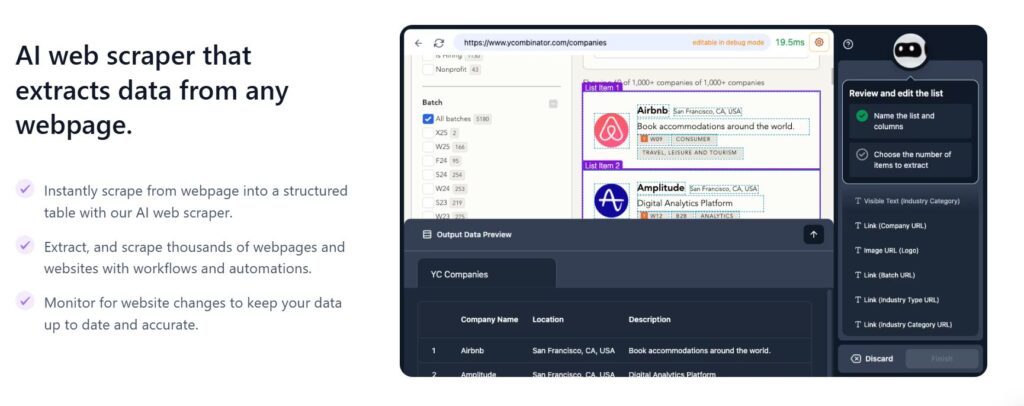
The main idea behind this tool is simple: you train a robot to capture the information you want, such as product prices, job listings, real-estate ads, or market research data. The interface is visual, so you select elements on a webpage, and the robot does the same task automatically.
It integrates with Google Sheets, APIs and databases, which helps you save scraped data and update it regularly. The automation runs in the cloud, so your robots continue working even when your computer is turned off.
If you are new to web scraping, Browse AI is easier to learn compared with more advanced tools like Apify. The goal is to make data extraction practical for freelancers, small teams, and companies that want results without the complexity of coding.
This Browse AI Review will help you understand what the tool can do, who it is suitable for, and whether it is still a good choice among no-code scrapers in 2025/2026.
2. Key Features and How Browse AI Works
It is built around a simple idea: you select the data you need on a webpage, and a robot captures it automatically. In this Browse AI Review, we focus on the features that make this possible and how the workflow functions in practice.
Key Features
Here are the main features that stand out:
Visual data selection: choose text, tables, prices, or listings directly on a webpage.
Robots for automation: once trained, a robot repeats the same action on similar pages.
Change monitoring: receive alerts when a price, product, or listing is updated.
Cloud execution: automation runs even when your computer is offline.
Data exports: send results to Google Sheets, databases, APIs, or CSV.
Prebuilt robot templates: start faster without configuring everything manually.
These features help users extract structured data for ecommerce, research, real estate, and competitor tracking.
How It Works Step-by-Step
The process is straightforward:
Choose a webpage
Select the elements you want to extract, such as titles or prices
Train a robot to repeat the action on similar pages
Schedule the automation to run once or at regular intervals
Export or monitor the data in Sheets, a database, or another tool
No coding or server setup is required; the system manages it for you.
Integrations and Automation
It integrates with Google Sheets, Airtable, Zapier, and Webhooks. This allows you to connect data extraction to real workflows like dashboards or reports. For advanced needs, you can explore platforms such as Zapier to automate additional steps after scraping.
Why It Matters
For many users, the main advantage of this tool is speed and simplicity. Instead of learning Python or using complex frameworks, you can automate repetitive data tasks in a few minutes.
In short, this Browse AI Review shows how the tool turns manual data collection into a repeatable, cloud-based automation workflow that anyone can use.
3. Who Is Browse AI For and When It’s Useful
In this Review, we explain who benefits most from the tool and in which situations it can make a real difference. Browse AI is aimed at users who need structured data from websites but do not want to build or maintain scraping code.
Browse AI is suitable for:
freelancers who monitor product prices or job listings
small businesses that track competitors or market trends
agencies that collect large datasets for reports
researchers who scrape public sources for analysis
ecommerce sellers who monitor catalogs or availability
These groups value the tool because it reduces manual work and simplifies data extraction.
Common Use Cases
| Use Case | What Browse AI Helps With |
|---|---|
| Price Monitoring | Tracking competitor prices and discounts automatically |
| Real Estate Listings | Extracting property details and availability |
| Job Market Research | Collecting job titles, salaries and posting dates |
| Ecommerce Catalogs | Scraping product titles, stock and reviews |
If you work with web data and want to automate extraction without learning a programming language, Browse AI offers a simple entry point. This review highlights how the tool fits real business needs, especially for users who value speed and simplicity.
4. Browse AI Pricing and Plans
We look at how the pricing works and what you get with each plan. This tool offers a free option and several paid tiers, depending on how many tasks you need to run each month.
Pricing Overview
| Plan | Monthly Price | Credits | Best for |
|---|---|---|---|
| Free | $0 | 100 credits/month | Testing and small tasks |
| Starter | $19/month | 2,000 credits | Freelancers and small teams |
| Professional | $99/month | 10,000 credits | Agencies and regular scraping |
| Enterprise | Custom | On request | Large companies and custom needs |
Prices may vary over time, so it is always a good idea to check the official website for updated details at browse.ai.
Value for Money
For small projects, the Free or Starter plans are usually enough. If you run frequent scraping tasks or need higher limits, the Professional plan offers better value. Enterprise plans can be negotiated for large workloads.
Summary
This review shows that the pricing model is flexible and scales depending on your needs. The free plan makes it easy to start without risk, while paid plans support regular automation.
5. Pros and Cons of Browse AI
It is useful to look at the main strengths of Browse AI and the points that need attention before using it in real projects. The table below gives a quick overview you can scan in a few seconds.
| Area | What Works Well | What to Consider |
|---|---|---|
| Ease of Use | Visual setup, simple steps and no-code approach make Browse AI accessible even for beginners. | Still requires some trial and error on complex or highly dynamic websites. |
| Automation & Features | Robots, scheduling and change monitoring cover most common scraping needs. | Very advanced logic or custom scripts may need developer tools instead. |
| Pricing & Credits | Free plan and scalable tiers allow you to start small and upgrade only when needed. | Heavy use can consume credits quickly, so monitoring usage is important. |
| Scalability | Cloud infrastructure runs robots in the background and supports regular automations. | Enterprise-level volumes may require custom plans and careful setup. |
| Ethics & Compliance | Useful for collecting publicly available data in a structured, repeatable way. | Users must always respect website terms of use, robots.txt and local regulations. |
| Support & Learning | Guides and templates help new users get started faster with Browse AI. | For very specific use cases, you may need to contact support or test several setups. |
Overall, shows that the tool is strong on simplicity and automation, while users should pay attention to credit usage, compliance and the limits of no-code solutions for very complex projects.
6. Alternatives and Competitors to Browse AI
It is useful to compare Browse AI with other no-code or low-code scraping tools. While Browse AI is simple and cloud-based, other platforms offer different features, pricing models, or flexibility. The table below gives a quick overview of the most common alternatives.
| Tool | Ease of Use | Automation | Price Range | Best For |
|---|---|---|---|---|
| Browse AI | Very easy | High | Free to mid-range | Beginners and small teams |
| Apify | Moderate | Very high | Mid to high | Advanced automations and custom flows |
| ParseHub | Easy to moderate | Medium | Free to mid-range | Visual scraping and simple workflows |
| Octoparse | Moderate | High | Subscription | Desktop scraping and scheduled tasks |
| Import.io | Moderate | High | High | Enterprise scraping and data pipelines |
Browse AI stands out for ease of use and fast setup, while tools like Apify and Import.io offer more flexibility for complex or large-scale projects. ParseHub and Octoparse provide alternatives for users who prefer desktop apps or visual builders.
7. Final Verdict — Is Browse AI Worth It?
After looking at the key features, pricing and real use cases, it is clear that Browse is a strong option for anyone who needs to extract data from websites without writing code. It focuses on ease of use, cloud automation and simple setup, which makes it practical for freelancers, small teams and businesses that want to save time.
It is especially useful if you:
want to build scraping tasks quickly
need regular updates or alerts for prices and listings
prefer a visual interface instead of complex scripts
do not want to manage servers or technical setups
However, if you need very advanced logic, extremely large datasets or full custom scripts, other tools may be more suitable. While Browse AI covers most common needs, enterprise automation and complex scraping may require specialised platforms.
Final Thoughts
In short, this shows that is worth considering if you want a no-code solution that is simple, scalable and fast to learn. It is not perfect for every scenario, but it offers a good balance of features and usability, especially for users who value convenience and automation over complexity.
8. Frequently Asked Questions
Q: Is it legal to use for scraping?
A: Yes, as long as you extract publicly available data and respect website terms, robots.txt and local regulations.
Q: Does it require coding skills?
A: No, you can train robots and automate scraping without coding, which makes it suitable for beginners.
Q: Can Browse monitor changes on a website?
A: Yes, it can detect updates such as price changes, new listings or product availability and notify you automatically.
Q: Is there a free plan?
A: Yes, there is a free plan with limited credits that is useful for testing or occasional small tasks.
Q: Can export data to Google Sheets?
A: Yes, it supports exports to Google Sheets, CSV, APIs and other tools to integrate scraped data into workflows.
Q: Is suitable for large companies?
A: It works well for regular automation, but very large or complex projects may require enterprise plans or more advanced tools.
If you found this Browse AI Review useful and want to explore similar tools for automation and productivity, the following posts might also interest you:
→ Harpa AI Review — Solid Weekday Tool for Power Users
→ Bardeen AI – Automate Everything in Your Browser
→ Superhuman vs Microsoft Copilot vs Google Gemini — Best AI Work Assistants?