
 Published on: June, 2025
1. Introduction: What is DeepSeek AI?
In 2025, DeepSeek AI is emerging as one of the most talked-about open-source ChatGPT alternatives, drawing attention from developers, businesses, and curious users alike. Developed by a Chinese research team, this large language model (LLM) stands out for its transparency, multilingual capabilities, and promise of a powerful yet free alternative to commercial AI tools.
But what exactly is DeepSeek AI? How do you actually use it? And is it really comparable to tools like GPT-4 from OpenAI or Claude 3 by Anthropic? Most importantly, can non-developers benefit from it in real, everyday scenarios?
In this clear and in-depth review, we’ll break down everything you need to know about DeepSeek AI: its core features, real-world use cases, who it’s best suited for, how it compares to other AI models, and the key ethical considerations worth keeping in mind. Let’s take a closer look.
2. Key Features of DeepSeek AI
-
Fully Open-Source: It’s free to use, inspect, and modify. You can find it on GitHub under the Apache 2.0 license.
-
Multilingual Support: Works well with both English and Chinese, making it great for bilingual environments.
-
Quality Training Data: Trained on a broad mix of online text, academic data, and multilingual corpora.
-
Customizable: Developers can “fine-tune” it, meaning they can teach it new tasks or adapt it to specific industries.
-
Lightweight Deployment: It can run on relatively accessible hardware, like consumer-grade GPUs, or in a browser.
Example: Unlike GPT-4 that you access through a web app and can’t control, DeepSeek AI lets you download and run it locally. That means more control, more privacy, and potentially no monthly costs.
3. How DeepSeek AI Compares to ChatGPT and Claude 3
To better understand where DeepSeek AI stands in today’s AI landscape, it helps to compare it directly with more familiar tools like ChatGPT and Claude 3. While all three are powerful language models, they are built with very different philosophies in mind — from open-source transparency to ease of use and enterprise readiness.
The table below highlights the most important differences across pricing, accessibility, setup complexity, and ideal use cases, helping you quickly see which tool aligns best with your needs.
| Criteria |
DeepSeek AI Open-Source |
ChatGPT (GPT-4o) OpenAI |
Claude 3 (Opus) Anthropic |
|---|---|---|---|
| Cost Pricing model |
Completely free and open to use. | Free (GPT-3.5) or $20/month (GPT-4o). | Free trial; Opus via Claude Pro ($20/month). |
| Open-Source Status Transparency & control |
Yes — fully open-source and modifiable. | No — proprietary model and infrastructure. | No — closed-source, API/UI only. |
| Languages Supported Multilingual capability |
Strong in Chinese and English; partial support for others. | Highly multilingual (50+ languages). | Excellent in English; growing multilingual support. |
| Setup Difficulty Ease of use |
Requires manual setup and technical knowledge. | Instant — web or app, no setup. | Simple — browser or API access. |
| Ideal Use Case Best-fit audience |
Developers, researchers, open-source teams. | General users, creators, students, marketers. | Enterprise teams, analysts, long-form work. |
What this comparison makes clear is that DeepSeek AI isn’t trying to replace ChatGPT or Claude 3 for everyone. Instead, it occupies a different space — one focused on flexibility, transparency, and technical control rather than convenience or polished user experience.
If you’re looking for a ready-to-use assistant that works instantly, commercial tools may be the better fit. But if you value open-source principles and want deeper control over how an AI model behaves, DeepSeek AI offers a compelling alternative worth exploring.
4. Who Should Use DeepSeek AI?
This tool is not for everyone, but it’s incredibly useful if:
You’re a developer or tech-savvy user who wants full control over an AI model.
You work in a non-profit, school, or research lab with no budget for commercial tools.
You care about data privacy and don’t want to send sensitive content to big tech companies.
You’re experimenting or learning how AI works and want a “hands-on” model.
If you’re just getting started in the world of AI, I personally recommend taking a look at our curated Top AI Gadgets for 2025, where you can find easier and more intuitive tools to get going without heavy setup.

5. Use Cases: What You Can Build with DeepSeek AI
Here are simple examples of how DeepSeek AI can be used:
Chat Assistants for Internal Teams: For example, answering repetitive company FAQs.
Bilingual Customer Support: You can create a chatbot that speaks both English and Chinese fluently.
Academic Tools: Summarize long documents, extract keywords, or help with language translation.
Customized Prompt Workflows: like the customizable workflows you’d find in advanced outreach tools such as Reply.io.
Tip: If you want to try it locally, make sure your PC has a decent GPU (at least 16GB VRAM). If not, I suggest checking out affordable VPS providers like Vultr. It’s a reliable way to deploy your AI projects without needing powerful home hardware.
6. Tips & Tricks to Get the Most Out of DeepSeek AI
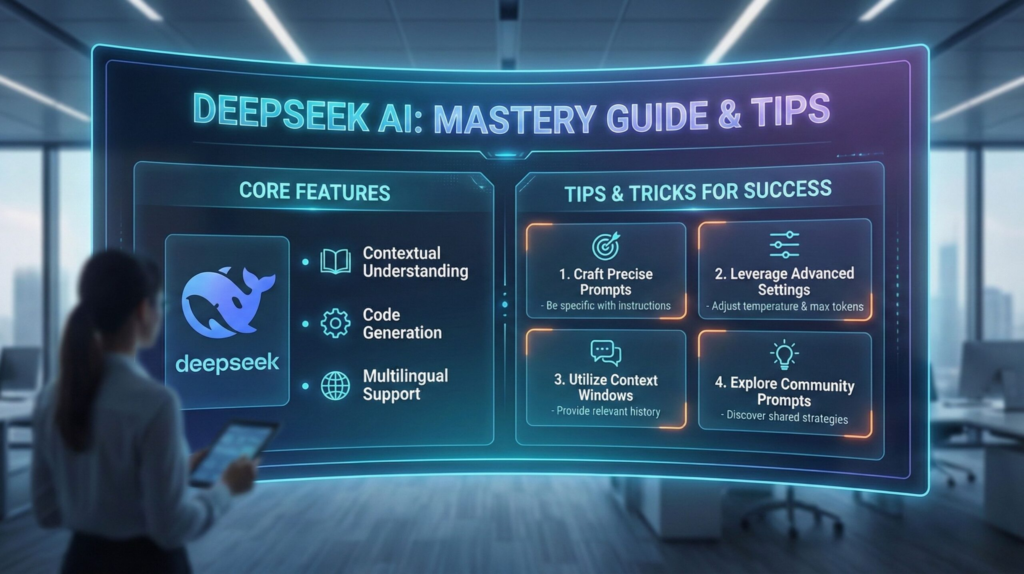
DeepSeek AI can be extremely powerful, but results depend heavily on how you interact with the model and how it’s configured. These practical tips will help you get more reliable and efficient outputs, especially if you’re working outside a polished, commercial interface.
Keep prompts clear and focused
Avoid long, overloaded prompts. DeepSeek AI performs best when instructions are specific and well-structured. If you have a complex task, break it into smaller steps instead of asking everything at once.
Use embeddings for consistency
If you’re working with documents, FAQs, or internal knowledge bases, pre-loading content through embeddings can make responses far more consistent. This is especially useful for support tools, research assistants, or internal search systems.
Pair it with a vector database
Combining DeepSeek AI with vector databases like FAISS or Pinecone significantly improves long-document search and contextual recall. This setup works well for projects involving large datasets or repeated queries over the same content.
Test token limits on your hardware
If you’re running DeepSeek AI on local or limited hardware, start with shorter prompts and lower token limits. Gradually increase complexity to find a stable balance between performance and reliability.
Document what works
Because DeepSeek AI is highly customizable, small configuration changes can lead to big differences in output. Keeping simple notes on prompt formats, settings, and successful workflows saves time in the long run.
For users who prefer productivity-focused tools that work straight out of the box, our guide to Best AI Tools for Productivity covers several plug-and-play options that require no technical setup and are better suited for everyday workflows.
7. Pros and Cons of DeepSeek AI
Before deciding whether DeepSeek AI is the right tool for your needs, it’s worth taking a balanced look at its strengths and limitations. As an open-source AI model, it offers a very different experience compared to polished, commercial platforms like ChatGPT or Claude — and that difference can be either a major advantage or a clear drawback, depending on who you are.
The table below summarizes the main pros and cons of DeepSeek AI in practical terms, focusing on real-world usability rather than marketing claims.
| 👍 Pros | 👎 Cons |
|---|---|
| ✅ Completely open-source and free to use or modify | ❌ Requires technical skills to deploy or fine-tune |
| ✅ Transparent model architecture and access to training details | ❌ No built-in GUI or chatbot interface out of the box |
| ✅ Ideal for researchers and AI developers who want full control | ❌ Smaller ecosystem and community compared to major commercial tools |
| ✅ Strong performance in English and Chinese language tasks | ❌ Not optimized for casual or non-technical users |
| ✅ High customizability and fine-tuning p
Overall, DeepSeek AI shines in scenarios where control, transparency, and customization matter more than convenience. For developers, researchers, and technically confident teams, its open-source nature can be a powerful asset. For casual users or those looking for a ready-to-use chatbot experience, however, the learning curve and lack of a polished interface may feel limiting.
As with most AI tools, the value of DeepSeek AI depends less on how powerful it is on paper and more on how well it fits your actual workflow and technical comfort level. 8. Ethical Considerations: What to Be Careful OfDeepSeek AI offers a high level of control — and with that control comes responsibility. Open-source AI models remove many of the guardrails found in commercial platforms, which makes them powerful tools but also increases the importance of how they are used. Here are a few key ethical points worth keeping in mind. It can generate incorrect or misleading information. Security and deployment risks matter more in open environments. Misuse is easier when safeguards are minimal. Transparency doesn’t replace accountability. Real talk: Open-source AI tools are incredibly empowering. But without an ethical framework, they can quickly become harmful rather than helpful. That’s why we consistently include this section — because AI isn’t just about performance or benchmarks. It’s about impact, trust, and long-term consequences.
If you’re looking for a widely accepted reference point, the OECD Ethical AI Principles provide a solid foundation for thinking about responsible AI use across transparency, safety, and human-centered design. 9. Alternatives to DeepSeek AI (Easier Tools)If DeepSeek feels too technical, try:
We also break down tools by category in our Top AI Tools Stack, where you can build a complete workflow tailored to your goals. Helpful Resources and Links10. Final Thoughts: Is DeepSeek AI Worth It in 2025?DeepSeek AI is not a plug-and-play solution. It requires patience, setup, and technical confidence. But for those who want full freedom over their AI tools, it may be the most liberating experience available right now. Unlike proprietary models that keep you in a closed system, DeepSeek offers transparency and adaptability. It’s not trying to beat GPT-4—it’s building a parallel, more open ecosystem. If you’re serious about customizing your AI and want to keep your data fully in-house, this is one of the best places to start. Try DeepSeek AI TodayStart with a local installation or deploy via a reliable VPS. For extra productivity, see our Top AI Stack 2025 and find your perfect combo. Let us know your results in the comments or connect via our newsletter. Manage Consent
To provide the best experiences, we use technologies like cookies to store and/or access device information. Consenting to these technologies will allow us to process data such as browsing behavior or unique IDs on this site. Not consenting or withdrawing consent, may adversely affect certain features and functions.
Functional Always active
The technical storage or access is strictly necessary for the legitimate purpose of enabling the use of a specific service explicitly requested by the subscriber or user, or for the sole purpose of carrying out the transmission of a communication over an electronic communications network.
Preferences
The technical storage or access is necessary for the legitimate purpose of storing preferences that are not requested by the subscriber or user.
Statistics
The technical storage or access that is used exclusively for statistical purposes.
The technical storage or access that is used exclusively for anonymous statistical purposes. Without a subpoena, voluntary compliance on the part of your Internet Service Provider, or additional records from a third party, information stored or retrieved for this purpose alone cannot usually be used to identify you.
Marketing
The technical storage or access is required to create user profiles to send advertising, or to track the user on a website or across several websites for similar marketing purposes.
|