
Leonardo AI vs Midjourney – Best AI tool for digital artists in 2025

Leonardo vs Midjourney – Best AI for Artists? (Comparison & Guide)

📅 Published on: June 16, 2025

1. AI for Artists: A Creative Revolution or a Trade-Off?

When it comes to creating digital art in 2025, one question keeps coming up: Leonardo vs Midjourney — which AI art tool should artists actually use?
And today, this debate goes far beyond features or image quality. It touches on trust, ethics, creative control, and ownership.

I still remember the first time I used AI to generate an illustration. It was fast, visually stunning, and — honestly — a little addictive. I typed a dreamlike prompt into Midjourney and instantly received an image I would never have drawn myself. Yet something felt off. Was this really my work?

Fast-forward to today, and Leonardo vs Midjourney has become the central AI art tools comparison for designers, illustrators, and creative entrepreneurs. One platform is structured, controllable, and workflow-oriented. The other thrives on unpredictability and artistic surprise. Artists are split: some feel empowered, others increasingly cautious — especially after major investigations into AI art, training data, and authorship.

Even established players like Adobe have stepped in, publishing ethical AI guidelines to respond to growing concerns about how models are trained — often using real artists’ work, sometimes without clear consent. This context matters when deciding which tool truly supports your creative practice.


This guide isn’t just another Leonardo AI review or Midjourney review. It’s a transparent look behind the algorithm: how these tools differ, how they affect your workflow, and what trade-offs you’re making when choosing the best AI for artists in 2025. By the end, you should have a clearer sense of which platform — if any — aligns with your creative vision.

2. What Is Leonardo AI? (And Why Everyone’s Talking About It)

In the growing debate of Leonardo vs Midjourney, Leonardo AI has emerged as the favorite for artists who crave control, clarity, and ethical transparency. It’s not just another AI image generator — it’s a platform designed with creators in mind, especially UI/UX designers, concept artists, and digital professionals who need consistency over chaos.

Where Midjourney leans into wild interpretation, Leonardo offers precision, style control, and post-processing tools that make it ideal for commercial work.

Key Features That Make Leonardo Stand Out

  • Image Refinement Panel: Edit and iterate on generated images without starting from scratch — perfect for nailing the final look.

  • Style Presets & Fine-Tuning: Apply consistent visual themes across projects, whether you’re designing fantasy worlds or mobile apps.

  • Personal Dataset Training: You can fine-tune the AI using your own references — a game-changer for brand-consistent visuals.

  • Layered Output & Background Control: Choose transparent backgrounds, editable layers, and upscaling for professional use.

  • Web UI + API Access: Loved by product teams who want to integrate it directly into their workflow.

Why the Creative Industry Is Embracing Leonardo AI

Leonardo has grown fast thanks to its creator-first approach. Many early adopters come from the game design, UX, and illustration space, where visual coherence and versioning really matter. Unlike the abstract results often seen in Midjourney, Leonardo gives you a sense of authorship and repeatability — making it ideal for commercial projects, brand decks, and product prototypes.

🎯 If Midjourney is where you go to explore, Leonardo is where you go to build.

Ethical Bonus: They’re Transparent About Data

One of Leonardo AI’s biggest draws? Clarity about how it’s trained.
The platform publicly discloses that it relies on licensed, opt-in, or proprietary datasets, not scraped images from across the web. For artists worried about theft or copyright gray areas, that makes a huge difference — and positions Leonardo as one of the most ethically conscious tools in the AI space.

3. What Is Midjourney? (Still the AI Art Powerhouse?)

When it comes to AI-generated art, Midjourney is often seen as the original game-changer. It’s been around longer, it built the hype early, and it continues to push artistic boundaries with its signature, dreamlike style. In the Leonardo vs Midjourney debate, Midjourney still holds its ground — but not without trade-offs.

Midjourney is powerful, unpredictable, and deeply creative. It’s the tool you use when you want something unexpected, expressive, and visually stunning right out of the gate.

🎨 Midjourney’s Signature Style: Bold, Surreal, One-of-a-Kind

What sets Midjourney apart is its unmistakable aesthetic. Think:

  • Deep textures, dramatic lighting, painterly finishes

  • Cinematic tones and moody palettes

  • Often looks like a cross between a concept art piece and a fine art oil painting

It’s not built for surgical control — it’s built to surprise and inspire, which is why so many visual creatives still flock to it.

💬 Discord-Only Access: A Dealbreaker for Some

Unlike Leonardo, Midjourney runs entirely through Discord. That means all image generation is handled via text prompts in chat channels — no standalone app, no polished UI. For some, it’s part of the fun (collaborating live, exploring prompts with others). For others, especially first-timers or professionals, the lack of structure can feel clunky.

🔧 If you’re used to drag-and-drop or visual editors, Midjourney’s Discord workflow takes getting used to.

Still, the platform is constantly evolving, and the Discord-based community remains one of the most engaged and helpful in the AI art world.

📝 Read Midjourney’s official community rules here →


📈 Used in Ads, Album Covers, and Book Jackets

Midjourney’s artistic strength has made it a favorite for:

  • Indie filmmakers crafting mood boards

  • Music producers designing cover art

  • Advertisers looking for bold visuals that don’t feel “stock”

  • Authors visualizing fantasy worlds and book scenes

But be aware: while its commercial licensing has improved over time, Midjourney’s terms of use vary by subscription — and creators must be mindful of attribution and redistribution rules.
 

4. Leonardo vs Midjourney: Feature-by-Feature Comparison

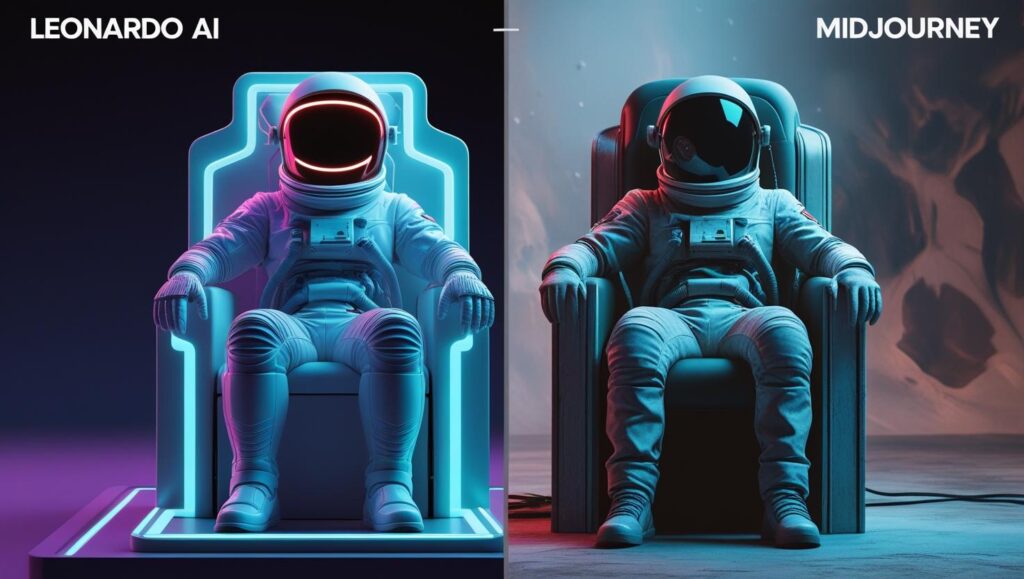
Leonardo vs Midjourney Side-by-side comparison of the same AI art prompt generated by Leonardo AI and Midjourney, showing different visual styles

When comparing Leonardo vs Midjourney, most artists quickly realize that this isn’t just a question of image quality. It’s a deeper AI art tools comparison that touches on workflow, creative control, transparency, and long-term usability.


Both tools rely on similar AI foundations, but they apply them in very different ways. Looking at features side by side helps clarify which platform better fits your style — whether you’re experimenting casually or searching for the best AI for artists who want consistency and control.

Feature Leonardo AI Midjourney
Ease of Use Clean web-based interface, accessible directly from the browser Operates through Discord commands, steeper learning curve for beginners
Creative Control High control with editable prompts, models, seeds, and fine-tuning options Strong artistic direction, less granular control over output
Art Style Output Versatile styles, well-suited for concept art, game assets, and design work Highly expressive, painterly, and visually striking results
Ethics & Transparency Publicly discusses training approach and allows more user control Ongoing debate around training data sources and artist consent
Pricing Model Free tier available, with paid plans for higher usage and features Subscription-only access after trial

This Leonardo vs Midjourney comparison makes one thing clear: there’s no single “winner” for everyone. Leonardo AI tends to favor artists who want structure, repeatability, and fine-grained control, while Midjourney shines when visual exploration and artistic surprise matter most.


Reading a Leonardo AI review or a Midjourney review in isolation rarely tells the full story. Seeing how they differ feature by feature makes it easier to choose the tool that supports how you actually create — not just what looks impressive in a demo. Ultimately, the best AI for artists is the one that aligns with your workflow, values, and creative goals.

5. Tips & Tricks: Getting the Best Results

Whether you’re team Leonardo, team Midjourney, or still deciding, knowing how to prompt these tools makes all the difference. The same idea can produce wildly different results depending on how you frame it — and each platform in the Leonardo vs Midjourney comparison responds to its own unique prompting style.

Below are the top prompting strategies, workflow hacks, and community resources we use to consistently get better, faster results — especially when comparing Leonardo vs Midjourney head-to-head.

Both tools use natural language prompting — but they interpret your words differently.

Leonardo AI Prompt Tips:

  • Use structured prompts: e.g., “cyberpunk cityscape, night, symmetrical, wide angle, cinematic lighting”

  • Add style modifiers: “digital painting,” “vector style,” “flat design”

  • Works best with clarity and specificity – great for UI/UX, product design, clean concepts

Midjourney Prompt Tips:

  • Use descriptive, poetic language: e.g., “a lone traveler in a glowing mushroom forest, fantasy style, misty atmosphere”

  • Try chaining visual styles: “oil painting + soft focus + surrealism”

  • Embrace ambiguity – the weirder, the better

🧪 Try This Prompt in Both Tools:
“A futuristic astronaut sitting on a neon throne, galaxies swirling in the background, dramatic lighting, concept art style”

⚡ Leonardo will give you a polished, design-friendly output.
🔮 Midjourney might give you something wild and emotionally immersive.

Upscaling Hacks That Actually Work

  • Leonardo AI: Use the built-in Upscale + Detail option after image generation. You can also export and post-process in tools like Let’s Enhance for sharper commercial-ready results.

  • Midjourney: Use --v 5.2 or --ar 16:9 for modern aspect ratios, then select “Upscale (Light)” for smoother results.
    For print-quality? Use Gigapixel AI (external tool) — many Midjourney creators swear by it.

Explore Community Packs & Templates

Want faster results without reinventing the wheel? Here’s where both platforms shine in the Leonardo vs Midjourney debate — through their thriving community content.

  • Leonardo AI:

    • Try their Style Library and Pre-built Prompts — perfect for design sprints

    • Follow their official Discord for prompt chains used by top designers

  • Midjourney:

    • Tap into Reddit threads like r/midjourney for wild prompt discoveries

    • Use prompt-sharing sites like PromptHero or Midjourney’s own community gallery

One prompt I loved (That Completely Surprised Me)

One night, I simply typed into Midjourney:

“An ancient library inside a whale’s belly, glowing lanterns, soft shadows, underwater haze.”

I expected some vague abstract shapes. Instead, I got something jaw-dropping: a richly detailed cathedral of books wrapped in glowing kelp, with floating stairs and bioluminescent lamps. It honestly made me rethink what this tool is capable of — and how imagination-first it really is.

✅ Want to find more AI prompt tips? Check out our Top AI Tools That Save You Time

6. Ethical Insight – What Are You Really Feeding the Machine?

One of the biggest questions in the Leonardo vs Midjourney debate isn’t about quality — it’s about ethics.

The AI-generated art space has been under fire for years over how training data is sourced. Many artists have discovered their unique styles mimicked by models they never gave consent to train. And if you’re using these tools professionally, it’s worth asking:
Who really owns the art you generate?
And are you unknowingly part of the problem?

Are These Tools Trained on Stolen Art?

Let’s be honest: this is the elephant in the room.

  • Midjourney has been heavily criticized for training on web-crawled datasets — which likely include copyrighted illustrations, photographs, and concept art scraped without permission. There’s no opt-out system in place (as of 2025), and their creators haven’t clearly disclosed the full scope of their data sources.

  • Leonardo AI, by contrast, has publicly committed to using licensed, proprietary, and opt-in datasets. They also allow users to train custom models on their own uploads, making it a safer option for brands, designers, and professionals concerned with originality and consent.

This makes a big ethical difference, especially for artists trying to avoid tools that exploit their peers.

Who’s Fighting Back for Artists?

Organizations like Spawning have launched the Have I Been Trained campaign to help creators check if their work has been used in AI datasets. They’ve also started pushing for industry-wide standards on artist rights, transparency, and opt-out enforcement.

You can support this movement — and protect yourself — by choosing tools that prioritize transparency and data integrity over raw capability.

📌 So… Is Leonardo AI More Ethical Than Midjourney?

In short: yes — as of now.

  • Leonardo is open about data sourcing, offers custom training options, and aligns with efforts to create consensual AI models.

  • Midjourney, despite its brilliance, continues to operate in a legal and ethical gray zone. For many artists, that’s a dealbreaker — especially as copyright lawsuits pile up across the industry.

7. Which Tool Should You Use?

You Are a... Best Pick Why
🎮 Game Designer Leonardo AI More control, consistent style output, ideal for concept environments
📱 Social Media Creator Midjourney Eye-catching, fast results perfect for engagement and visual trends
🧑‍🎨 Illustrator or Concept Artist Midjourney Great for bold artistic exploration and original visual inspiration
👶 Beginner Leonardo AI Simpler interface, easier learning curve, built-in templates
🧑‍💻 UX/UI Designer Leonardo AI Precise prompts, editable outputs, great for wireframes & design flows
🕵️ Privacy Advocate Leonardo AI Ethical transparency, no scraped datasets, GDPR-conscious
📖 Author or Storyteller Midjourney Generates surreal, emotional imagery perfect for narrative scenes

8. Bonus: AI Artist Starter Kit (Free Resources)

If you’re just getting started with AI art — or want to take your Leonardo vs Midjourney results to the next level — this free resource kit is packed with tools we personally recommend at AIDigitalSpace. These links will help you build, refine, and scale your creative workflow without spending a dime.

Free Prompt Libraries You’ll Actually Use

Explore proven, community-tested prompt formulas for both tools:

💡 Tip: Save prompts you like in Notion or Google Docs, and tweak them with your own keywords for custom results.

Top AI Art Tutorials (Beginner to Pro)

Want tutorials tailored to your level? We’re building out creator-specific guides. Join the AIDigitalSpace newsletter to get notified when they drop!

🧰 More Tools? Try Our 2025 Creative Stack

  • We’ve put together a handpicked collection of the Best AI Tools for Creatives – 2025 Edition, including:

    • Ethical image generators

    • Prompting assistants

    • Design accelerators

    • Tools that save you time without stealing your style

    👉 Explore the full list here →

9. Final Verdict: What Matters Most to Artists in 2025?

At the end of the day, Leonardo vs Midjourney isn’t just a comparison of two tools — it’s a reflection of what kind of creator you want to be in the age of AI.

If you’re chasing bold, cinematic, emotion-heavy visuals with minimal guidance, Midjourney still delivers that wow factor better than anyone else. It’s chaotic in the best way — and perfect for sparking unexpected inspiration.

But if you value ease of use, creative control, and most importantly, transparency, then Leonardo AI might just be your best creative partner in 2025. It’s the more ethical, flexible, and professional-grade choice — especially for artists who care where their data goes and how their art is handled.

🎨 While Midjourney still leads in pure visual wow, Leonardo wins in trust, ease, and transparency.

And honestly? There’s no rule that says you can’t use both. Many creatives do. Use Midjourney when you’re dreaming — and Leonardo when you’re building.

💬 Let’s Hear From You

Which one are you using — and why?
Drop your experience in the comments below — we’re building a space where creators can learn, share, and grow together.

👇
Which AI art tool do you trust the most in 2025? Tell us below.

Want more time-saving AI tools?
Check out our full roundup: Top 10 AI Tools That Save You 10+ Hours a Week