
 Published on: January 31, 2026
Disclosure:
This post may contain affiliate links. If you purchase through them, we may earn a small commission — at no extra cost to you. This helps support our research and keeps AI Digital Space running. Thank you!
1. Why So Many People Are Searching for Grok AI Right Now
We’ve all had that moment recently: you open an AI tool expecting a quick answer, and instead you get no response, a delay, or something that feels… off. A few minutes later, you’re on Google typing the name of the tool plus words like “down”, “issues”, or “not working”.
That’s exactly what’s happening right now with Grok AI.
Over the past weeks, many people have noticed sudden slowdowns, temporary outages, or inconsistent answers — especially during peak usage. At the same time, Grok keeps popping up in conversations on X, tech forums, and AI newsletters. The result? Curiosity mixed with frustration. People aren’t just asking what it is anymore; they’re asking why it behaves the way it does and whether it’s actually worth using.
This article is here to clear that confusion. We’ll look at why Grok is trending right now, what’s driving these search spikes, and how to separate real strengths from temporary limitations — without hype and without technical overload. The goal is simple: help us understand what’s really going on, so we can decide when Grok makes sense for our daily work and when it doesn’t.
2. Is Grok AI Down or Unreliable? What’s Actually Happening
If you’ve ever typed a question and watched the response stall—or not arrive at all—you’re not imagining things. Many users are searching right now because Grok AI feels inconsistent at times, especially when demand spikes.
What we’re seeing isn’t unusual for fast-growing AI tools. When a system is suddenly used by far more people than expected, a few things tend to happen: slower responses, temporary unavailability, or answers that feel rushed or incomplete. This doesn’t automatically mean the tool is “broken,” but it does explain why trust can wobble.
To make this clearer, here’s what’s usually going on behind the scenes:
| Use case | Why it works well |
|---|---|
| Email follow-ups & replies | Clear intent and predictable patterns make automation reliable when the task is well-scoped |
| Calendar actions & reminders | Time-based logic is where automated systems feel natural and low-friction |
| Task creation after meetings | Helps turn vague “we’ll do this later” moments into immediate, trackable actions |
| Light decision routing | Simple if/then logic reduces mental load without forcing complex decision trees |
The important point is this: unreliable moments don’t always equal an unreliable tool. They often reflect how new AI systems behave when adoption grows faster than infrastructure. In the next section, we’ll move past the technical hiccups and look at what Grok genuinely does well—and why people keep coming back despite these issues.
3. What Grok AI Is Good At (And What It Does Better Than ChatGPT)

At this point, a fair question comes up naturally: if Grok AI has these reliability hiccups, why are people still using it?
The answer is simple — because in some very specific situations, it feels more “in the moment” than most other AI tools.
Where tools like ChatGPT shine with structured tasks, planning, and polished outputs, Grok AI leans into contextual awareness and live conversation. It’s designed to react quickly to what’s happening right now, especially around trending topics, public discussions, and fast-moving narratives.
Here are the areas where Grok AI tends to stand out the most:
| Strength | Why it matters in practice |
|---|---|
| Real-time conversation tone | Feels closer to how people talk online, especially around breaking topics |
| Trend and social context awareness | Better at reflecting what’s circulating publicly, not just static knowledge |
| Opinion-style summaries | Useful for quickly understanding how a topic is being discussed or framed |
| Fast reactions to current events | Helpful when timing matters more than perfect structure |
This design choice explains both the appeal and the limitations. Grok AI prioritizes speed and relevance over refinement, which can feel refreshing when you’re trying to understand a fast-moving topic — but less ideal for deep research or polished work.
For readers who want a neutral, high-level explanation of how conversational AI systems differ in approach, this overview from IBM offers a solid foundation: check it here.
In the next section, we’ll translate these strengths into something even more practical: when Grok AI is the right tool to use — and when another AI will save you time and frustration.
4. When You Should Use Grok AI — And When You Shouldn’t
Once we understand why Grok behaves the way it does, the next step is practical: knowing when it actually helps us—and when it quietly slows us down. Using the right AI at the right moment makes a bigger difference than chasing the newest tool.
Grok AI works best when speed, context, and public conversation matter more than perfect structure. It’s less effective when accuracy, depth, or repeatability are the priority.
Here’s a simple way to decide.
| Use Grok AI when… | Avoid Grok AI when… |
|---|---|
| You want quick insight into trending topics or public debates | You need precise, structured research or long-form writing |
| Timing matters more than polish | You’re preparing professional or client-facing content |
| You’re exploring how people are framing a topic right now | You need consistent outputs across multiple sessions |
| You’re brainstorming angles or reactions | Accuracy and verification are critical |
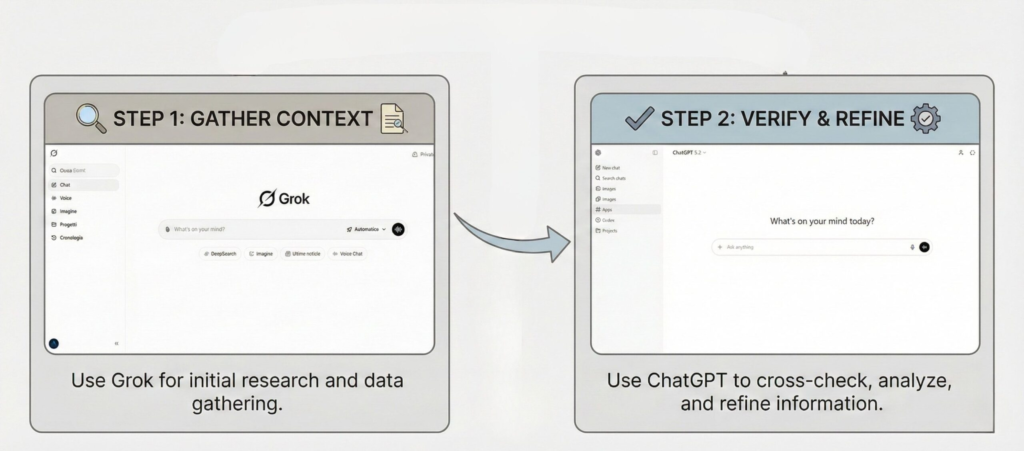
A good mental shortcut is this: Grok is a “what’s happening” tool, not a “final answer” tool. Many of us end up using it at the start of a workflow—then switching to something more structured once the direction is clear.
5. Reliability, Bias, and Data Risks You Should Know
When we rely on an AI to help us understand what’s happening right now, it’s easy to forget an important detail: speed often comes at the cost of stability and verification. This is where Grok AI requires a bit more awareness from our side.
Because Grok is designed to reflect live conversations and public discourse, its answers can sometimes feel confident even when the underlying information is incomplete, exaggerated, or simply trending rather than true. This doesn’t make it “bad,” but it does mean we should be careful about how much trust we place in its outputs.
Here are the main points to keep in mind:
| Risk area | Why it matters |
|---|---|
| Overconfidence in answers | Live context can amplify strong opinions without proper verification |
| Social and narrative bias | Public discourse is not neutral and can skew how topics are framed |
| Inconsistent availability | Heavy usage can affect reliability during peak moments |
| Limited fact-checking depth | Not ideal for critical decisions without a second source |
That’s why, when we need to verify information, reduce bias, or get a stable answer, Grok AI shouldn’t be the final stop. A practical and widely used approach is to cross-check Grok’s output with a tool built for consistency and reasoning.
ChatGPT is particularly effective here because it:
Prioritizes structured reasoning over social signals
Produces more stable answers during peak traffic
Is better suited for summaries, explanations, and decision-making
In short: Grok helps us see what’s being talked about; ChatGPT helps us understand what’s actually solid.
6. Final Verdict: Is Grok AI Worth Using Today?
After looking at how Grok behaves in real situations, the verdict is fairly clear. Grok AI is useful—but only when we use it for the right job.
It works best as a context tool: understanding what people are talking about, spotting trends, or getting a quick sense of how a topic is being framed right now. That’s where its speed and conversational tone shine. When we expect precision, depth, or consistency, though, it’s smarter to treat Grok as a first step, not the final answer.
A good rule of thumb is this: use Grok to explore, then use a more structured AI to decide. This keeps us informed without drifting into overconfidence or noise-driven conclusions.
For readers who want a broader, neutral perspective on how different AI systems handle reliability and reasoning, this overview from Stanford is a solid reference.
It helps put tools like Grok into context and reminds us why no single AI should be used blindly.
FAQ
Q: Why does Grok AI sometimes stop responding?
A: Most of the time, it’s due to heavy usage or temporary server load. Rapid growth often creates short-term instability.
Q: Is Grok AI better than ChatGPT?
A: Not overall. Grok is stronger for real-time context and trending discussions, while ChatGPT performs better for structured reasoning and reliable explanations.
Q: Can Grok AI be trusted for research?
A: It works well for orientation and context, but it’s not ideal for final research without verification from another tool or source.
Q: Is Grok AI free to use?
A: Access and features depend on the platform and current availability, which can change over time.
Q: What’s the safest way to use Grok AI today?
A: Use it to understand what’s happening now, then confirm important information with a more stable, reasoning-focused AI before acting on it.
If this guide helped you make more sense of how fast-moving AI tools like Grok should be used — with curiosity, but also caution — there are a few related pieces on AIDigitalSpace that naturally build on the same mindset.
→ ChatGPT vs Gemini: Which One Wins in Daily Use?
→ AI Hallucinations Explained: Why AI Gets Things Wrong
→ How Voice Assistants Work – Simple Guide to Understand Alexa, Siri & More