
 Published on: December 17, 2025
Disclosure:
Some links in this post are affiliate links. If you click and purchase, we may earn a small commission at no extra cost to you. Thank you for supporting AIDigitalSpace.com and helping us keep this content free and useful.
1. Why AI Confidence Feels So Convincing
We’ve all experienced it. You ask an AI a question, and the answer comes back clear, structured, confident — sometimes even better written than a human reply. The problem? That confidence doesn’t always mean the answer is correct.
From our experience testing dozens of AI tools on AIDigitalSpace, this is exactly why AI sounds confident even when it’s heading in the wrong direction. The tone feels authoritative, the wording feels precise, and there’s rarely hesitation. For users, that creates an instant sense of trust — even when the information behind it is weak, incomplete, or simply wrong.
This is where AI trust issues begin. Confidence triggers credibility in our brain, and modern AI systems are trained to respond fluently, not cautiously. That’s also why accuracy can feel inconsistent: the delivery stays polished, while the substance quietly slips.
We’ve already explored how this behavior connects to AI hallucinations in a dedicated guide, but here we’re focusing on something more subtle — the psychological effect of confidence itself. It’s one of the hardest risks to notice because nothing looks broken.
And this is exactly where ethical AI matters. If we don’t understand how confidence is generated, we risk outsourcing judgment instead of supporting it.
If you’ve ever followed an AI answer thinking “this sounds right”… this article is for you.
Related reading on AIDigitalSpace:
What Are AI Hallucinations? Understanding the Risks Behind Smart Answers
Why AI Tools Behave Differently for Each User (What’s Tracked)
Recommended Read
For a clear, research-backed explanation of why fluent AI responses often feel more trustworthy than they should, this analysis from MIT Technology Review explores how confident language can mask uncertainty, errors, and incomplete reasoning in modern AI systems.
2. The Moment AI Confidence Becomes Dangerous
AI confidence becomes dangerous when it replaces hesitation. The moment we stop double-checking because an answer sounds right, we’ve already crossed the line from assistance to dependence.
This happens most often in everyday decisions — writing emails, summarizing documents, interpreting policies, or explaining complex topics quickly. The issue isn’t dramatic failure; it’s quiet distortion. Small inaccuracies slip through because the language feels polished, creating trust issues without any obvious warning signs.
What makes this risky is that accuracy doesn’t degrade loudly. A confident answer can be partially correct, outdated, or missing context — and still feel complete. This is why hallucinations aren’t always obvious fabrications. Sometimes they’re just confident guesses dressed up as facts.
From our perspective, understanding all this is essential before using it for anything that affects people, money, or decisions. Confidence should be a signal to verify, not to relax.
A simple habit helps here:
If an AI answer makes you stop thinking, pause.
That’s usually the moment confidence has gone too far.
This is exactly where ethical AI becomes practical — not as a policy debate, but as a daily user skill.
3. Real Examples Where Confident AI Was Wrong
Confident AI errors are rarely absurd. They’re convincing because they sit close to the truth. Here are a few realistic scenarios where this happens — and why people fall for them.
Example 1: Summaries That Omit the Risk
AI tools often generate confident summaries of contracts, policies, or articles. The wording feels complete, but key limitations or exceptions quietly disappear. The result isn’t false information — it’s incomplete certainty, which is often more dangerous.
Example 2: Outdated Facts Stated as Current
AI may confidently explain regulations, prices, or features that have changed. Because the tone doesn’t reflect uncertainty, users assume accuracy where there is none. This is one of the most common sources of trust issues in professional settings.
Example 3: Plausible Explanations for Things That Don’t Exist
This is where hallucinations become visible. The system fills gaps with logical-sounding details, citations, or explanations — all delivered with the same confident structure used for correct answers.
Example 4: “Confident Guessing” Under Pressure
When prompts are vague or rushed, AI tends to choose fluency over caution. The answer sounds decisive, even if the model lacks enough context. Understanding it, helps explain why hesitation is rarely shown unless explicitly requested.
Practical takeaway
Confident AI errors usually share one trait:
They remove friction from thinking.
If an answer feels instantly usable without questions, that’s the moment to slow down — not speed up.
This pattern is well documented in human–AI interaction research. Stanford HAI and MIT researchers have repeatedly shown that people are more likely to accept incorrect answers when they’re delivered fluently and without visible uncertainty.
4. Why AI Sounds Confident Even When It’s Wrong
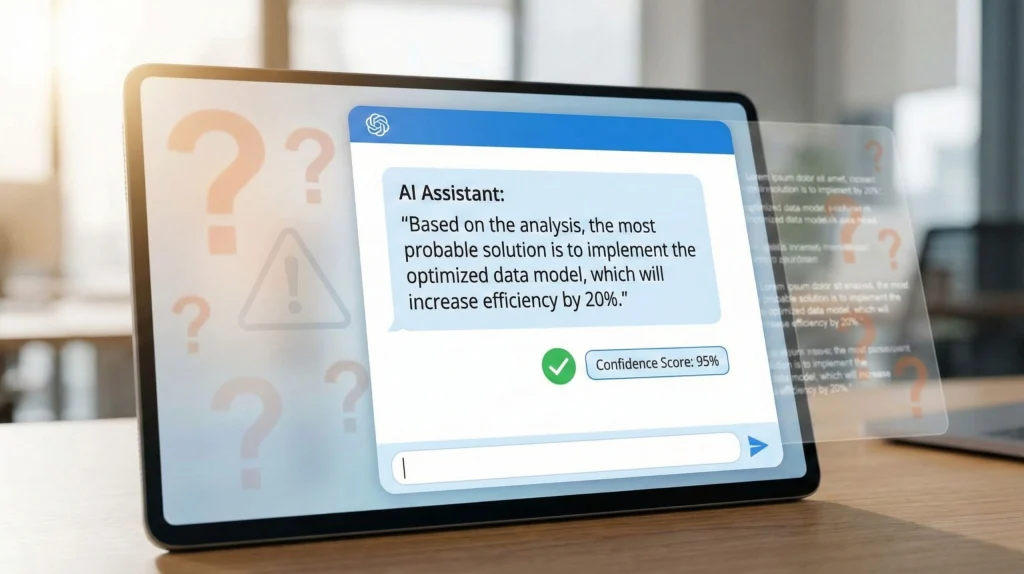
At its core, AI doesn’t “know” when it’s right or wrong. It doesn’t feel doubt. What it does extremely well is produce language that sounds complete. That’s the key reason why sounds confident, even when the answer is inaccurate.
AI models are trained to predict the most likely next word, not to check facts in real time. Confidence isn’t a decision — it’s a side effect of how fluent language is generated. If uncertainty isn’t explicitly requested, the system defaults to a polished, assertive tone.
This is also why accuracy and confidence don’t always move together. An answer can be wrong, outdated, or missing context — and still sound perfectly sure of itself. That gap is where most trust issues begin, and where hallucinations quietly slip in.
To make this clearer, here’s a simple breakdown.
| What AI Does | Why It Sounds Confident | What Can Go Wrong |
|---|---|---|
| Predicts likely words | Fluent sentences feel authoritative | Facts aren’t verified automatically |
| Fills gaps logically | No visible hesitation or doubt | Assumptions replace missing data |
| Optimizes for clarity | Clean structure boosts trust | Nuance and edge cases disappear |
| Matches user intent | Confident tone mirrors your expectations | Wrong answers feel personalized |
The key idea to remember
AI confidence is a design outcome, not a reliability signal.
Once you understand this, the behavior stops feeling deceptive and starts feeling predictable. And that’s important, because ethical AI use begins when we stop equating confidence with truth and start treating it as a prompt to verify.
This understanding sets you up perfectly for the next step: learning how to spot unreliable answers before they influence your decisions.
5. 5 Signals That an AI Answer Shouldn’t Be Trusted
Here’s the practical part. Once we understand how it works, we can spot “confident wrong” answers fast — without becoming paranoid. These 5 signals cover most real-life cases and protect accuracy in daily use.
Signal 1: It gives exact numbers, dates, or quotes without sources
If a tool states specifics with zero proof, treat it as unverified. This is where AI hallucinations often hide behind confidence.
Signal 2: It skips uncertainty in topics that obviously have it
Health, legal, taxes, prices, breaking news, product specs — certainty here is suspicious. This is the moment AI trust issues begin.
Signal 3: It answers fast even when your prompt is vague
When you give little context and it still responds like an expert, that’s a red flag.
Signal 4: It sounds “perfect” but can’t explain its steps
Ask: “How did you reach this?” If it can’t show a clear path, confidence becomes style, not reliability — and ethical AI use means we don’t accept style as truth.
Signal 5: It avoids clarifying questions when they’re needed
If a good assistant would ask “Which country?” or “Which version?” and the AI doesn’t, it may be guessing while sounding sure — again, why AI sounds confident matters.
Quick self-check table
| Signal | Fast question to ask |
|---|---|
| No sources for specifics | “Where did this come from?” |
| Overconfident on risky topics | “What could be wrong or missing?” |
| Vague prompt, strong answer | “What details do you need from me?” |
| No steps, only conclusions | “Show your reasoning step-by-step.” |
| No clarifying questions | “Which assumptions are you making?” |
6. Ethical Reflection: Confidence, Responsibility, and Human Judgment
The ethical problem isn’t that AI makes mistakes — it’s that can quietly shift responsibility away from us. When fluent answers feel certain, we’re tempted to stop checking. That’s how trust issues form: confidence becomes a shortcut for truth.
From an ethical AI perspective, confidence should invite verification, not replace it. Accuracy improves when humans stay in the loop — asking for sources, limits, and assumptions. When we don’t, small gaps turn into hallucinations that look reliable simply because they’re well written.
Our view is simple: using AI responsibly means treating confidence as a signal to slow down. Ethical AI isn’t about fear or restrictions; it’s about habits. If a tool sounds sure, we pause, confirm, and decide — that’s human judgment doing its job.
This approach aligns with guidance from standards bodies like NIST, which emphasize that users must understand AI limitations and avoid over-reliance on fluent outputs. In practice, ethics here is a daily skill: confidence in, verification out.
7. Tools and Habits That Help You Verify AI Answers
The goal isn’t to stop using AI — it’s to use it better. Verification doesn’t require complex tools; it starts with simple habits that protect AI accuracy and reduce trust issues.
Two habits make the biggest difference:
-
Force friction: ask for sources, assumptions, or alternatives before acting.
-
Cross-check fast: compare answers across tools or with one trusted reference when the stakes matter.
Tools can help, but they should support judgment, not replace it. Search-first assistants, citation-aware modes, and structured prompts reduce hallucinations by design. Used together with human review, they make confident answers safer — and more useful.
In our daily testing, tools that prioritize sources over fluency are often the safest companions when accuracy matters. For example, search-based AI assistants like Perplexity are designed to show where information comes from, making it easier to verify confident answers instead of blindly trusting them.
If you want to go deeper, these internal guides expand on practical verification and trust-building workflows:
Recommended reads on AIDigitalSpace:
What Are AI Hallucinations? Understanding the Risks Behind Smart Answers
Perplexity AI Review – The Smartest AI Search Engine in 2025?
Why AI Tools Behave Differently for Each User (What’s Tracked)
The takeaway is simple: ethical AI use isn’t about saying “no” to tools — it’s about choosing workflows where confidence is checked, not assumed.
8. FAQ – Why AI Sounds Confident, Accuracy, and Trust Issues
Why does AI sound confident even when it’s wrong?
AI is trained to generate fluent, complete language — not to express doubt. That’s why AI sounds confident by default, even when information is missing, outdated, or uncertain.
Are AI hallucinations the same as confident wrong answers?
Not always. AI hallucinations are completely fabricated details, while confident wrong answers can be partially correct but misleading. Both create AI trust issues because the tone feels reliable.
How can I improve AI accuracy when using tools like ChatGPT?
Ask for sources, request assumptions, and force step-by-step reasoning. Simple verification habits dramatically improve AI accuracy without slowing you down.
Can AI be trusted for work or important decisions?
Yes — but only with human judgment involved. Ethical AI use means treating AI as a support tool, not a final authority, especially for legal, health, or financial topics.
Is AI confidence a design flaw or a feature?
It’s a design outcome. Confidence makes AI easier to use, but without verification it can mislead. Understanding why AI sounds confident helps users stay in control.