

Mirko
AI Tech Writer
You ask ChatGPT about a historical event, and it confidently gives you dates, names, and details. Everything sounds right. But part of it is completely made up. AI hallucinations aren't glitches — they're a fundamental feature of how LLMs work. I dug into the 2026 research on why this happens and how to catch AI hallucinations before they cost you something.
As AI tools like Claude AI, ChatGPT, and Gemini become workplace standards, AI hallucination rates still swing from under 2% on simple grounded tasks to well over 50% on hard, unaided factual recall. One false citation in a legal brief or medical summary can have serious consequences.
Some links are affiliate links · they support this site at no extra cost to you · Full disclosure
1. What Are AI Hallucinations?
An AI hallucination happens when a language model generates information that sounds completely credible but is factually wrong. It's not a bug or a glitch — it's how these systems work. LLMs like ChatGPT, Claude AI, and Gemini don't "know" things the way humans do. They predict the most likely next word based on patterns in their training data. Sometimes those predictions lead to confident lies.
The term "hallucination" comes from the AI research community. It describes any output where the model fabricates facts, invents citations, or creates details that don't exist. Think of it like this: if you ask an LLM about a book that was never written, it might generate a full plot summary, author bio, and publication date — all completely made up.
Here's what makes AI hallucinations tricky: the model doesn't flag them. There's no warning label, no uncertainty marker. The hallucinated answer comes out with the same confidence as a factually correct one. To the user, both look identical.
AI hallucinations aren't random errors. They're a fundamental limitation of how large language models process information. Unlike traditional search engines that retrieve existing data, LLMs generate text based on statistical patterns. When the model encounters a gap in its training data or a question it can't confidently answer, it fills that gap with what seems most plausible — even if it's completely false.
AI hallucinations happen across all major AI tools. Whether you're using ChatGPT for research, Claude AI for writing, or Gemini for brainstorming, the risk is real. The key difference between tools isn't whether they hallucinate, but how often and in what contexts. I've found some models hallucinate more on technical topics, others struggle with recent events or niche subjects.
The challenge with AI hallucinations? Most users don't verify AI outputs. A 2025 study found that 78% of people trust LLM answers without fact-checking when the response seems detailed and authoritative. That trust can be dangerous — especially in fields like medicine, law, or finance where accuracy matters. AI hallucinations have already caused real-world problems: fabricated legal citations in court filings, invented medical advice, false historical claims that spread online.
What you need to know: AI hallucinations are predictable, detectable, and manageable — but only if you understand how they work. Let's break down why they happen in the first place.
AI hallucination: when an LLM generates false information presented as fact, without any indication of uncertainty. The model "hallucinates" details that sound plausible but don't exist in reality.
2. Why Do AI Hallucinations Happen?
AI hallucinations happen because of how LLMs are built. These models don't store facts like a database. They don't "look up" information when you ask a question. Instead, they generate text by predicting what word should come next based on billions of examples from their training data.
The process is probabilistic, not factual. When you ask Claude AI or ChatGPT a question, the model calculates which sequence of words is most statistically likely to follow your prompt. Most of the time, this works beautifully. But when the model encounters a question it hasn't seen enough examples of, it starts guessing — and those guesses can be completely wrong.
Here are the main reasons AI hallucinations occur:
1. Training Data Gaps
LLMs learn from text scraped from the internet, books, and other sources. If a topic wasn't well-represented in the training data, the model has no strong patterns to rely on. Ask about a niche historical event or a recent news story after the model's knowledge cutoff? It might fabricate details to fill the gap.
2. Ambiguous or Vague Prompts
When your question is unclear, the model interprets it in whatever way seems most probable. A vague prompt like "tell me about the experiment" leaves the LLM guessing which experiment you mean, instead of asking for clarification.
3. Overconfidence in Pattern Matching
LLMs are designed to sound confident. They don't have an internal mechanism that says "I'm not sure about this." Even when generating text from weak statistical signals, the model presents it with the same authoritative tone as a well-supported answer — which is why AI hallucinations feel so convincing.
4. Context Window Limitations
Every LLM has a limit on how much text it can process at once. When you're deep into a long conversation, the model might "forget" earlier details, and fills those memory gaps with plausible-sounding information that isn't grounded in what was said.
5. Conflicting Information in Training Data
The internet is full of contradictions. If a model's training data includes conflicting claims, it might blend them into a response that mixes true and false elements — stating a confident middle-ground answer that's wrong.
Why this matters: AI hallucinations aren't bugs you can patch. They're inherent to how generative AI works. Companies like Anthropic, OpenAI, and Google are actively working on reducing hallucination rates through better training techniques, reinforcement learning from human feedback, and retrieval-augmented generation (RAG) systems.
But no LLM is hallucination-free. Understanding why AI hallucinations happen helps you predict when they're most likely. If you're asking about recent events, obscure topics, or giving vague prompts, your risk goes up.
LLMs don't "think" or "reason" — they pattern-match. When patterns are weak or contradictory, AI hallucinations fill the gaps. It's a feature of the architecture, not a flaw you can eliminate.
3. Real Examples of AI Hallucinations (2026)
AI hallucinations aren't just theoretical problems — they've caused real damage in professional settings, legal cases, and everyday situations. Here are documented examples that show how LLM hallucinations manifest in the wild.
Legal Disasters From AI Hallucinations
In 2023, a New York lawyer used ChatGPT to research case law for a court filing. The AI generated six legal citations that sounded legitimate — complete with case names, dates, and court decisions. All six were completely fabricated. The lawyer submitted them without verification, and the court sanctioned him for citing non-existent cases.
By 2026, multiple law firms have reported similar problems with generative AI tools inventing precedents, misquoting statutes, or fabricating judicial opinions that never existed. Documented court cases involving AI-hallucinated legal material have grown from a single high-profile sanction in 2023 to more than 1,900 tracked cases worldwide today, according to Damien Charlotin's continuously updated AI Hallucination Cases database — a growth curve that shows no sign of slowing.
Medical Misinformation From AI Hallucinations
A 2025 study tested multiple LLMs on medical questions and found hallucination rates between 8-15% on basic health queries. When asked about rare conditions or experimental treatments, that rate jumped to over 30%. One documented case: a patient asked an AI chatbot about medication interactions. The model confidently stated that two drugs were safe to combine — they weren't. The false medical advice could have caused serious harm if the patient hadn't double-checked with their doctor.
Historical Fiction Presented as Fact
Ask an LLM about obscure historical events, and you might get elaborate stories that never happened. Users have reported ChatGPT and other models inventing:
- Fake scientific discoveries with detailed descriptions
- Non-existent books complete with plot summaries and author bios
- Fabricated historical events with specific dates and locations
- Made-up statistics that sound plausible but have no source
Business and Financial Errors From AI Hallucinations
In early 2026, a financial analyst used Claude AI to summarize quarterly earnings reports. The model hallucinated revenue figures that were 15% higher than actual results. The analyst caught the error before publishing, but not everyone does.
Hallucination rates vary sharply by task type. Here's what current research shows:
Compiled from Stanford HAI's 2026 AI Index and 2026 frontier-model benchmark testing. The spread is the finding — task type moves the number more than which model you pick.
Why these examples matter: AI hallucinations like these aren't edge cases. They represent common scenarios where people rely on AI tools for important decisions. The risk increases when users lack expertise in the topic, the output is detailed and specific, there's time pressure, or the stakes are high.
The most dangerous AI hallucinations aren't the obvious ones. They're the subtle errors buried in otherwise accurate responses — a wrong date, a fabricated statistic, a non-existent source. These slip past because 90% of the answer is correct.
4. AI Hallucination Detection: How to Spot One
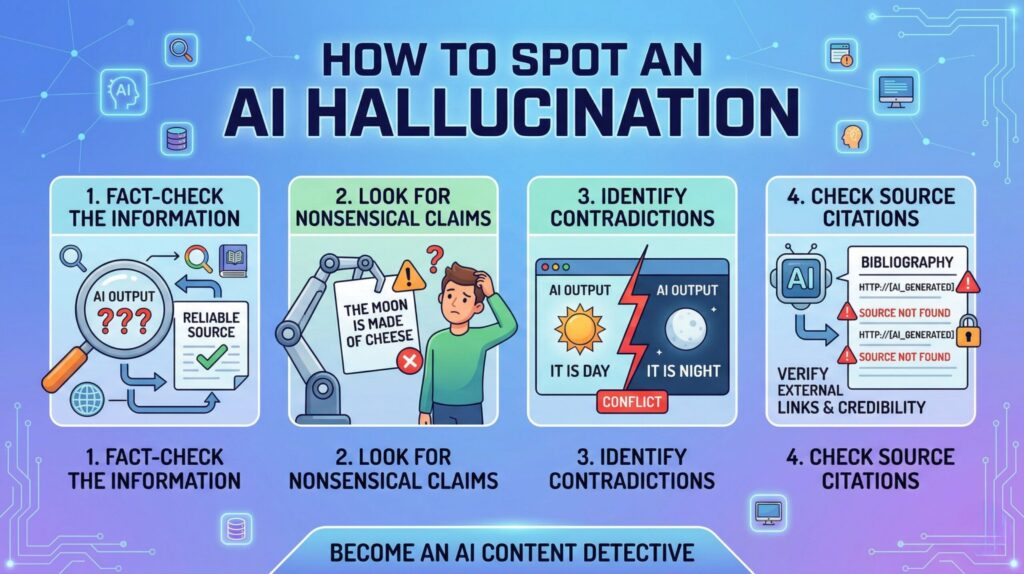
Spotting an AI hallucination — what researchers now call AI hallucination detection — isn't always obvious. That's what makes them dangerous. But there are patterns anyone can learn to catch, no engineering background required.
Red flags that suggest hallucination:
Overly Specific Details Without Sources
If Claude AI or ChatGPT gives you exact dates, precise statistics, or detailed quotes without citing where that information came from, be suspicious. Real data comes with sources. Hallucinated data comes with confidence but no receipts.
Inconsistencies Within the Same Response
Does the model contradict itself? If paragraph three says an event happened in 2015, but paragraph seven references the same event in 2018, that's a hallucination red flag.
Perfect Answers to Obscure Questions
If you ask about something incredibly niche and the model responds with a detailed, thorough answer instantly, verify it. The more obscure the topic, the higher the hallucination risk.
Citations That Don't Exist
Always check links, case citations, and academic references. Many AI hallucinations involve fabricated URLs, non-existent court cases, or made-up research papers. Copy-paste citations into Google Scholar or a legal database before trusting them.
- Cross-reference numbers: check statistics against original sources
- Verify citations: search for case names, paper titles, or URLs independently
- Test for consistency: ask the same question in different ways — do answers align?
- Check recent claims: for events after the model's cutoff date, verify with news sources
- Use reverse search: copy suspicious quotes into Google to see if they exist elsewhere
Practical verification techniques:
1. The "Explain Your Source" Test
Ask the AI: "Where did you get that information?" If the model can't point to a specific origin, treat the answer as unverified. LLMs will sometimes admit they don't have a source when pressed.
2. The Consistency Challenge
Rephrase your question and ask again. If you get wildly different answers to the same question, one (or both) contains AI hallucinations.
3. Cross-Check with Trusted Sources
Never rely on a single LLM for critical information. Cross-reference answers with official documentation, academic databases, legal databases, or news archives depending on the topic.
4. Check the Confidence Level
Some newer models indicate uncertainty with phrases like "I believe" or "based on my training data." If the model hedges, that's a good sign — it means the system recognizes lower confidence. Absolute certainty on obscure topics is a warning sign.
Medical diagnoses • Legal advice • Financial investment decisions • Safety-critical engineering specs • Breaking news verification • Academic citations without checking
Always verify with domain experts or authoritative sources before acting on AI-generated information in high-stakes contexts.
Some AI platforms now include built-in fact-checking features. ChatGPT's web browsing mode grounds responses in current sources. Claude AI's citations feature links claims to training data passages. Gemini includes a "double-check response" button. But these tools aren't foolproof — they reduce hallucination rates but don't eliminate them. The best defense is still manual verification, especially for information that matters.
Understanding how to spot AI hallucinations also helps you evaluate what information to share with these tools. Learning how to protect your private data when using AI tools is just as important as catching factual errors.
Keep a "verify later" list. Mark any claims that include specific numbers, dates, or citations. Before publishing or acting on the information, spend 5-10 minutes fact-checking those marked items. This simple habit catches 80%+ of AI hallucinations.
How Companies Detect Hallucinations at Scale
If you're using AI inside a product or workflow, manual spot-checks won't cover everything. Engineering teams increasingly run automated hallucination-detection platforms — tools like Galileo, DeepEval, and Patronus that score every AI response for factual groundedness before it reaches a user. You don't need any of this for everyday ChatGPT or Claude AI use, but knowing it exists sets the right expectation: even companies built specifically for AI hallucination detection don't claim to catch all of them.
5. Which AI Tools Are Most Affected?
All major AI tools produce AI hallucinations — but not equally. Some models are more prone to fabricating information depending on the task, training data, and architecture.
ChatGPT is the most widely used LLM, which means its AI hallucinations are also the most documented. Hallucination rate: 5-15% on general tasks, higher on citations and recent events. Common issues: fabricated URLs, invented academic papers, confident answers about post-cutoff events.
Claude tends to hallucinate less on technical and coding tasks but still struggles with obscure topics and recent news. Hallucination rate: 4-12% across general use cases. Common issues: made-up statistics when pressed for specific numbers, occasional citation errors on niche research.
Gemini has web access in some modes, which reduces AI hallucinations on current events, but it still invents details when information is scarce. Hallucination rate: 6-14% depending on mode.
Built on GPT-4, Copilot integrates with Bing search to ground responses. This helps with factual accuracy but doesn't eliminate AI hallucinations. Hallucination rate: 5-13% on general queries.
Open-source models like Llama, Mistral, and Falcon show higher hallucination rates than commercial models — typically 15-30% depending on task and model size. Smaller models (7B-13B parameters) hallucinate more than larger ones (70B+), mostly due to less training data and lighter fine-tuning for factual accuracy.
Some AI platforms focus on specific domains and produce fewer AI hallucinations in their niche:
- Perplexity AI: grounds answers in cited web sources, reducing AI hallucinations on current events
- GitHub Copilot: lower hallucination rate on code since it can verify syntax, but still invents non-existent libraries
- Legal AI tools (Harvey, CoCounsel): purpose-built for law with verified databases, but still require human review
No AI company publishes official hallucination rates — the numbers here come from third-party research and user testing. The safest assumption: every LLM can hallucinate on any topic.
Don't choose an AI tool assuming it won't hallucinate. Match the tool to the task: web-connected models for current events, GitHub Copilot or Claude AI for coding, any model for creative work, and always verify for research regardless of which LLM you use.
6. AI Hallucination Prevention: How to Reduce the Risk
You can't eliminate AI hallucinations completely, but AI hallucination prevention is mostly a process problem — and you can drastically cut how often they happen.
1. Be Specific in Your Prompts
Vague questions get vague, often hallucinated, answers. Instead of "tell me about the study," ask "summarize the 2024 Stanford study on LLM accuracy in medical diagnosis." Specific prompts mean fewer AI hallucinations.
2. Ask for Sources and Citations
Add "cite your sources" to your prompt. While the model might still fabricate citations, this forces it to be more explicit about where information supposedly comes from, making verification easier.
3. Use System Prompts to Set Boundaries
Many AI tools let you set instructions that apply to the whole conversation: "if you don't know something, say so instead of guessing," or "indicate uncertainty when appropriate." This won't eliminate AI hallucinations, but it makes the model more likely to hedge when uncertain.
- "Based only on your training data..." — prevents web speculation
- "If you're not certain, say so" — encourages honest uncertainty
- "Explain your reasoning step by step" — reveals logical gaps
- "Double-check this for accuracy" — triggers internal review in some models
4. Break Complex Questions into Steps
AI hallucinations increase when tasks are complex or multi-part. Instead of one giant question covering years of legislation, enforcement, and industry impact, ask three separate questions and synthesize yourself.
5. Verify Facts Independently
This is the single most important habit against AI hallucinations. Copy claims into Google, check citations in legal or academic databases, cross-reference statistics with original reports, and confirm recent events with news archives. Never skip verification for high-stakes decisions.
6. Use AI Tools with Built-In Fact-Checking
Perplexity AI cites web sources for every claim. ChatGPT's web browsing mode grounds answers in current search results. Claude AI's citation feature links claims to training data passages. Gemini's "double-check" button verifies factual statements. These help but aren't perfect — always apply your own verification layer.
- Draft with AI: use LLMs for brainstorming, outlining, first drafts
- Flag claims: mark any specific facts, dates, statistics, or citations
- Verify flagged items: spend 5-10 minutes checking marked claims
- Edit for accuracy: correct errors, add proper citations, remove unverifiable claims
- Final review: read as if you didn't write it — would you trust this without checking?
7. Compare Responses Across Models
Ask the same question to ChatGPT, Claude AI, and Gemini. If all three agree, the information is probably accurate. If responses conflict, that's a red flag — verify independently. This cross-checking method catches many AI hallucinations that would slip past single-model use.
8. Know Your High-Risk Scenarios
AI hallucinations spike when you're asking about events after the model's training cutoff, requesting citations, working with niche topics, asking for precise numbers without context, or using open-source or smaller models. In these scenarios, assume risk is 2-3x higher than normal.
Hallucinated answers often sound more confident than accurate ones. Don't let authoritative tone override your verification instinct. The more certain an AI sounds about an obscure topic, the more suspicious you should be.
The Technical Side of AI Hallucination Prevention (Briefly)
Behind the scenes, the main prevention technique is retrieval-augmented generation, or RAG — grounding a model's answer in retrieved, verified documents instead of letting it recall from memory alone. It's why Perplexity AI and the web-connected modes of ChatGPT and Gemini hallucinate less on current events: they're checking a source before they answer. You don't need to build a RAG pipeline to get the same benefit. Just ask your AI tool to search the web or cite a specific document instead of answering from memory.
Reducing AI hallucinations is about process, not perfection. Use AI for speed and creativity, but build verification into your workflow. The 5-10 minutes you spend fact-checking could save you from spreading misinformation, making bad decisions, or losing credibility.
7. Why AI Hallucinations Matter in 2026
AI hallucinations aren't just a technical curiosity — they have real consequences as LLMs become embedded in everyday work and decision-making.
Professional Risk From AI Hallucinations
More companies are integrating AI tools into workflows. When AI hallucinations slip through unchecked, they create:
- False data in reports and presentations
- Fabricated citations in legal or academic work
- Incorrect technical specs in engineering docs
- Made-up statistics in business proposals
Information Ecosystem Damage From AI Hallucinations
When people publish AI-generated content without fact-checking, AI hallucinations spread. False information gets indexed by search engines, cited by other users, and absorbed into new training datasets — a feedback loop that degrades information quality across the internet.
Trust Erosion From AI Hallucinations
As more people encounter AI hallucinations, trust in these tools declines. A 2025 survey found that 64% of users have caught an LLM making up information at least once — eroding confidence in legitimate AI applications and slowing adoption of genuinely useful tools.
Video credit: Claude page, via YouTube.
- 22–94%: hallucination rate range across 26 top models on hard factual-recall questions — Stanford HAI's 2026 AI Index
- 3–19%: frontier-model hallucination rate on general tasks, down from 15–45% in 2024
- 362: documented AI incidents logged in 2025, up from 233 in 2024 — Stanford HAI's AI Incident Database
- 1,900+: court cases worldwide where a judge found a party relied on AI-hallucinated material, and climbing daily
Why This Gets Worse Before It Gets Better
As generative AI becomes more accessible, more people use it without understanding its limitations. Most treat LLMs like search engines — authoritative sources that retrieve facts rather than systems that generate plausible text. Students submit papers with fabricated citations. Journalists publish stories with unverified AI-generated quotes. Businesses make decisions based on hallucinated market data.
The Responsibility Question
Who's accountable when AI hallucinates? The model developer, the user who didn't verify, or the platform that deployed the tool? This legal and ethical gray area remains unresolved. What's clear: users bear the verification burden. AI companies include disclaimers, courts hold users responsible for submitting false information, and the expectation is that humans will fact-check AI outputs — even though most don't.
AI hallucinations matter because AI tools are no longer experimental — they're mainstream. What was once a research problem is now a daily risk for anyone using ChatGPT, Claude AI, or Gemini at work, school, or home.
8. Final Thoughts
AI hallucinations are here to stay. They're not a temporary bug waiting to be fixed — they're a fundamental characteristic of how large language models work. Understanding this changes how you should use these tools.
The goal isn't to avoid AI because it hallucinates. The goal is to use AI strategically while building verification into your workflow. ChatGPT, Claude AI, Gemini, and other LLMs are incredibly powerful for brainstorming, drafting, coding, and research. But they're assistants, not authorities.
AI hallucinations can happen with any LLM, on any topic. Some models are better than others in specific domains, but none are immune. Models will improve and hallucination rates will drop, but the risk won't disappear completely. Your defense is simple: verify what matters. For creative work or first drafts, use AI freely. For anything you'll publish, present, or make decisions on, take 5-10 minutes to fact-check key claims.
AI tools are transforming how we work, create, and solve problems. AI hallucinations don't make these tools useless — they make verification essential.
Use AI for: speed, creativity, exploration, first drafts, brainstorming, learning new topics.
Always verify for: citations, statistics, medical/legal advice, financial decisions, anything you'll publish or present.
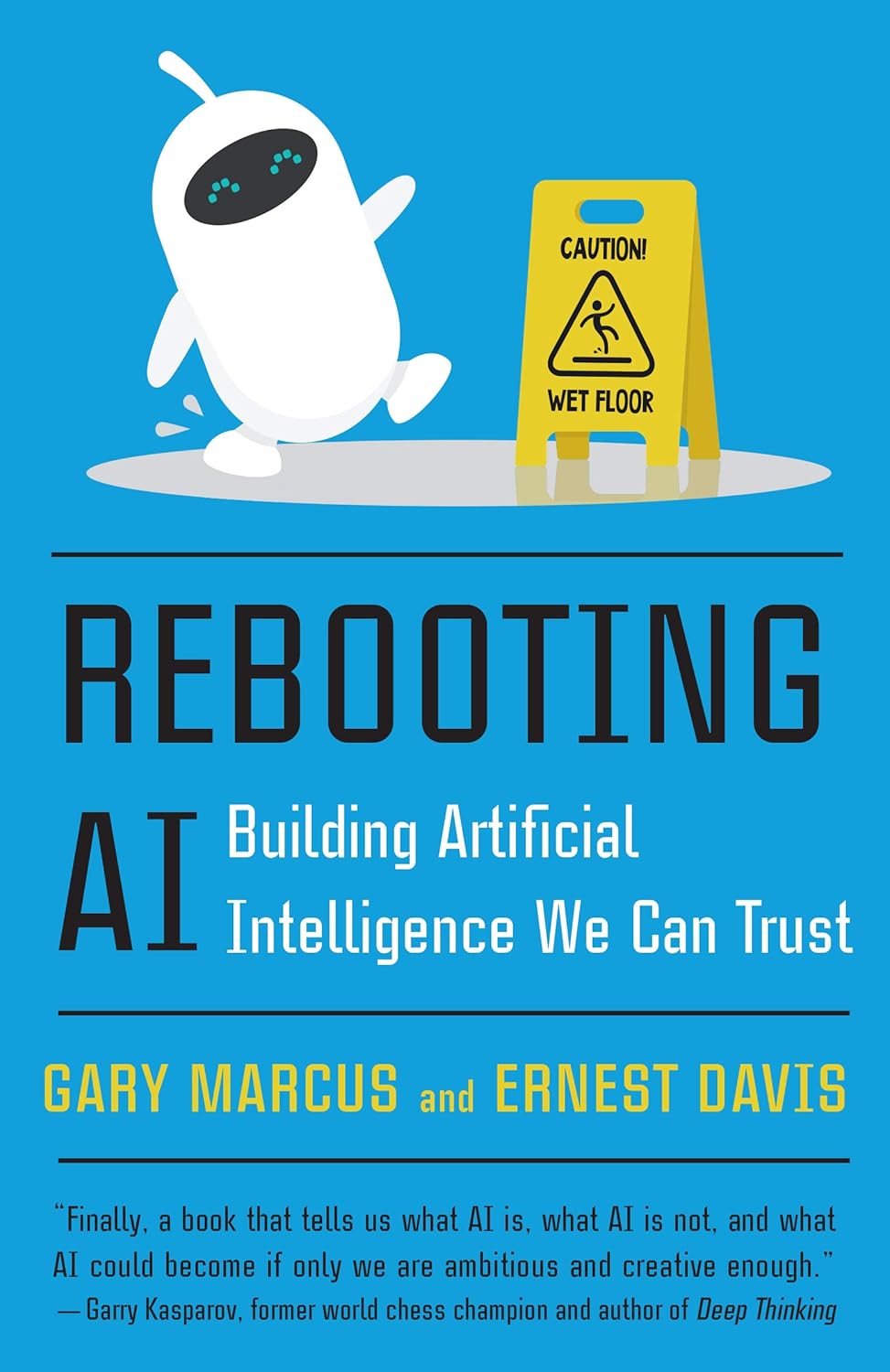
Rebooting AI: Building Artificial Intelligence We Can Trust
If this topic interests you beyond one article, I'd point you to Rebooting AI by Gary Marcus and Ernest Davis. It's the clearest explanation I've found for why today's AI systems produce confident nonsense — written years before "hallucination" became a household word, which makes its predictions land harder in hindsight.
Check the Book →The best AI users aren't the ones who trust blindly — they're the ones who verify strategically. Build that habit, and AI hallucinations become manageable rather than dangerous.
AI is evolving fast, and staying informed is your best protection against AI hallucinations and other risks. Whether you're looking to deepen your AI knowledge or see what these tools can do, that's exactly what I cover here every week.
Frequently Asked Questions — AI Hallucinations
📚 Continue Learning About AI
Dive deeper into AI tools, applications, and safety with these related guides: