
 Published on: September 27, 2025
- 1. Introduction to AI Agents in 2025
- 2. What Is Deep Research?
- 3. What Is Claude 4?
- 4. Feature Comparison: Deep Research vs Claude 4
- 5. Productivity Use Cases
- 6. Creativity and Research Capabilities
- 7. Pricing and Plan Options
- 8. Real-World Workflows and Integrations
- 9. Ethical AI Reflection
- 10. Final Verdict: Which AI Agent Should You Pick?
Disclosure:
Some links in this post are affiliate links. If you click and purchase, we may earn a small commission at no extra cost to you. Thank you for supporting AIDigitalSpace.com and helping us keep this content free and useful.
1. Introduction to AI Agents in 2025
AI agents are no longer just experimental tools — they’re quickly becoming the backbone of how we manage work, creativity, and research. In 2025, two names stand out in particular: Deep Research vs Claude 4. Both claim to make our workflows faster and smarter, but the way they approach this mission is very different. That’s why so many professionals are asking: Which AI agent is actually worth using this year?
At AI Digital Space, we’ve seen how choosing the right AI tool can make the difference between small productivity gains and a real step-change in how you work. Deep Research, designed by OpenAI, is making headlines for its advanced reasoning and multi-step research abilities. Claude 4, from Anthropic, has quickly become the go-to for people who need reliable, conversational intelligence. Comparing them isn’t just about features — it’s about which one fits your actual daily needs.
If you’re interested in how these tools stack up, you might also like our guide on ChatGPT vs Gemini: Which One Wins in Daily Use? or our recent breakdown of AI voice replication. And if you’d like to explore what experts are saying about the rise of agentic AI, Wired has covered why these tools are changing how we think about automation (source).
2. What Is Deep Research?

Deep Research is OpenAI’s latest agent designed to go beyond quick answers and handle multi-step reasoning. Instead of giving you a single response, it breaks down complex questions into smaller steps, retrieves reliable data, and delivers structured results. This makes it especially useful for researchers, students, and professionals who don’t want to waste time jumping between multiple sources.
What sets Deep Research apart is its ability to work autonomously. Once you give it a task — whether that’s comparing financial reports, analyzing trends, or summarizing dozens of documents — it doesn’t just stop at surface-level summaries. It builds a chain of reasoning, checks sources, and presents you with a result that feels closer to human-level analysis. For anyone who’s struggled with AI “hallucinations” in the past, this is a big step forward.
From our perspective at AI Digital Space, this tool fits perfectly into the growing trend of “agentic AI” — systems that don’t just answer but actively work for you. It’s part of the same wave we covered in Best All-in-One AI Tools for 2025 – Work, Write & Organize Smarter. By automating research in a reliable way, Deep Research positions itself as a serious competitor to conversational AI like Claude 4.
3. What Is Claude 4?
Claude 4 is Anthropic’s most advanced AI agent, built to combine strong reasoning skills with natural, context-aware conversation. It comes in three main versions — Opus for maximum intelligence, Sonnet for balanced performance, and Haiku for speed. This tiered approach means you can choose the model that best matches your workload and budget.
Where Claude 4 really stands out is its ability to stay consistent across long tasks. Whether you’re drafting reports, analyzing documents, or running customer communications, it keeps track of context without drifting. It’s also known for being safer and less error-prone than many competitors, thanks to Anthropic’s focus on reducing bias and hallucinations.
For users who need an AI partner that can handle everything from everyday writing to deep reasoning, Claude 4 is a reliable choice. It’s already being adopted in professional environments because it balances accuracy, speed, and flexibility in ways that help real workflows run smoother.
4. Feature Comparison: Deep Research vs Claude 4
When choosing between Deep Research vs Claude 4, it helps to look at the features side by side. Below is a simplified comparison of their core strengths, so you can quickly see where each one fits best.
| Feature | Deep Research | Claude 4 |
|---|---|---|
| Core Strength | Multi-step reasoning, structured analysis | Context-aware conversation, flexible writing |
| Best For | Researchers, analysts, academic tasks | Writers, businesses, customer workflows |
| Integrations | Still limited, works within OpenAI ecosystem | APIs for business tools, team adoption ready |
| Accuracy | High in structured tasks, reduced hallucinations | Balanced, strong in long dialogues |
| Pricing | Included in OpenAI premium plans | Tiered (Opus, Sonnet, Haiku) with flexible options |
| Try Deep Research | Explore Claude 4 |
5. Productivity Use Cases
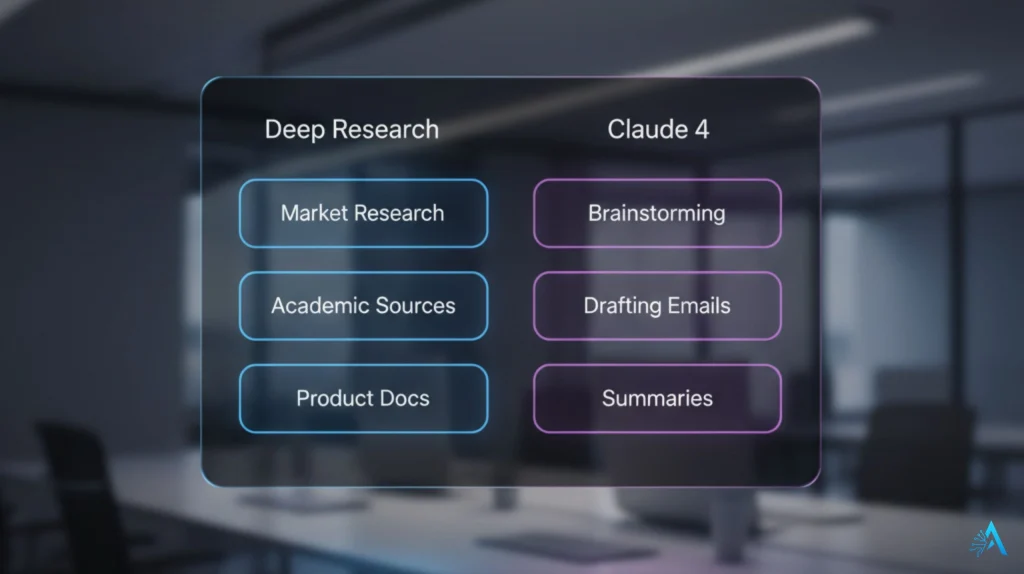
When it comes to productivity, both Deep Research vs Claude 4 deliver results in different ways. The real question is which one fits your daily workflow.
Deep Research is built for structured tasks that require digging into data. If you need to compare multiple reports, extract insights from long PDFs, or gather evidence for decision-making, it works like an autonomous assistant that saves you hours. Instead of manually switching between tabs or sources, it handles the heavy lifting for you.
Claude 4, on the other hand, is more adaptable for everyday productivity. It’s the tool you’ll lean on to draft emails, summarize meetings, create knowledge bases, or manage customer communication. Its conversational strength means you can guide it step by step without losing context, which makes it reliable for ongoing projects or collaborative environments.
In short, Deep Research is like having a specialist analyst, while Claude 4 acts as a general-purpose productivity partner. Both improve efficiency, but your choice depends on whether you need precise research output or flexible assistance across many small tasks.
6. Creativity and Research Capabilities
The real test of any AI agent isn’t just productivity — it’s how well it helps with creativity and deeper research. Here, Deep Research vs Claude 4 once again take very different paths.
Deep Research excels when accuracy and structure are non-negotiable. It can read through long academic papers, collect insights from multiple data sources, and present information in a clear, referenced way. This makes it powerful for analysts, students, or anyone who needs reliable research without the noise. Its strength is in methodical thinking, where every step is documented.
Claude 4, meanwhile, shines in creative workflows. Whether you’re brainstorming marketing copy, outlining a blog post, or exploring fresh product ideas, it keeps the conversation flowing naturally. Unlike Deep Research, which works more like an autonomous researcher, Claude 4 feels like a collaborative partner that adapts to your tone and expands your ideas in real time.
Together, the two represent opposite ends of the creative spectrum: Deep Research as the precision tool for facts and evidence, and Claude 4 as the idea amplifier that helps concepts grow.
7. Pricing and Plan Options
Pricing often decides whether a tool becomes part of your daily routine. Here’s how Deep Research vs Claude 4 compare when it comes to cost and accessibility.
Deep Research is currently bundled into OpenAI’s premium subscription tiers. If you’re already paying for ChatGPT Plus or enterprise-level access, you may see Deep Research included as an advanced feature. This makes it a natural extension for users who are already in the OpenAI ecosystem and don’t want to manage multiple subscriptions.
Claude 4 follows a different model with tiered plans.
-
Haiku is the fastest and most affordable option, good for light tasks.
-
Sonnet balances performance and cost for daily professional use.
-
Opus is the premium tier, designed for complex reasoning and enterprise-grade workloads.
This flexibility means you can scale your usage depending on needs — a startup might start with Sonnet, while a research team could justify Opus for higher accuracy.
| Plan | Deep Research | Claude 4 |
|---|---|---|
| Free Access | Not available | Basic access via Claude.ai |
| Standard Tier | OpenAI Plus ($20/month) | Claude 4 Sonnet (~$20/month) |
| Premium / Enterprise | Business & Enterprise plans | Claude 4 Opus (~$30–40/month) |
| Try Deep Research | Explore Claude 4 Plans |
8. Real-World Workflows and Integrations
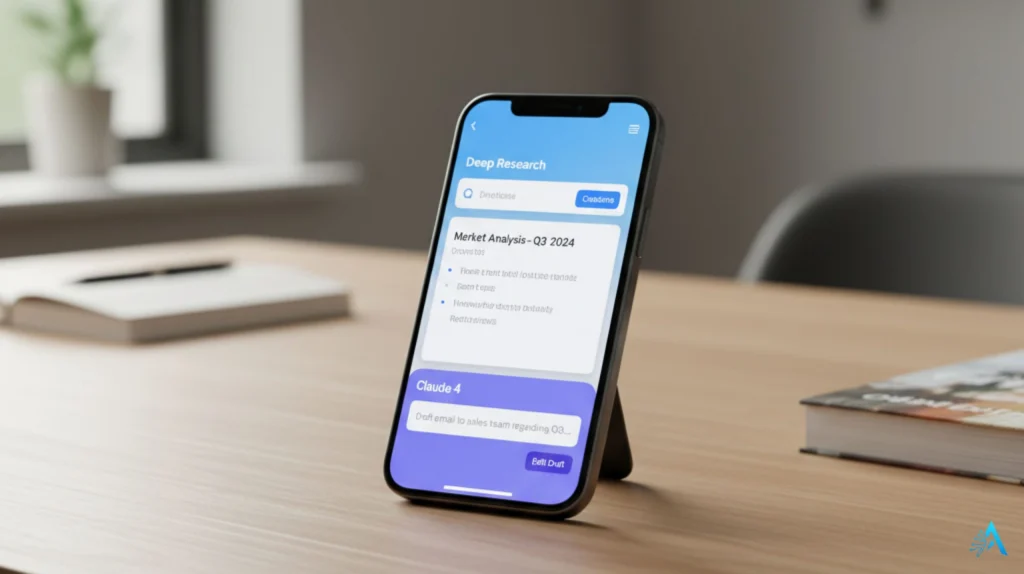
Knowing what an AI agent can do in theory is one thing — but what really matters is how it fits into your daily workflow. Here’s how Deep Research vs Claude 4 perform when plugged into real-world tasks.
Deep Research is most valuable when you need an assistant that can run complex projects with minimal oversight. For example, a financial analyst can feed it multiple reports and let it extract key insights, or a student can assign it a set of articles and receive a clean literature summary. While its integrations are still limited mainly to the OpenAI ecosystem, its autonomous task handling makes it a powerful addition if you’re already using ChatGPT or OpenAI enterprise tools.
Claude 4 integrates more smoothly with team and business environments. Through APIs, it connects to collaboration platforms like Slack, customer service tools, and document management systems. This means a support team can build knowledge bases, or a marketing team can draft and refine campaigns, all while keeping everything synced in existing workflows. Its conversational style also makes it easier for teams to adopt — you don’t need to reframe tasks in technical language.
In practice, Deep Research feels like hiring a dedicated analyst, while Claude 4 becomes the colleague who joins your meetings, chats in Slack, and drafts documents with you. Your choice depends on whether you need structured outputs or smooth integration across the tools you already use.
9. Ethical AI Reflection
Whenever we compare tools like Deep Research vs Claude 4, it’s important to look beyond features and pricing. Both OpenAI and Anthropic put a strong emphasis on responsible AI use, but the risks are never fully eliminated.
With Deep Research, the main concern is transparency. Since it automates multi-step reasoning, users need to know where the information comes from and whether sources are reliable. Over-reliance without verification could lead to blind trust in automated research.
With Claude 4, the ethical focus is on bias and safety in dialogue. Because it interacts in long, conversational ways, the risk is that subtle biases may slip into outputs or that sensitive topics could be handled in ways that require human judgment.
For us as users, the key is balance: treat these agents as powerful assistants, not replacements for critical thinking. They can save time and expand creativity, but final responsibility should stay in human hands — especially in professional or sensitive contexts.
10. Final Verdict: Which AI Agent Should You Pick?
Choosing between Deep Research vs Claude 4 comes down to your needs. Both are excellent AI agents, but they solve different problems.
-
Pick Deep Research if your work depends on structured analysis, research accuracy, and multi-step reasoning. It’s best for professionals, analysts, or students who need reliable insights without spending hours cross-checking sources.
-
Pick Claude 4 if you want a flexible partner for writing, communication, and team workflows. It’s ideal for businesses, content creators, and anyone who values natural, context-rich collaboration.
Our take? These tools aren’t rivals as much as they are complements. Many users will benefit from Deep Research’s precision alongside Claude 4’s conversational support. If you’re still deciding, start with the tool that matches your most common tasks — you can always expand later.