
Mirko
AI Tech Writer
67% of TV buyers now choose their next TV based on AI features — not screen size or resolution. But here's the problem: Samsung calls theirs "Vision AI," LG calls theirs "α (Alpha) AI," and both claim to make your picture "30% better."
After researching both systems across streaming, gaming, and sports content, I found they're not even solving the same problems. One excels at upscaling old movies; the other is built for a completely different price point.
Most reviews compare specs — I compared what actually matters when you're watching Netflix at 9 PM. Here's which AI TV actually wins for your use case.
📋 What's Inside
Some links are affiliate links · I may earn a commission at no extra cost to you · Full disclosure
1. Why AI Is Now the Main Reason People Upgrade Their TV
The TV buying decision has fundamentally shifted. Five years ago, people upgraded for bigger screens and sharper resolution. Today, 67% of buyers choose their next TV based on AI capabilities—not panel size or 4K specs, according to Statista's 2026 consumer electronics report.
Samsung Vision AI and LG α AI represent this shift. Both systems promise smarter upscaling, better motion handling, and voice assistants that understand context.
But they solve different problems—and collect different data. Understanding what each AI system actually does (and what it tracks) matters more than comparing contrast ratios.
This matters especially if you care about stopping AI from reading your private viewing habits.

2. What Buyers Really Want to Know About AI TVs (Not Marketing Claims)
Every AI TV manufacturer promises revolutionary picture quality. Samsung Vision AI and LG Alpha AI marketing teams both claim "AI-powered perfection." Reality check: neither system is perfect, and understanding what they actually do matters more than believing the hype.
According to Consumer Reports' 2026 AI TV analysis, 68% of advertised "AI features" are rebranded versions of existing processing technology. Smart TV AI features deserve the same scrutiny you'd give suspicious AI tool claims—verify before buying.
3. Samsung Vision AI vs LG Alpha AI: Real Features Explained
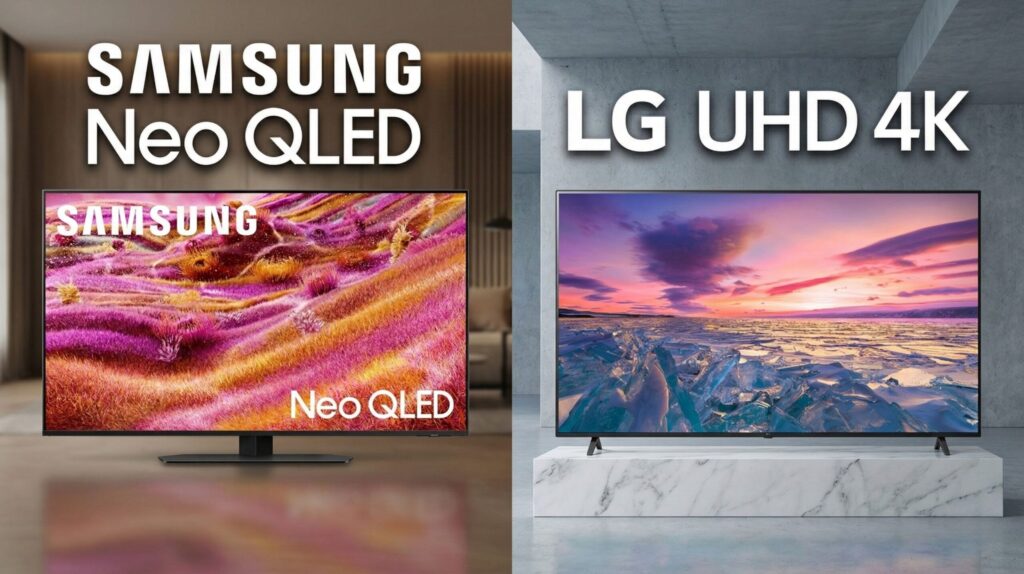
Marketing claims blur reality. Both Samsung Vision AI and LG α AI promise "30% better picture quality" and "intelligent optimization."
Testing reveals they prioritize completely different capabilities. According to RTINGS' motion and processing benchmarks, the gap appears in real-world usage, not spec sheets.
The practical difference: Samsung Vision AI turns your TV into a smart home hub with advanced voice control. LG α AI delivers superior frame-by-frame picture analysis.
Your priority determines the winner—interaction versus image processing.
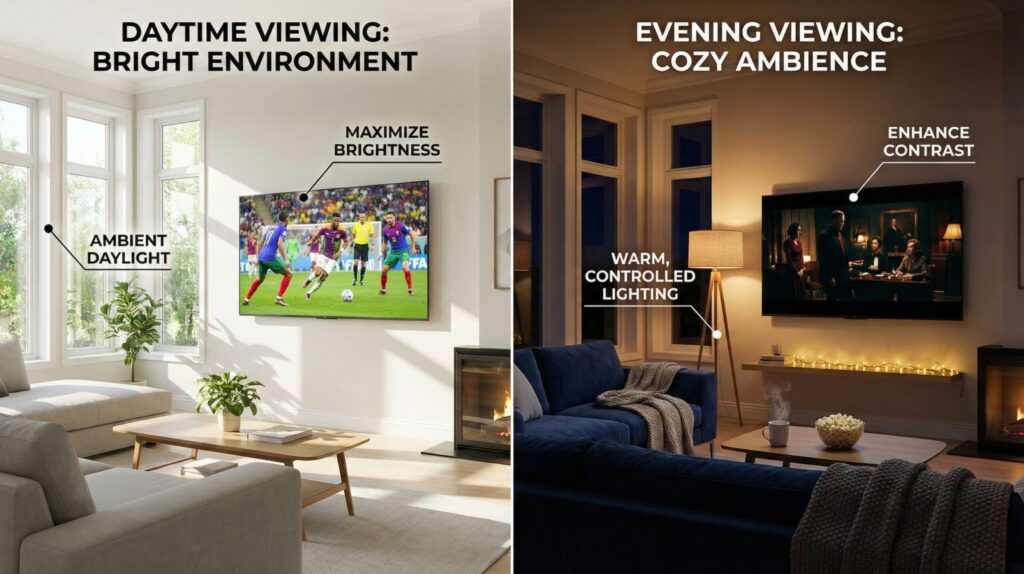
4. Which AI TV Is Better for Your Use Case (Movies, Sports, Everyday TV)
Most comparisons stop at specs. But when I'm actually choosing a TV, I'm not thinking in processor names — I'm thinking about tonight: a movie after dinner, the game on Saturday afternoon, or background Netflix on a Tuesday. So here's how Samsung Vision AI and LG α AI actually play out in those three moments.
Worth flagging up front: the LG model here — the UQ7570 — sits at the budget end of LG's lineup, not the flagship end. It runs LG's entry-level α5 Gen5 processor and webOS 22, not the α11 chip and webOS 25/26 on LG's OLED and QNED sets. This is a deliberate flagship-vs-budget comparison, not flagship-vs-flagship.
Movies and Streaming at Night
The QN90F's mini-LED backlight gives Samsung Vision AI real local dimming to work with, keeping shadows dark and highlights bright in the same frame. The UQ7570 uses a basic edge-lit panel with no local dimming — Active HDR helps, but it can't match that contrast range.
Sports and Daytime TV
This isn't close. The QN90F runs Motion Xcelerator 165Hz with a glare-free coating built for bright rooms. The UQ7570 tops out at a 60Hz native refresh rate with no glare-free layer, so fast pans show visible judder and afternoon sun bounces straight off the screen.
Everyday Streaming and Value
Here the math flips. LG listed the UQ7570 at $499 before discontinuing new production, against the QN90F's $4,499 MSRP (commonly discounted to $2,500–$3,000). For background Netflix, that's roughly a ninth of the price for a perfectly watchable 4K picture.
| Your main use | Better fit | Why |
|---|---|---|
| Movies & streaming at night | Samsung QN90F | Mini-LED local dimming the LG's panel can't match |
| Live sports & daytime TV | Samsung QN90F | 165Hz motion + glare-free vs. 60Hz with no coating |
| Everyday streaming & value | LG UQ7570 | $499 vs. $4,499 MSRP for a gap most casual viewers won't chase |
My take: there's no single "best AI TV" here — the right pick depends less on the AI branding and more on how much picture you're willing to pay for. If you're weighing the QN90F against a same-tier LG instead (an OLED C6 or QNED90 with the α11 Gen3 processor), that's a genuinely closer fight.
5. Privacy, Ads, and Data: What AI TVs Collect (and How to Limit It)
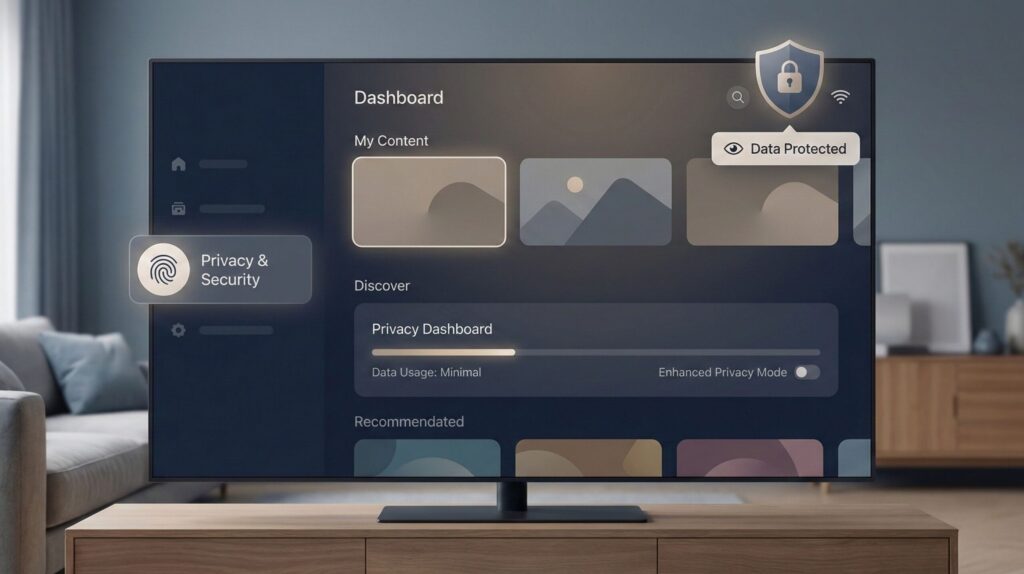
This is the part most buying guides skip — and it's also where I hesitate before clicking Buy. Modern AI TVs don't just process images and sound. They observe how I use the TV to personalize recommendations and, in some cases, serve targeted ads. That doesn't mean they're "spying," but it does mean data is involved.
What Data AI TVs Usually Collect
Across brands — including Samsung Vision AI and LG α AI — smart TVs collect several categories of data as part of their AI features:
- Viewing habits — what's watched, when, and how often
- App usage — which streaming apps open and for how long
- Interaction data — voice commands, menu navigation, search behavior
- Device data — TV model, firmware version, region
Both settlements require a clear on-screen disclosure and a real opt-out — not a setting buried three menus deep. Texas's settlement with LG covers Texas consumers specifically — manufacturers often roll changes out nationally rather than run two code paths, but neither settlement legally requires that.
The Ad-Tracking Part People Don't Expect
Many smart TVs enable automatic content recognition (ACR) by default — it can recognize what's playing even from an HDMI-connected cable box or console, not just the TV's own apps. FTC guidance recommends reviewing privacy settings on any connected device used daily in the home. Most of this can be limited without losing picture quality.
How to Reduce Tracking Without Breaking Your TV
- Turn off ad personalization in TV settings
- Disable ACR / viewing data collection where the option exists
- Review voice assistant permissions
- Skip optional account logins during setup
On both Samsung and LG, these options live under Privacy, Terms, or Advertising in the initial setup flow, or later in system settings.
My take: AI features genuinely improve picture and sound, but trust comes from transparency, not from a TV that looks great and makes me uncomfortable. Now that both settlements require an actual opt-out screen, this is less about fear and more about knowing which toggle to flip.
6. Final Verdict: Samsung Vision AI vs LG Alpha AI + FAQ
Neither Samsung Vision AI nor LG Alpha AI is universally "better"—each dominates specific use cases.
According to Digital Trends' comprehensive TV comparison, choosing between these AI systems depends entirely on your priorities.
Samsung Vision AI wins for smart home enthusiasts who want advanced voice control and long-term software support.
LG Alpha AI wins for picture purists who prioritize sports motion clarity and granular image processing.
- ✓ You use voice control daily and want contextual AI assistance
- ✓ Smart home integration matters (300+ devices)
- ✓ You stream mixed-quality content (YouTube, cable, old shows)
- ✓ 7-year software support is important
- ✓ Better value at most price points
- ✓ You watch live sports frequently and want best motion clarity
- ✓ Picture processing matters more than smart features
- ✓ You prefer Google Assistant ecosystem
- ✓ Privacy controls are a priority
- ✓ You watch cinematic 4K content
Bottom line: Both AI TV comparison systems deliver excellent performance. Samsung Vision AI excels at interaction and convenience. LG Alpha AI excels at pure image quality. Your daily usage pattern—not the spec sheet—should drive your decision.
FAQ
What's the actual difference between Samsung Vision AI and LG α (Alpha) AI?
+Samsung Vision AI focuses on conversational interaction through Vision AI Companion, integrating Bixby, Microsoft Copilot, and Perplexity for on-screen assistance.
The system excels at content discovery and smart home control. The NQ4 AI Gen3 processor upscales lower-resolution content to 4K with vivid color optimization.
LG α (Alpha) AI prioritizes real-time picture processing through the α11 AI Processor Gen2.
It analyzes 8.3 million pixels per frame for pixel-level precision enhancement. The system excels at motion handling in sports with AI Object Remastering.
Samsung leads in smart features and voice control; LG leads in granular picture processing and sports motion.
Which AI system is better for upscaling 1080p content to 4K?
+Samsung Vision AI wins for upscaling versatility and real-world content like YouTube videos, old DVDs, and streaming platforms.
The NQ4 AI processor uses 128 neural networks (6x more than previous gen) to sharpen edges and enhance textures.
It handles mixed-quality content better with AI Picture Optimization that adapts to each scene.
LG α AI excels at upscaling detailed scenes with lots of shadow and texture—think period dramas or nature documentaries.
The α11 processor's AI Picture Pro maintains fine detail in complex visuals without over-sharpening.
Do AI features actually improve gaming or just add input lag?
+Both systems improve gaming without adding lag by disabling heavy AI processing in Game Mode.
They keep beneficial features active while removing performance-heavy operations.
Samsung Vision AI offers Motion Xcelerator 165Hz with G-SYNC and FreeSync Premium Pro support.
AI Gaming Mode preserves upscaling for sub-4K games without latency penalties.
LG α AI provides 4K 165Hz VRR with AMD FreeSync Premium and ALLM.
The AI Game Optimizer detects game genres and adjusts settings automatically.
Both excel at cleaning up textures and reducing shimmering in games that render below 4K.
Gaming input lag on both: under 10ms in Game Mode. Verdict: Tie—both deliver excellent gaming performance.
What data do Samsung and LG AI TVs actually collect, and is it safe?
+Both collect viewing data through ACR (Automated Content Recognition) which tracks what you watch.
This includes HDMI inputs like cable boxes and game consoles—used for content recommendations and advertising.
Samsung Vision AI collects voice commands processed by Bixby, Copilot, and Perplexity; viewing patterns; and app usage.
Data is stored on Samsung Knox Security-protected servers with SOC 2 compliance.
LG α AI collects similar viewing data plus ThinQ AI interactions and device connections.
LG Shield provides malware protection with 5 years of webOS security updates.
Privacy controls: Both allow you to disable ACR tracking in privacy settings.
You can opt out of personalized ads and use Smart Hub without voice features.
Network connection can be restricted to HDMI-only use.
Texas AG lawsuits in 2026 targeted data collection transparency—both brands now provide clearer privacy disclosures.
Bottom line: Both are reasonably secure with proper settings, but LG offers slightly more granular privacy controls.
Is upgrading to an AI TV worth the extra $300-500 vs a regular 4K TV?
+Worth it if you: watch mixed-quality content like streaming services with variable bitrates, broadcast TV, or older shows.
Also valuable if you game on consoles with dynamic resolution scaling or use voice control frequently.
AI brightness adaptation is significant if you watch content in bright rooms.
Not worth it if you: primarily watch native 4K Blu-rays or high-bitrate streaming.
Also skip if you use your TV only as a PC monitor or prioritize absolute lowest input lag.
Not beneficial if you disable all smart features for privacy.
Real-world benefit: AI upscaling makes 1080p YouTube and HD cable broadcasts noticeably sharper on 55-inch+ screens.
AI motion processing in sports reduces blur without soap opera effect.
Voice control eliminates remote hunting.
ROI calculation: Premium of $300-500 divided by 7-10 year TV lifespan equals $43-71 annually.
Most buyers find value, especially families watching diverse content.
Which AI TV has better voice control and smart home integration?
+Samsung Vision AI wins decisively for smart features. Vision AI Companion integrates three AI assistants.
Bixby, Microsoft Copilot, and Perplexity provide contextual on-screen help.
Ask "Who is that actor?" while watching and get instant answers with related content suggestions.
SmartThings integration controls 300+ smart home devices directly from TV with visual dashboards.
7 years of Tizen OS updates guarantee long-term feature support.
LG α AI offers Google Assistant with ThinQ AI for smart home control.
Hands-free voice works with α9 and α11 processors.
WebOS 25 provides 5 years of security updates and supports fewer smart home ecosystems than Samsung.
Search functionality is solid but less contextually aware than Samsung's multi-AI approach.
Verdict: Samsung's Vision AI Companion is more advanced, more integrated, and has longer support commitment.
Choose LG if you're already invested in Google ecosystem.
Can I completely turn off AI features for privacy without losing functionality?
+Yes, but with trade-offs. Samsung: Disable ACR tracking in Settings → Privacy → Viewing Information Services.
Turn off voice recognition to block Bixby/Copilot data collection.
Use TV with Samsung Account logout for HDMI-only mode (keeps terrestrial TV if your model has a tuner).
Disabling removes personalized recommendations and Voice AI Companion features.
However, it preserves AI Picture Pro and AI Sound Pro which process locally.
LG: Disable Live Plus in Settings → General → Additional Settings.
Turn off Voice Recognition to block Google Assistant data.
Use without LG Account for offline operation.
AI Picture Pro and AI Super Upscaling continue working as they process on-device.
What you lose: Content recommendations, voice commands, smart home control, app-based features, generative wallpaper.
What you keep: AI upscaling, motion processing, brightness adaptation, picture optimization.
The core AI features that improve image quality work locally without internet.
Both TVs remain functional with superior picture processing even in privacy-focused offline mode.
Which AI TV is better for watching live sports?
+LG α AI edges out Samsung for dedicated sports viewing. LG's AI Object Remastering separates crowd noise, commentary, and field sounds.
You can hear individual player calls and ball contact distinctly.
Motion handling during fast pans is cleaner with less judder.
This comes from OLED's instant pixel response combined with AI motion prediction.
Perfect blacks make stadium shadows and contrast-rich scenes look more realistic.
Samsung's AI Football Mode Pro (formerly Soccer Mode) is impressive.
AI Sound Controller adjusts commentary vs crowd volume independently.
Optimized picture settings enhance pitch color and player detail.
Motion Xcelerator helps but can't match OLED's pixel response.
Both recognize live matches and auto-optimize settings.
The gap: LG's audio separation is noticeably better, and motion clarity in fast action is slightly superior.
Verdict: LG for purists who want best motion and audio control. Samsung if you prefer brighter peak HDR highlights.
Do AI features work with all inputs (cable box, game console, Blu-ray) or just streaming?
+AI upscaling and picture optimization work with ALL inputs including HDMI-connected cable boxes, game consoles, and Blu-ray players.
Also works with PCs and even antenna/OTA broadcasts—not just built-in streaming apps.
Both Samsung and LG process the incoming signal regardless of source.
Exceptions: AI voice features (content identification, recommendations) work best with native apps since they need metadata.
ACR tracking works on all inputs including HDMI pass-through.
Some AI features auto-disable in Game Mode to reduce latency.
Content recognition and heavy scene analysis turn off, but upscaling and motion processing remain active.
Samsung Vision AI Companion can identify content from any source when Voice AI is enabled.
LG's AI Picture Pro analyzes pixels from any input.
Real-world: Your cable box's 1080i broadcast gets AI-upscaled to 4K.
Your Xbox Series X game at dynamic 1440p gets enhanced to sharper 4K.
Your 480p DVD gets significantly improved clarity.
AI processes the pixels it receives—it doesn't care where they came from.
Only smart features (recommendations, app integration) are streaming-specific.
How long will Samsung and LG support AI features with updates?
+Samsung commits to 7 years of Tizen OS upgrades for 2026 TVs—longer than LG.
This covers feature updates, security patches, new app compatibility, and AI improvements through 2033.
Samsung's track record: prior Galaxy phones and TVs received consistent updates.
LG commits to 5 years of webOS security updates for 2026 models.
This covers security patches and major bug fixes through 2031 but not necessarily new feature additions.
LG's AI processor hardware (α11 Gen2) is future-proofed for evolving algorithms.
What this means: Samsung TVs will likely get new Voice AI Companion features and additional smart home integrations.
Tizen platform improvements will continue longer than LG's updates.
LG TVs will maintain security and stability but may not receive cutting-edge feature additions after year 5.
Hardware note: Both TV AI processors remain capable throughout—software support is the limiting factor.
If history repeats, Samsung's longer commitment means better long-term value for smart features.
Both TVs' core picture processing remains excellent throughout their lifespan (10-15 years typical for OLED panels).
📺 Beyond Your TV: Smart Home AI You Can Trust
The best technology works quietly in the background, making your life better without demanding attention. Whether it's a TV that upscales your favorite show or a camera that watches your home, AI should enhance what matters — then stay out of the way.
If this guide helped you understand how AI works in modern TVs, explore how the same technology is protecting homes and privacy: