

Mirko
AI Tech Writer
Gartner predicts that 20% of organizations will use AI to eliminate more than half of their middle managers by the end of 2026. Amazon already cut 14,000 corporate roles. Meta slashed another 8,000. Google reduced its manager headcount by a third. I dug into the data behind these cuts — and found 7 specific strategies that separate the managers getting promoted from the ones getting replaced.
Some links are affiliate links · they support this site at no extra cost to you · Full disclosure
The Numbers Behind the Cuts — Why AI Replacing Managers Is Accelerating
AI replacing managers isn't a future scenario — it's a documented corporate trend with hard numbers behind it. And the pace of AI replacing managers picked up sharply between 2025 and 2026.
Gartner's widely cited prediction puts it plainly: 20% of organizations will use AI to flatten their structure, eliminating more than half of current middle management positions by the end of 2026. That prediction is now playing out at the world's largest employers.
at risk (Gartner)
staff with AI is "good"
at public companies (2022–2025)
fear AI will replace them
Sources: Beautiful.ai 2026 Survey · Gartner Predictions
Beautiful.ai's 2026 survey of 3,000 U.S. managers adds more weight. Daily AI usage at work jumped from 18% to 34% year over year — a 16-point increase. Only 7% of surveyed managers now say they never use AI tools.
The most striking shift is attitudinal. In 2025, 23% of managers thought replacing employees with AI would be good for their company. By 2026, that number rose to 35%. And 42% now believe it would be a smart financial move — up 12 points in one year.
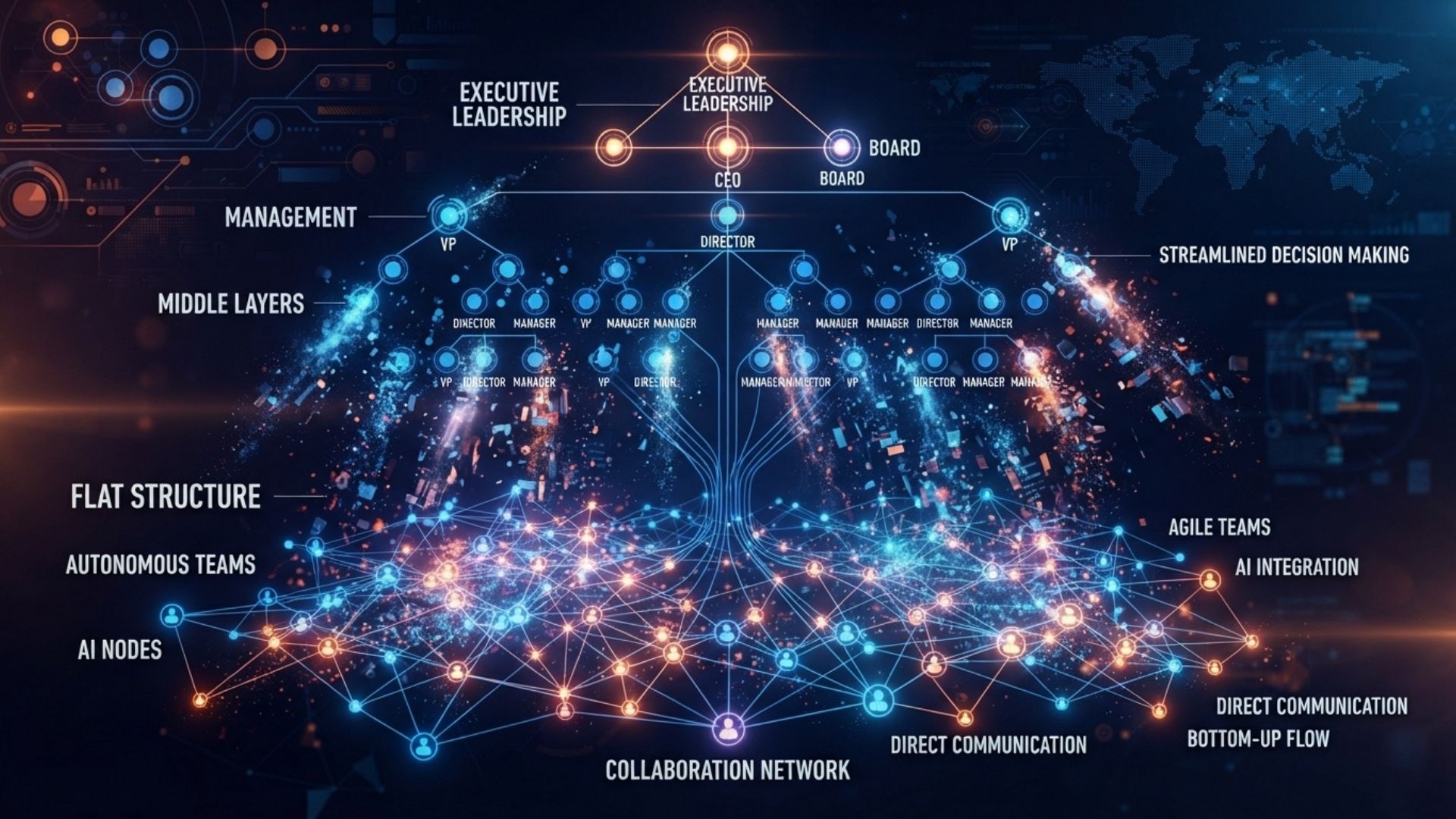
But here's what the headlines miss: AI isn't coming for leadership itself. It's coming for the administrative half of management — the scheduling, status tracking, report generation, and KPI monitoring that filled most managers' weeks. The companies cutting managers aren't eliminating the need for human judgment. They're eliminating the jobs that were mostly coordination, and concentrating the human work into fewer, higher-impact roles.
That distinction is the entire point of this post. Understanding exactly which tasks are being automated — and which ones aren't — is what separates a career crisis from a career opportunity.
What AI Automates vs. What It Can't — The Task-Level Reality
Most conversations about AI replacing managers stay abstract — vague warnings with no specifics. Here's the concrete breakdown of AI replacing managers, task by task — what AI handles today and where it still falls short.
| Management Task | 🤖 AI Can Handle | 🧠 Needs a Human |
|---|---|---|
| Meeting scheduling & calendar | ✅ Fully | — |
| Status reports & KPI dashboards | ✅ Fully | — |
| Task assignment & routing | ✅ Fully | — |
| Meeting notes & action items | ✅ Fully | — |
| Performance data tracking | ⚡ Partial | ⚡ Interpretation |
| 1-on-1 coaching conversations | — | 🧠 Critical |
| Conflict resolution | — | 🧠 Critical |
| Strategic decision-making | — | 🧠 Critical |
| Cross-team negotiation | — | 🧠 Critical |
| Team morale & motivation | — | 🧠 Critical |
The pattern is clear. AI takes over information relay — everything that involves collecting, routing, or summarizing data. What it can't touch is relational judgment — noticing a top performer has gone quiet, sensing a team conflict before it escalates, or knowing which person needs encouragement and which one needs accountability.
One Asana executive told Quartz she used to spend 4–5 hours each week consolidating status updates. AI now does it in seconds. That freed time isn't a job loss — it's a job description change. But only if the manager actually fills those reclaimed hours with the high-value human work in the right column above.
If your week is mostly tasks from the left column, AI replacing managers in your role is a real risk. If your week runs on the right column, AI is about to make you faster — not obsolete.
Who's Getting Cut — Real Company Examples
This isn't a theory — it's a documented corporate strategy at companies that employ millions of people. The "great flattening" is the name the trend earned. Here's what I found when I looked at the specifics.
Cut 14,000 corporate roles and increased the ratio of individual contributors to managers by 15% by March 2025.
CEO Andy Jassy explained the move bluntly: managers who "want to put their fingerprint on everything" slow organizations down. The restructure combined teams and reassigned managers rather than running mass layoffs.
Cut 8,000 additional roles in 2026, replacing traditional titles with AI-focused roles like "AI builder" and "AI pod lead."
Zuckerberg stated that "projects that used to require big teams can now be accomplished by a single very talented person." The CFO added that Meta is still evaluating what optimal workforce size looks like in an AI-driven environment.
Eliminated management layers across 100,000 employees, expanding manager spans of control from the standard 6–7 direct reports to as high as 90 in some divisions.
Early results: some customer teams doubled revenue in a single 90-day cycle, and a major product launch hit the market a year ahead of schedule. A production line that once required 15 specialists now runs with 5.
Cut roughly a third of its manager positions and told employees it would be harder to move into management roles going forward.
The move pushed existing managers toward expanded teams and individual-contributor tracks — turning "manager" from a default promotion path into a specialized role you have to earn.
There's a counter-signal worth noting. The Bureau of Labor Statistics still projects management occupations to grow faster than average this decade. That's not a contradiction — it means the category survives while the shape of the role changes. Fewer layers, wider spans, more human work per person.
I couldn't verify how many of these restructured managers were terminated outright versus reassigned to individual-contributor roles — that granularity isn't published company by company. But the pattern behind AI replacing managers is unmistakable: if your job is mostly relaying information between layers, that layer is the one being compressed.

7 Proven Ways to Stay Indispensable When AI Is Replacing Managers
The managers surviving AI replacing managers aren't fighting the trend — they're using it to do more of what machines can't. Here are 7 strategies backed by what I found in the data.
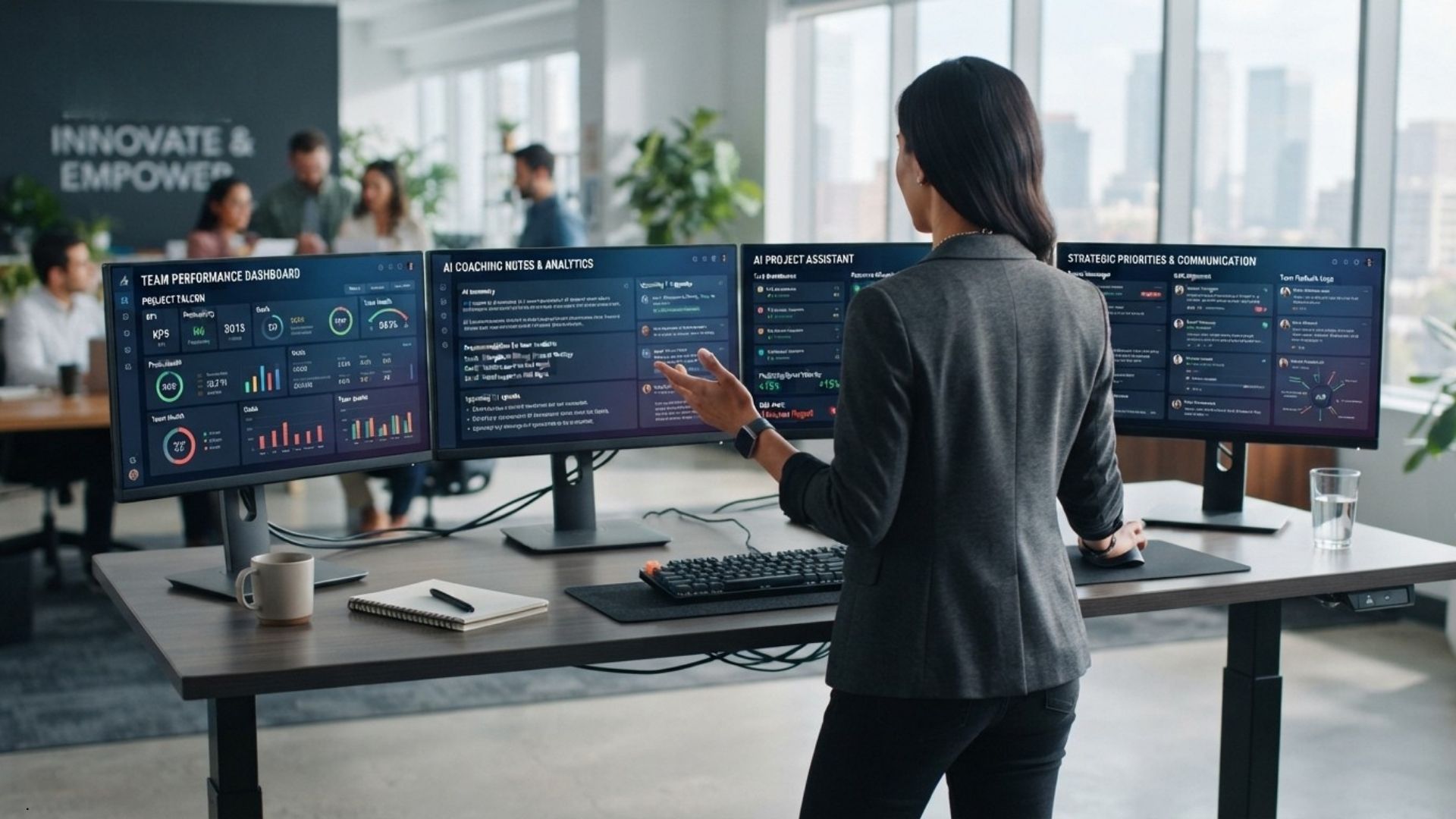
List every recurring task from the past two weeks. Categorize each as coordination (scheduling, status updates, report generation) or judgment (coaching, strategy, conflict resolution). Everything in the coordination column is what AI replaces first. Shift your time budget toward the judgment column — before someone else makes that decision for you.
Gallup's data shows that providing meaningful feedback to each employee at least once per week nearly triples the percentage of engaged employees. AI can generate performance data — but it can't sit with someone and help them grow. The coaching manager is the one organizations keep. The checklist manager is the one they automate.
New performance metrics are emerging: how effectively you use AI to improve outcomes, how fast you adapt to new AI systems, and what ROI your team's automations generate. Managers who can set up a Make workflow or configure a Reclaim AI calendar aren't just keeping up — they're building a skill set that's becoming a hiring requirement.
The biggest reason companies cut middle managers is speed: too many layers slow decisions down. The managers who survive are the ones who accelerate information flow rather than sit in it. Translate strategy into clear action for your team. Push decisions downward instead of hoarding them. If removing you would make things faster, your position is fragile — regardless of your title.
Volunteer to pilot AI tools. Document what works. Run internal training. The person who introduces the automation becomes the person the organization needs to keep around — they hold the institutional knowledge of how AI actually fits the team's workflow. A Quartz report found that MIT research shows 91% of data leaders cite "cultural challenges and change management" as the primary obstacle to AI adoption — not the technology itself. Managers who solve the human side of AI rollouts are solving the hardest problem.
AI can route information between departments. It can't navigate politics, build trust across competing priorities, or sense when two teams are about to collide. The managers who connect people and reduce friction across the organization are doing work that no tool replicates — and that executives notice because it prevents problems they'd otherwise have to fix themselves.
When restructuring decisions are made, the managers with documented results survive. Track your team's engagement scores, retention rates, project velocity, and AI-tool adoption metrics. If you can show concrete before-and-after numbers, you're presenting a case for your value — not hoping someone notices it.
Co-Intelligence: Living and Working with AI
by Ethan Mollick
The clearest framework I've found for where AI genuinely helps a manager and where it gets in the way — directly relevant to everything this post covers on AI replacing managers.
Check It Out →AI Tools That Make Managers Better, Not Redundant
If AI replacing managers is driven by automation, the smartest move is to be the one controlling that automation. The right AI tools don't replace your management skills — they remove the busywork that was burying them. Here are the tools I'd recommend for managers looking to reclaim their time for actual leadership.
Best for: Calendar & scheduling automation. Reclaim protects focus time, auto-schedules 1-on-1s and habits, and defends your calendar from meeting creep. Managers report saving 3–5 hours per week on scheduling tasks alone. Works with Google Calendar; Outlook support is in beta.
Best for: Automating reports and workflows. Build visual automations that pull data from Slack, Google Sheets, CRMs, and project tools into automated status reports. The no-code builder means you don't need engineering support. Free tier covers basic automations; Pro starts at $9/month. See my full comparison with Zapier and n8n.
Best for: Personal AI assistant for managers. Lindy handles email triage, meeting prep, and follow-up tasks automatically. It learns your communication style and can draft responses in your voice. Connects with Gmail, Slack, and most calendar tools. Read my full Lindy AI review.
I'd start with Reclaim AI if scheduling eats most of your week, or Make if you're drowning in manual reporting. Either one takes under 30 minutes to set up and shows results the same week. For a broader look at AI workflow automation tools, I've covered the full landscape separately.
Frequently Asked Questions — AI Replacing Managers
Will AI replace managers completely?
+Not completely — but the administrative half of management is being automated at speed. Scheduling, status reports, KPI dashboards, and task routing are all tasks AI handles well now.
What stays human: coaching, conflict resolution, strategic thinking, and the judgment-based skills that no dashboard can replicate. Gartner estimates 20% of organizations will use AI to cut over half their middle management roles — but the Bureau of Labor Statistics still shows management occupations growing overall.
Which management roles are most at risk?
+Roles focused on information relay face the most pressure — project coordinators who mainly track deadlines, managers whose primary job is summarizing progress, and team leads whose weeks are filled with scheduling and check-in meetings.
Roles centered on people development, cross-team negotiation, and strategic decisions carry far less automation risk. The table above breaks this down task by task.
What is the "great flattening" in management?
+The great flattening describes the corporate trend of removing middle management layers to speed up decisions and reduce cost. Amazon, Meta, Google, and Bayer have all publicly cut management positions, using AI tools to absorb the coordination work.
A Korn Ferry survey found 41% of employees reported their company had already trimmed management layers. Some organizations are calling the trend "conscious unbossing."
How can I prepare for AI replacing my management role?
+Start by auditing your weekly tasks — separate coordination work (AI can handle it) from judgment work (it can't). Then shift your time toward coaching, strategy, and relationship-building.
Learning to set up AI workflow tools like Make or Reclaim AI positions you as the person who drives AI adoption — not the one displaced by it.
What AI tools help managers stay productive?
+Reclaim AI automates calendar management and protects focus time. Make builds no-code automations for reporting workflows. Lindy AI acts as a personal assistant for email and meeting prep.
I covered the full landscape of AI meeting productivity tools and AI calendar apps in separate reviews if you want to go deeper.
Are companies like Amazon and Meta really firing managers for AI?
+The restructures are documented. Amazon cut 14,000 corporate roles and widened its contributor-to-manager ratio by 15%. Meta eliminated 8,000 positions while creating new AI-specific titles. Google reduced its manager count by about a third.
In many cases, managers were reassigned to individual-contributor roles rather than terminated outright — but the management layer shrank. The managerial work didn't vanish. It was either automated or redistributed across fewer, more senior leaders.
What skills should managers develop to survive AI disruption?
+Emotional intelligence, coaching ability, cross-functional relationship building, and the capacity to lead people through change are the skills gaining the most value. Technical AI literacy — not coding, but understanding how AI tools work and how to evaluate their outputs — is becoming a baseline expectation.
Gallup's research shows that managers who give meaningful weekly feedback to each report nearly triple engagement. That's the kind of measurable human impact that protects a role. I explored the long-term picture in my analysis of which skills will matter in 2045.
Should companies remove middle management entirely?
+The evidence says no — at least not without a plan. Research shows 37% of employees feel directionless after management layers are removed, and nearly half of senior executives doubt they can manage what remains.
The smarter approach is redesigning managerial roles to focus on coaching, strategy, and change management, while letting AI absorb the coordination work. Cutting the entire layer without replacing the mentoring, context-holding, and culture-building those managers provided tends to create problems that cost more than the savings.
🚀 Your Next Moves in the AI Workplace
The managers who thrive in 2026 aren't the ones who resist AI — they're the ones who use it to lead better. Here's where I'd go next: