
 Published: July 12, 2025

Open source AI is not just a concept — it’s a movement. And right now, there are a few standout models leading the charge. Whether you’re a developer, business owner, or simply curious about AI, knowing the key players can help you understand where the industry is heading.
Here are the most talked-about open source AI models in 2025:
1. Mistral AI
A French-based initiative creating lightweight, high-performance models.
Loved for speed and flexibility — and it doesn’t require massive computing power.

2. Meta’s LLaMA 3
Short for “Large Language Model Meta AI,” this model powers some of the most advanced chatbots and tools.
Open weights are available, but commercial use may have limits depending on version.
3. Falcon AI
Developed by the Technology Innovation Institute (UAE).
Known for impressive multilingual capabilities.
Falcon 180B is one of the largest open source models ever released.
4. Hugging Face Transformers
Not a single model, but a hub of thousands of open models.
Hugging Face is the “GitHub for AI” — if you’re curious, it’s a great place to explore.
5. Google’s Gemma
A new lightweight model family from Google designed to run locally.
Great for developers who want open, portable, and responsible AI.
Let’s break it down in the simplest way possible.
Imagine two kinds of robots:
One robot works really well, but it’s locked inside a box. You can ask it to do things, but you can’t see how it thinks, or what it does with your questions. That’s a closed source AI model — like ChatGPT, Gemini, or Claude.
The other robot is made from see-through parts. You can look inside, understand how it works, and even take it apart to build your own version. That’s an open source AI model.
So, what’s actually different?
 You can access the code
With open source AI models, the instructions (called “weights” and “architecture”) are public. Developers and researchers can study, improve, or adapt them — like editing an open recipe.
 You can run them offline
Many open source AI models can be downloaded and run directly on your laptop or device using tools like LM Studio or Ollama (internal link). This means:
You don’t need an internet connection to use the AI
Your data stays local and private
 They’re (often) free
Instead of paying monthly for a premium AI subscription, open source models let you build or use apps with no extra cost, especially if you’re running them yourself.
 You can build on top of them
Startups, students, and creators use these models to build smarter tools without starting from scratch. That’s one reason platforms like Hugging Face and GitHub are filled with new AI tools every day.
In short?
Open source AI models are like digital LEGO: you can take them apart, learn from them, and build whatever you need — instead of depending on a locked, expensive system someone else controls.
Now that we’ve seen the differences, let’s take a closer look at why this matters beyond the tech world.
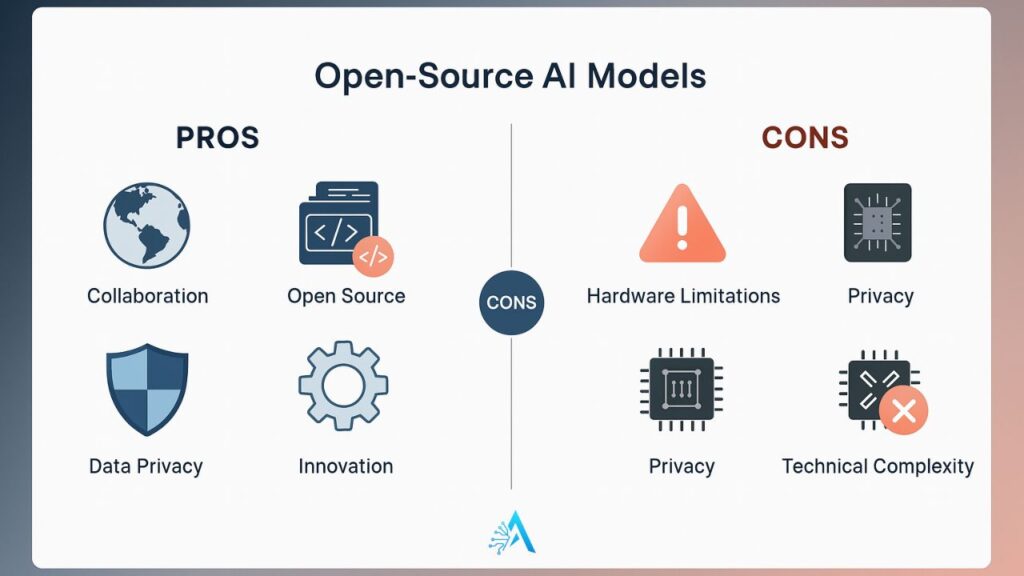
Open source AI models are getting more attention every day — and for good reason. But like anything powerful, they come with both benefits and potential downsides.
Here’s a simple overview to help you understand both sides.
 The Pros
1. Freedom to build and customize
With open source AI, anyone — from solo developers to big companies — can adapt the model to their needs. You’re not stuck with whatever a big tech company decides to offer.
2. Lower cost (or free)
Many open source AI models are free to use. No subscriptions, no API limits, no pricing tiers. Just download and go.
3. Transparency and trust
You can see how the model was made, what data it used, and how it processes information. That makes it easier to check for bias, privacy issues, or unfair behavior.
4. More innovation
Since people all over the world can contribute, open source models evolve fast. New features, better performance, and creative tools show up almost weekly.
5. Better privacy options
Running a model locally means your data never leaves your device. That’s a big plus if you care about personal privacy.
 The Cons
1. Not always beginner-friendly
Running an open source AI model yourself can require some technical skills. Setting up a model like LLaMA or Mistral on your laptop isn’t always plug-and-play (yet).
2. Hardware limitations
Some powerful models need a strong computer — with a good GPU — to work smoothly offline. This might be a barrier if you’re using a basic laptop or mobile device.
3. Less support and polish
Big companies offer customer support and slick interfaces. Open source tools might have bugs or lack documentation, especially if the community behind them is small.
4. Risk of misuse
Because the models are open, they can be used for harmful or unethical purposes too — like deepfakes, spam bots, or misinformation. That’s why ethical AI awareness is crucial.
Bottom line?
Open source AI models open up huge opportunities — but they also ask for more responsibility. If you’re willing to learn and explore, they can be one of the most powerful tools you’ll use in 2025.
Open source AI models aren’t just for tech labs anymore. Today, people are using them in smart, everyday ways — from building chatbots to automating creative work.
Here are some of the most common (and impressive) use cases in 2025:
 Personal AI Assistants
Tools like LM Studio or Ollama let you run your own AI chatbot locally. People use these to:
Plan their week
Draft emails or social posts
Answer questions offline — even without internet
This puts ChatGPT-like power on your laptop, without needing a subscription or sending your data to the cloud.
 AI for Small Businesses
Startups are using open source AI models to:
Generate product descriptions and customer emails
Analyze sales trends with custom prompts
Build their own branded chatbots, trained on company documents
It’s a low-cost way to automate real tasks and compete with big players.
 Creative Tools & Art Projects
Artists and creators use models like Stable Diffusion and Mistral to:
Generate images and videos
Brainstorm story ideas
Build AI-powered video editors or comic makers
Since everything is open source, they can experiment freely without restrictions.
Education & Research
Teachers and students love open source AI because it:
Encourages hands-on learning
Allows safe, offline experimentation
Offers a deeper look into how large language models actually work
Universities often choose open models so students can explore AI without needing paid tools.
These aren’t science fiction ideas.
They’re tools people are already using — and building — with open source AI models.
Open source AI models aren’t just a side trend — they’re rewriting the rules of how artificial intelligence grows and spreads.
Here’s why they matter so much for the future of tech, work, and personal freedom:
 Global collaboration = faster innovation
With open source, anyone can contribute — developers in Brazil, students in India, researchers in Germany. That global teamwork creates:
Faster breakthroughs
Smarter updates
More diverse ideas
It’s the same model that made Linux and Wikipedia succeed — and now it’s pushing AI forward, fast.
Custom AI for every niche
Need an AI that understands your small business or local language? Open source lets you train your own version. No need to wait for a big company to build it.
That’s why local AI models are emerging everywhere — from legal chatbots in France to farming tools in Africa.
 Building blocks for the AI economy
Just like open source code powered today’s web apps, open source AI models will fuel tomorrow’s startups. From health tech to education platforms, developers are already using models like Mistral, LLaMA 3, and Phi-3 as foundations.
More control, more trust
People are starting to ask: Who owns the AI I use? Who sees my data?
Open source offers a different answer: you do — especially if you run the models on your own machine, with your own rules.
In short:
Open source AI models are not only changing how we build technology — they’re changing who gets to build it.
They open the door for everyone to learn, create, and control the future of artificial intelligence — not just the big tech giants.
Open source AI models offer freedom, creativity, and innovation — but they also raise real ethical questions that we can’t ignore.
If anyone can download and use these powerful tools, then how do we make sure they’re used responsibly?
Here are a few key things to keep in mind:
Misuse is easy — and hard to trace
Because open source tools are public and free, bad actors can use them to:
Create deepfakes and disinformation
Build spam bots or phishing tools
Train biased or harmful models in secret
With no gatekeeping, responsibility shifts to each of us to use AI consciously — and to call out abuse when we see it.
 Transparency doesn’t always mean safety
It’s great that open source AI models let us see the code and training data — but that doesn’t guarantee the model is fair or safe. Many models still reflect:
Cultural biases
Stereotypes
Unethical training sources (like scraped content without consent)
That’s why ethical AI developers are pushing for better dataset auditing and clear guidelines on what’s acceptable.
“More power” = “More responsibility”
Running AI locally means you are in charge of privacy, behavior, and even regulation. For example:
Are you logging user prompts?
Could your model give harmful advice?
Are you protecting user data?
It’s like having your own little server: it’s powerful — but also requires care.
What can we do about it?
Educate yourself and others on responsible AI use
Support projects that include fairness and safety checks
Stay curious — ask questions about how models are made, used, and governed
We believe AI should empower, not exploit. Open source AI models give us that chance — but only if we use them wisely.
Open source AI models aren’t just for coders or tech insiders anymore. They’re becoming the foundation for how we’ll all interact with AI in the near future — whether you’re a student, freelancer, developer, or small business owner.
We wrote this guide to give you the full picture:
What open source AI models are
Why they’re exploding in popularity
How real people are already using them
What ethical questions we need to ask
We didn’t test these models ourselves — instead, we carefully researched the most trustworthy, trending, and widely discussed tools available in 2025. Our goal is always the same: make AI more understandable and useful to everyone.
Want to stay ahead of the curve?
We’re tracking the best AI tools and trends across every industry. Join our free newsletter to get curated tools, ethical tips, and smart insights straight to your inbox.