

 Published on: January 3, 2026
Disclosure:
This post may contain affiliate links. If you purchase through them, we may earn a small commission — at no extra cost to you. This helps support our research and keeps AI Digital Space running. Thank you!
1. What Reply.io Is and Who It’s Built For
Most of us have had the same moment: we send a few outreach emails, we wait… and nothing happens. Then we try again with a “quick follow-up”, and it still feels like we’re talking to a wall. Not because our offer is bad — but because outreach is noisy, attention is low, and automated follow-ups are often the part we postpone until it’s too late.
If we’re running a small business, building a side hustle, or doing sales without a full team, this becomes a weekly frustration. We either spend hours writing, tracking, and remembering who needs a follow-up using basic sales outreach software… or we automate too aggressively and end up sounding like spam.
This guide is here to make it simple.
In this post, we’ll review Reply.io — an AI sales automation platform — in a practical, grounded way: what it actually does, who it’s best for, how it works as an AI cold email tool to support outreach and automated follow-ups, and the common mistakes that quietly ruin results, such as weak sequences or poor deliverability practices. We’ll also look at pricing logic, realistic use cases, and the ethical side of automation, because efficiency should support real communication, not turn it into noise.
To keep this grounded in real-world standards, we’ll also reference best practices around responsible outreach — including guidance from the U.S. Federal Trade Commission on commercial email compliance — which helps frame where automation is useful and where it can cross the line if misused.
| By the end, we’ll know… | What we’ll do with it |
|---|---|
| If Reply.io is the right tool for our outreach | Decide fast: use it, skip it, or choose an alternative |
| How AI improves outreach without making it “robotic” | Write cleaner sequences that feel human |
| What mistakes kill replies (and inbox placement) | Avoid the traps that waste time and hurt our domain |
If we’ve ever thought, “Outreach works… I just don’t have the time to manage it properly,” we’re exactly where we should be.
A Must-Read if You Want Better Outreach Results
One of the best foundations for understanding modern sales outreach — especially before you automate — is Predictable Revenue. This book walks you through the systems that helped Salesforce scale its outbound sales process, including how to build repeatable, high-reply workflows that don’t feel cold or robotic. If you’ve ever wondered how great teams structure sequences, segment audiences, and avoid common pitfalls, this is a practical, proven read.
2. The Real Problem: Outreach Takes Time and Gets Ignored
We all know the feeling: we do the work — we research a lead, write a decent message, hit send — and then… silence.
At first we tell ourselves it’s normal. People are busy. Inboxes are full. But after the third or fourth “no reply,” something else happens: our sales outreach starts slipping down the priority list. Not because it’s unimportant, but because it’s mentally exhausting to keep pushing when the feedback loop is basically zero.
Here’s the uncomfortable truth: most outreach doesn’t fail because the offer is bad. It fails because the process breaks — especially when follow-ups rely on fragmented tools instead of structured sales outreach software.
We usually get stuck in one of these patterns:
| What happens in real life | Why it kills results | What we end up doing |
|---|---|---|
| We follow up too late (or not at all) | Most replies come after follow-ups, not the first email | We restart from zero with new leads |
| We copy-paste messages that feel generic | It looks automated, so it gets ignored fast | We “optimize” by sending more, not better |
| We lose track of who got what | Outreach becomes messy, inconsistent, and hard to repeat | We waste time searching spreadsheets and threads |
| We over-automate to “save time” | Deliverability drops and replies get worse | We blame the market, the niche, or the tool |
This is exactly where an AI sales automation tool can help — but only if it’s used to support good outreach, not replace it. The goal isn’t sending more emails. The goal is making sure the right message reaches the right person, with follow-ups that feel consistent and respectful.
3. How Reply.io Uses AI to Automate Outreach
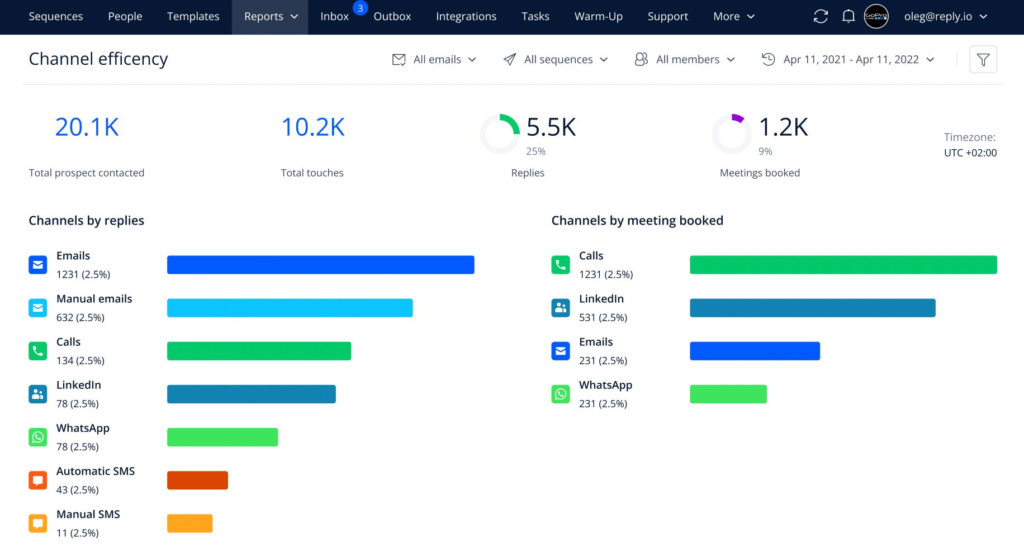
At this point, a fair question usually comes up: “Okay, but what does the AI actually do?”
Not in theory — in day-to-day outreach.
The useful part isn’t that emails get written faster. It’s that the boring, fragile parts of outreach stop breaking — which is exactly where AI sales automation makes the biggest difference.
Here’s how the workflow really works, step by step.
First, the AI helps with structure — not magic copy.
Instead of starting from a blank page every time, we get help shaping messages that already make sense: opening lines, follow-ups that don’t repeat themselves, and reminders that sound natural rather than desperate. When tools like Reply.io are used as an AI cold email tool, we’re still fully in control of tone and intent — the AI simply removes friction.
Second, timing and sequencing are handled automatically.
This is where most outreach fails in real life. Follow-ups go out too late, too early, or not at all. With structured sales outreach software, sequences stay consistent and reliable, even when our schedule gets messy.
Third, personalization stays lightweight but intentional.
Rather than stuffing emails with fake personalization tokens, the AI focuses on context: role, company type, previous interaction. That’s usually enough to feel relevant — and it scales well across automated follow-ups without crossing into “creepy.”
To make it clearer, here’s what’s actually automated — and what stays human:
| Handled by AI | Still up to us | Why this balance works |
|---|---|---|
| Drafting outreach and follow-up variations | Deciding what we’re offering and why | Messages stay aligned with real intent |
| Sequencing and timing of messages | Choosing when to stop or pivot | Automation doesn’t turn into spam |
| Tracking replies and follow-up logic | Handling real conversations | Human replies stay human |
What matters here is mindset. This isn’t about sending more emails. It’s about removing the mental load that causes outreach to fall apart after the first attempt.
Once the system takes care of consistency, we’re free to focus on the part that actually moves deals forward: listening, replying with intent, and knowing when to stop pushing. This approach aligns with what research on effective sales conversations has shown for years — quality interactions outperform volume-driven outreach in the long run.
To reinforce this point, you can reference Harvard Business Review’s analysis on sales effectiveness and buyer engagement, which highlights how trust, relevance, and timing matter more than sheer activity.
4. Real Use Cases Where Reply.io Actually Works
Once we understand how the system works, the next question is practical: where does this actually make a difference in real life?
Not in theory. Not in demos. In everyday workflows where time and attention are limited.
What we’ve seen is that Reply.io performs best when outreach has structure but still needs a human touch. These are the scenarios where AI sales automation supports consistency instead of replacing judgment.
B2B cold outreach with a clear audience
When we already know who we want to contact — founders, managers, decision-makers — this AI cold email tool helps keep messages organized and follow-ups consistent. Instead of rewriting the same email five times, we refine one solid sequence inside structured sales outreach software and let timing do the work.
Inbound leads that need fast follow-ups
Someone fills a form, replies to a campaign, or shows interest… and timing suddenly matters. Automating the first step with automated follow-ups removes hesitation, while real conversations stay manual once the reply arrives.
Agencies managing multiple clients
This is where structure becomes essential. Different campaigns, different tones, different goals — all running in parallel. AI sales automation helps prevent crossed wires and forgotten prospects without turning everything into a template factory.
Solo founders and small teams
When sales isn’t the only job we’re doing, outreach is often the first thing to slip. A structured system built on reliable sales outreach software keeps momentum going even during busy weeks.
To make this clearer, here’s where it fits — and where it doesn’t:
| Good fit | Poor fit | Why |
|---|---|---|
| Targeted B2B outreach | Mass, untargeted emailing | Relevance matters more than volume |
| Structured follow-up sequences | One-off “blast” campaigns | Consistency drives replies |
| Small teams scaling outreach | Highly personal, bespoke sales | Some conversations must stay fully manual |

The key takeaway is simple: automation works best when it supports a clear strategy. When outreach already makes sense, this kind of system keeps it running smoothly. When the strategy is unclear, no tool can fix that.
5. Pricing, Alternatives, and the Mistakes That Kill Results
Before we decide if a tool is worth it, we usually ask three questions:
How much will this cost me?
Are there simpler or cheaper alternatives?
What happens when the setup is wrong?
In this section, we answer all three — and give you a quick side-by-side comparison so you can decide without confusion.
 Pricing Reality Check
Reply.io is priced for ongoing outreach workflows, not one-off emails. If you send outreach sporadically, the value may feel lower. But when it replaces manual follow-ups and organization work, the ROI becomes clearer.
Rather than quoting prices (which change often), think about it this way:
If outreach and follow-ups take you hours every week, automation can save that time.
If you send hundreds of emails each month, tools built for bulk newsletters won’t give the same structured follow-up logic.
Below is a simple comparison with alternatives.
| Tool | Best For | AI Features | Follow-Up Logic | Ideal Use Case | Try / Learn More |
|---|---|---|---|---|---|
| Reply.io | AI-assisted outreach & sequences | AI draft suggestions, email variations | Advanced, rule-based sequences | Structured B2B outreach & follow-ups | Try Reply.io |
| Mailshake | Cold email sequences | Basic AI email ideas | Good but less dynamic | Simple outreach workflows | Try Mailshake |
| Saleshandy | Email tracking & sequences | No true AI drafting | Sequencing + tracking | Follow-ups with analytics | Try Saleshandy |
| GMass | Gmail-based campaigns | AI subject/line suggestions | Basic follow-ups | Gmail users wanting integration | Try GMass |
Reply.io stands out when structured sequences + AI assistance matter most.
Mailshake is simpler but less dynamic for complex follow-ups.
Saleshandy is great for analytics, not drafting.
GMass works well inside Gmail, but it’s not built for multi-step logic.
 Mistakes That Kill Results (Even With Good Tools)
Even with the right tool, we still see the same traps:
1. Treating AI as a “set-and-forget” strategy
AI drafts are only as good as the logic behind them.
2. Ignoring deliverability basics
Domain reputation, warm-up, and timing affect results more than you think.
3. Overloaded sequences
More steps ≠ more replies. Often the opposite.
4. No reply monitoring
The moment someone replies — automation should step aside.
6. Ethical Sales Automation, Final Verdict, and FAQs
Automation always raises a quiet concern: where does efficiency end, and annoyance begin?
That’s the right question to ask — because outreach done badly doesn’t just fail, it damages trust.
Used well, AI supports discipline. Used poorly, it scales bad habits.
The ethical line isn’t about whether AI sales automation exists. It’s about how intentionally we use it within real sales outreach software.
Where sales automation stays ethical
-
Consent and relevance come first.
We contact people who actually fit what we offer, using AI sales automation to support relevance — not replace judgment. -
Follow-ups are respectful, not relentless.
Well-designed automated follow-ups stop when there’s no signal, instead of pushing volume for the sake of activity. -
Replies trigger human control.
The moment a person engages, automation steps aside — which is how an AI cold email tool should behave in practice.
Where it crosses the line
-
Sending messages just because a list exists
-
Hiding behind “personalization” that isn’t real
-
Treating volume as a shortcut to relevance
This is where Reply.io makes sense for teams who already care about doing outreach properly. Used as structured sales outreach software, it doesn’t force spam — it amplifies whatever process we design. That’s a responsibility, not a feature.
Our final take
If outreach is part of our workflow and follow-ups often fall apart due to time or organization, this tool can genuinely help. It shines when we want consistency without losing control.
If we’re looking for a magic button to generate replies without thinking, it’s the wrong fit — and that’s actually a good thing.
To close things out, here are the most common questions people ask before deciding.
FAQ
Q: Is Reply.io safe to use for cold outreach?
A: Yes — when used responsibly. Safety depends more on how we structure sequences, warm up domains, and manage follow-ups than on the tool itself. Used well, it supports compliant, respectful outreach.
Q: Does Reply.io replace a sales rep or founder?
A: No. It replaces repetitive tasks, not human judgment. Conversations, negotiations, and relationship-building still require a real person.
Q: Can outreach still feel human with automation?
A: It can — if AI supports structure and timing rather than pretending to be personal. Automation should remove friction, not fake personality.
Q: Is Reply.io suitable for small teams or solo founders?
A: Yes. It’s especially useful when outreach competes with many other responsibilities and consistency is hard to maintain manually.
Q: What’s the biggest mistake to avoid when using Reply.io?
A: Over-automation. Long, aggressive sequences usually hurt replies and trust. Fewer, well-timed messages perform better in the long run.
If this guide resonated with you, it probably means outreach and automation are already part of your daily workflow — or about to be. At that point, the real advantage isn’t just using tools, but understanding how AI fits into your work without taking control away from you.
If you want to go one step further, here are three related articles we’ve already published that many readers find useful at this stage:
→ Best AI Tools for Small Business Owners in 2025
→ Write Better Prompts for AI Tools: 7 Workflow Hacks for 2025
→ Avoid These Common AI Tool Scams in 2025 – What to Look For Before Signing Up