
 Published on: January 7, 2025
Disclosure:
This post contains affiliate links. If you click through and make a purchase, we may earn a small commission at no additional cost to you. Thank you for supporting AIDigitalSpace — we only recommend tools and services we genuinely trust and believe bring real value to our readers.
1. AI Drones in 2026: What They Can Actually Do Today
We’ve all noticed it by now.
AI drones keep popping up everywhere — in ads, videos, product pages — often shown flying on their own, avoiding obstacles perfectly, or “thinking” like a human pilot.
And naturally, we start wondering: is this really how they work today, or are we just seeing the best-case scenarios?
If you’ve ever looked at a drone listing and felt unsure about what’s real and what’s marketing, you’re not alone. Many of us are curious, slightly excited, but also confused — especially when words like AI-powered, autonomous, or smart tracking are used without much explanation.
In this guide, we’ll slow things down and be very clear.
We’ll explain how AI is actually used in drones today, what these systems really help with, and where the limits still are — without technical overload or hype.
By the end of this article, you’ll know what to realistically expect from AI drones in 2026, whether they make sense for a home or small business, and which promises are worth trusting — and which ones deserve a second look.
Recommended Read:
If we want to understand how AI is really applied to drones today — without hype or sci-fi promises — Mastering Drone Technology with AI is a solid companion read. The book explains, in a clear and practical way, how AI supports navigation, perception, and decision-making in modern drones, while also highlighting current limits and real-world constraints.
2. Why Homes and Small Businesses Are Turning to AI Drones
At this point, many of us aren’t looking at AI drones out of pure curiosity anymore.
We’re looking at them because something feels inefficient, hard to monitor, or easy to miss in our daily environment.
For homeowners, it’s often about visibility. Large properties, rooftops, fences, or shared areas are difficult to check regularly. Cameras help, but they stay fixed. Walking around takes time, and issues are often noticed too late.
For small businesses, the problem is usually scale. Warehouses, construction sites, farms, rental properties, or even outdoor retail spaces require frequent visual checks, but hiring people or stopping operations to inspect everything manually isn’t always realistic.
This is where AI-powered features start to matter — not because drones “think”, but because they reduce friction.
Obstacle avoidance, automated flight paths, subject tracking, and visual recognition allow drones to cover space consistently, without needing expert piloting skills every time.
What’s important to clarify is this:
AI drones don’t replace human judgment. They extend our eyes, automate repetitive checks, and help us notice changes faster — cracks, blocked areas, unexpected movement, or simple wear and tear.
This practical direction is also reflected in how regulators describe drone usage today. For example, guidance from the European Union Aviation Safety Agency highlights that most civilian drone applications focus on inspection, monitoring, mapping, and safety support — not full autonomy or independent decision-making.
(You can see this clearly in their public documentation on civilian and commercial drone operations.)
In other words, people aren’t adopting AI drones because they want futuristic machines.
They’re doing it because checking, monitoring, and documenting physical spaces is still a very human problem — and drones, when used correctly, simply make that job easier.
3. Best AI Drone Use Cases That Actually Make Sense
Once we move past marketing language, AI drones become much easier to understand.
They’re not universal tools — but in specific situations, they genuinely save time, reduce effort, and improve consistency.
Below are the use cases that actually make sense today, both for homes and small businesses.
Home security and property checks
For private homes, AI-assisted drones are mainly used for periodic visual inspections.
Instead of walking around a property or relying only on fixed cameras, a drone can follow a preset route, check rooftops, fences, or gardens, and record changes over time.
AI here helps with:
obstacle avoidance
stable flight near structures
basic subject detection (people, vehicles, animals)
This doesn’t replace alarm systems — it complements them, especially for larger or harder-to-reach areas.
Roof, facade, and infrastructure inspections
This is one of the most practical uses today.
Small businesses, property managers, and even homeowners use drones to inspect roofs, solar panels, gutters, or facades without scaffolding or ladders.
AI doesn’t “diagnose” problems, but it:
keeps flight paths stable and repeatable
helps capture consistent angles
reduces the need for manual piloting skills
The result is faster documentation and fewer blind spots.
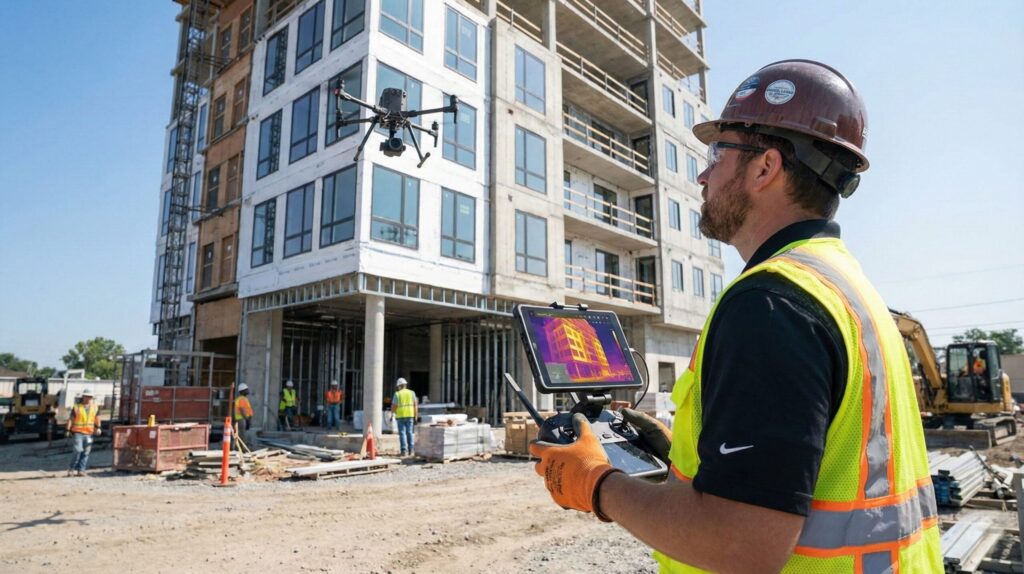
Construction sites and outdoor workspaces
For construction, agriculture, and logistics, drones help with progress tracking and safety checks.
AI features make it easier to:
follow predefined routes
avoid workers and equipment
collect visual data regularly
This allows teams to spot delays, layout issues, or unsafe areas earlier — without interrupting daily operations.
Content creation and documentation
For creators and small businesses, AI-assisted tracking is one of the most visible features.
Follow modes, subject framing, and stabilized flight allow:
solo filming
smoother motion shots
faster setup
It’s useful — but it’s also where expectations should stay realistic. AI helps assist filming, not replace planning or creativity.
At-a-glance comparison of real-world use cases
| Use case | Where AI helps | Who benefits most |
|---|---|---|
| Home & property checks | Navigation, obstacle avoidance | Large homes, rural properties |
| Roof & facade inspections | Stable paths, repeatable angles | Homeowners, property managers |
| Construction & worksites | Route automation, safety buffers | Small businesses, contractors |
| Content creation | Subject tracking, stabilization | Creators, solo operators |
What all these cases have in common is simple:
AI works best when the task is repeatable, visual, and time-consuming, not when complex judgment or autonomy is required.
This is also where many popular consumer models — including those from DJI — focus their AI features today: helping users fly more safely and consistently, not replacing human decisions.
Below are three models we see most often recommended because their AI features focus on safety, stability, and everyday reliability — not experimentation.
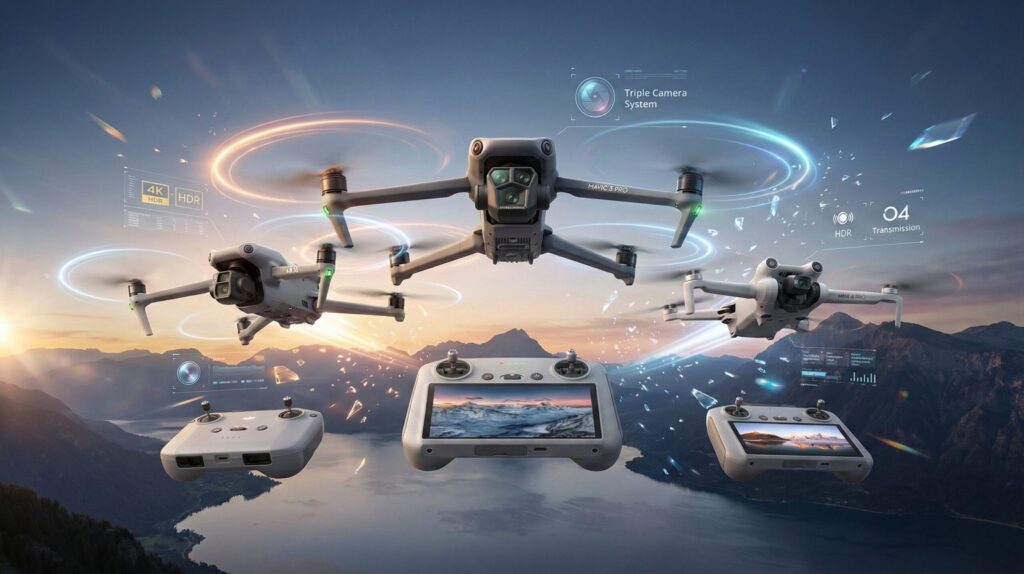
| Model | Typical price (EU) | AI features that matter | Best for | View model |
|---|---|---|---|---|
|
DJI Mini 4 Pro
Lightweight · easiest to fly
|
From ~€849
price varies by bundle
|
Omnidirectional obstacle sensing
ActiveTrack smart following
AI assistance focused on safety and simplicity
|
Home checks, simple inspections, solo filming, travel documentation.
Ideal if we want strong AI help without complexity.
|
See Mini 4 Pro |
|
DJI Air 3S
Balanced home + business option
|
From ~€1,099
varies by combo
|
Enhanced obstacle sensing
Smarter return-to-home behavior
Designed for repeatable, stable flights
|
Roof and facade checks, outdoor sites, consistent documentation.
Best middle ground for reliability and flexibility.
|
See Air 3S |
|
DJI Mavic 3 Pro
Pro-grade visuals and safety
|
From ~€2,569
higher with pro kits
|
Omnidirectional obstacle sensing
Advanced assisted flight safety
Built for high-quality, controlled operations
|
Professional inspections, premium documentation, advanced content workflows.
Worth it when quality truly matters.
|
See Mavic 3 Pro |
Prices shown are typical starting points in EU listings and may vary by bundle, retailer, or promotion.
4. Buying an AI Drone in 2026: What to Look For (and Avoid)
Once we understand where AI drones actually help, the next step is choosing one without falling for feature overload.
Many buyers focus on the word AI itself — but in practice, a few specific capabilities matter far more than long spec lists.
Here’s how we recommend approaching a purchase in 2026.
What really matters when choosing an AI drone
Reliable obstacle avoidance
This is one of the most valuable AI features today. Good obstacle sensing reduces crashes, stress, and the need for constant manual corrections — especially near buildings, trees, or tight spaces.
Stable automated flight paths
Predefined routes and repeatable flights are far more useful than “smart autonomy.”
They allow consistent inspections, documentation, and monitoring — which is where drones save real time.
Camera quality over AI tricks
AI can assist framing, but image clarity still depends on sensors and optics.
A solid camera with predictable results beats advanced AI modes that only work in ideal conditions.
Battery life and return safety
No AI feature matters if the drone can’t finish its task.
Look for reliable return-to-home behavior, conservative battery warnings, and realistic flight times.
What to be cautious about
“Fully autonomous” claims
In 2026, consumer drones are still supervised systems.
If a product suggests independent decision-making without human oversight, expectations are likely being stretched.
Overloaded AI modes
Too many automated options can make drones harder — not easier — to use.
We’ve seen users abandon advanced features because setup becomes confusing or inconsistent.
Ignoring local regulations
AI doesn’t override airspace rules.
Before buying, it’s worth checking guidance from authorities like the Federal Aviation Administration or your local aviation body to understand limits on flight zones, altitude, and privacy.
A simple buying mindset that works
Instead of asking “Which drone is the smartest?”, a better question is:
“Which drone helps me complete my specific task with less effort and fewer mistakes?”
When AI supports navigation, safety, and repeatability, it adds value.
When it promises independence or intelligence beyond that, caution is healthy.
This mindset also makes affiliate recommendations clearer and more honest — focusing on fit, not hype.
5. Privacy, Safety and Ethical Limits of AI Drones
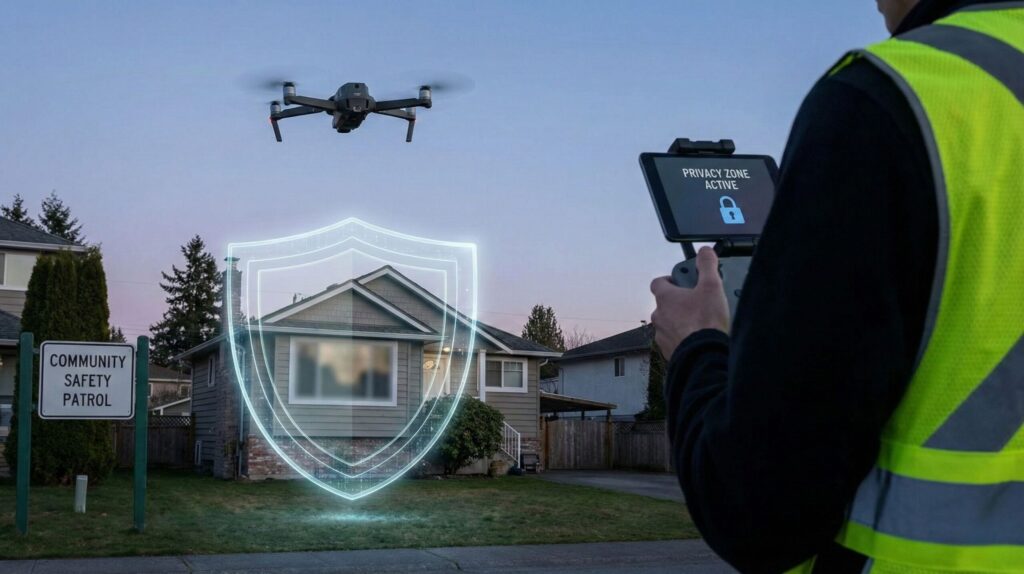
AI drones don’t usually raise concerns at checkout.
They raise concerns once they’re in the air.
Most of us are fine with a drone inspecting a roof or checking a site.
What feels uncomfortable is not knowing what’s being recorded, why, and for how long.
That discomfort is important. It tells us where the real limits are.
AI helps flying — not judgment
This is the key distinction we shouldn’t blur.
AI can help a drone:
avoid obstacles
follow routes
keep a subject in frame
But AI doesn’t understand context.
It doesn’t know when recording becomes intrusive, unnecessary, or inappropriate.
Those decisions remain human — always.
Where privacy issues actually start
In real life, problems rarely come from abuse.
They come from everyday situations like:
flying over shared or semi-private spaces
capturing people who weren’t part of the task
keeping footage “just in case”
using recordings without explaining their purpose
For small businesses, this matters more than tech specs.
Trust is easier to lose than to rebuild.
European guidance linked to the European Commission reinforces this idea clearly:
collect only what’s necessary, for a clear purpose, and nothing more.
Safety still needs a human in the loop
AI reduces mistakes — it doesn’t remove uncertainty.
Wind changes, signal drops, unexpected movement, crowded areas…
These are normal conditions, not edge cases.
That’s why supervision is still required in most regulations:
not because AI is weak, but because reality is unpredictable.
6. AI Drones FAQ: Laws, Privacy, Safety and Real Expectations
Q: What can AI drones actually do in 2026?
A: AI drones today can assist with navigation, stable flight paths, obstacle avoidance, and basic subject tracking — but they are not independently autonomous and still require human supervision.
Q: Are AI drones fully autonomous?
A: No, consumer and small-business drones are assisted by AI for tasks like collision avoidance and route planning, but they can’t operate independently or make ethical decisions.
Q: Do I need a license to fly an AI drone?
A: It depends on your country and drone weight; many places require a basic license or registration even for assisted drones — check your local aviation authority’s guidelines before flying.
Q: Can AI drones record people automatically?
A: They can record video, but they don’t automatically decide who to record; setting up recording and respecting privacy boundaries remains the operator’s responsibility.
Q: Is it legal to fly an AI drone over my property?
A: Often yes, if you follow local rules on altitude, line-of-sight, and no-fly zones; regulatory bodies like the European Union Aviation Safety Agency and Federal Aviation Administration publish up-to-date requirements you should follow.
Q: Are AI drones safe to use near buildings and people?
A: AI improves safety, but drones can still pose risks; stable flight and obstacle avoidance help, but operators must always supervise and avoid flying over crowds or restricted spaces.
Q: How long do AI drones typically fly on a battery?
A: Most consumer AI drones offer 15–30 minutes of flight per battery under normal conditions; plans for projects requiring longer uptime should include spare batteries or ground support.
Q: Do AI drones replace security cameras?
A: No, they complement fixed cameras; drones are mobile tools that help with periodic checks and inspections, whereas cameras provide constant monitoring.
Q: Which tasks are AI drones best for in home and small business?
A: Practical tasks include property inspections, roof and facade checks, progress documentation on worksites, and support for content capture, not complex autonomous missions.
Q: What privacy issues should I consider before using an AI drone?
A: You should avoid capturing non-consenting individuals, respect private spaces, keep footage only as long as necessary, and clearly communicate how and why you are using the drone.
If this guide helped you understand how AI drones really work in 2026 — beyond marketing claims — and you’d like to explore other practical, real-world AI gadgets and technologies we’ve already tested and explained, you may also find these related posts useful:
 Best AI Security Cameras – What to Know Before You Buy Smart Home AI Cameras – What to Know Before Buying AI Privacy Gadgets – Anti-Tracking Devices That Protect Your Identity How to Spot AI-Generated Product Reviews – Tips for Smarter Shopping