
Mirko
AI & Consumer Tech Writer
That 5-star product you just bought? The reviews might have been written by a bot. In 2026, over 38% of verified-purchase reviews on major platforms show patterns consistent with AI generation — and the FTC is now hitting companies with fines up to $53,088 per fake review. This guide gives you the exact red flags, free tools, and 60-second checks to spot AI-generated product reviews before they drain your wallet. No guesswork, just a proven detection system.
🔍 In This Guide
Some links are affiliate links · You support the blog at no extra cost · Details
1. Have You Been Fooled by an AI Review?
Picture this: you find a product on Amazon with hundreds of glowing reviews. Five stars, happy customers, convincing details. You hit “Buy Now” without a second thought.
Two days later? Total disappointment. The product is nothing like described — and those reviews were never real. They were AI-generated product reviews, written by algorithms designed to manipulate your trust.
This isn’t a rare edge case. The FTC’s Consumer Review Rule — now actively enforced with penalties up to $53,088 per fake review — exists because the problem has reached epidemic scale. Even trusted platforms like Amazon, eBay, and Best Buy can’t catch them all.
The real danger? You lose money on products that don’t deliver, waste hours on returns, and make decisions based on information that never existed.
If you’ve ever wondered whether the reviews you’re reading are real, you’re asking the right question. And if you’re concerned about how AI tools access and use your personal data beyond just reviews, our guide on how to stop AI from reading your private data covers that side of the equation.
This guide gives you everything you need — the exact red flags, free detection tools, and a 60-second system to spot AI-generated product reviews before they drain your wallet.
Sources: FTC Consumer Review Rule · Amazon Transparency Report
2. The Rise of AI-Generated Product Reviews
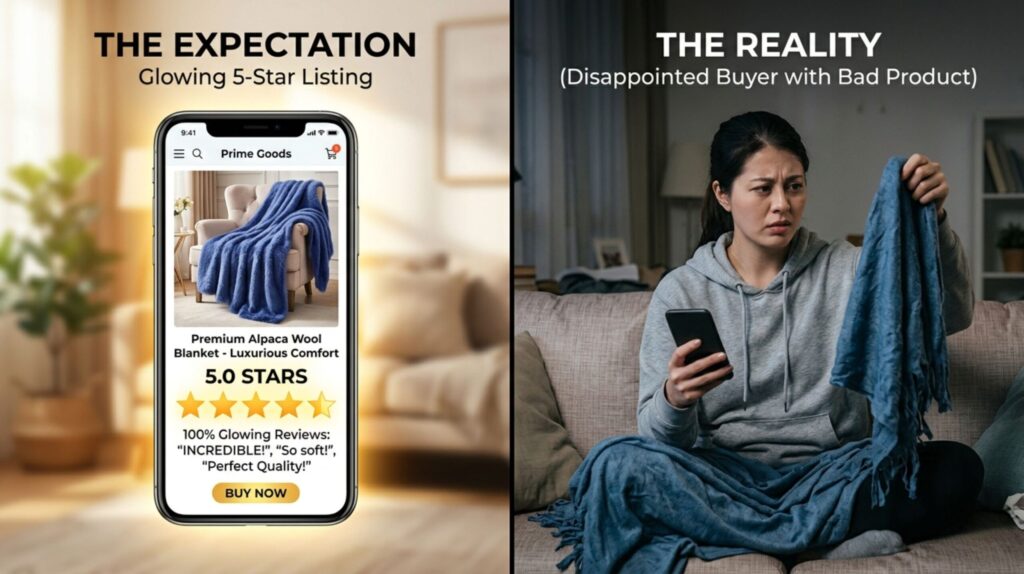
AI-generated product reviews didn’t appear overnight. They’re the result of three forces colliding: cheap AI writing tools, brutal seller competition, and the psychology of social proof.
Here’s how it works. Marketplaces rank products that look trusted. Sellers need trust at scale. Generative AI makes it possible to produce hundreds of convincing, unique-sounding reviews in minutes — for almost nothing.
Unlike the old copy-paste fakes, today’s AI-generated product reviews sound natural. They drop in “personal” details, vary sentence length, and mimic real emotion. That’s what makes them so much harder to catch.
The pattern is clear:
- Cheap generation → dozens of “authentic” reviews posted in bursts
- Ranking pressure → uniform 5-star praise with vague benefits
- Global scale → odd phrasing repeated across regions and languages
Once you understand why AI-generated product reviews spread, the red flags become obvious. The next sections give you the exact signals to look for.
For a deeper look at how platforms quietly shape what you see and trust, explore our Behind the Algorithm hub.
3. Why This Matters to You
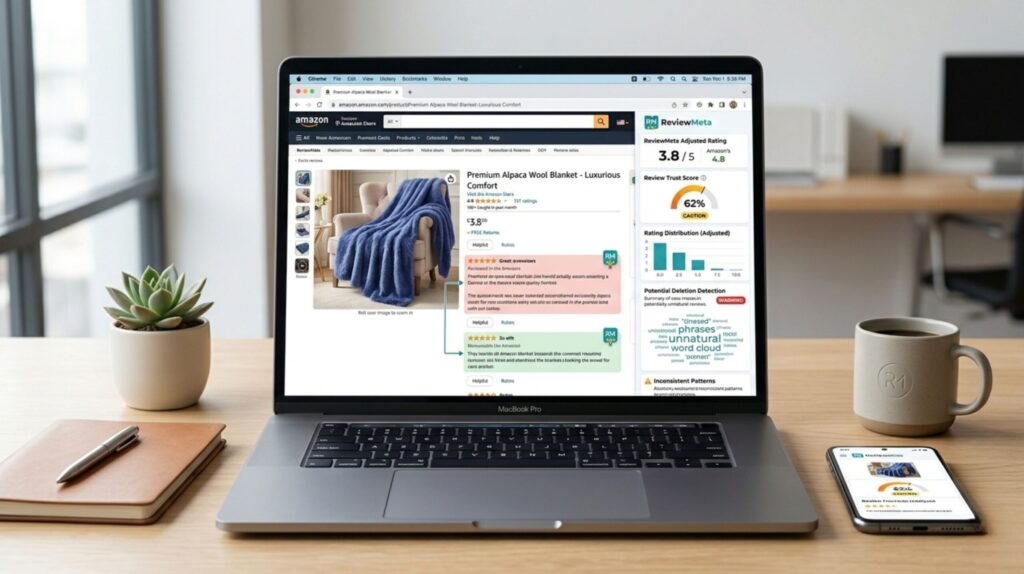
Why should you care? Because AI-generated product reviews don’t just waste your time — they actively cost you money.
When fake reviews inflate star ratings, low-quality products climb rankings while genuinely good alternatives get buried. You end up buying something that underdelivers, dealing with returns, and repeating the whole cycle.
It’s not just about a bad purchase. Consider the real impact:
- Money lost on overhyped products that don’t match the description
- Time wasted on returns, packaging, customer support emails
- Safety risks when health, tech, or kids’ products carry fabricated claims
The simplest defense? Never trust a star rating at face value. Instead, build a quick habit: check the 3-star reviews first (they’re almost always the most balanced), scan reviewer profiles for suspicious patterns, and look for real-life details like usage duration or specific model mentions.
AI-generated product reviews thrive on your trust. The moment you start questioning what you read, their power disappears.
4. 5 Obvious Signs of AI-Written Reviews

AI-generated product reviews aren’t always sophisticated. Most follow predictable patterns that become obvious once you know what to look for.
These are the five red flags that give away even the most polished fakes:
1. Overly generic praise
“This is the best product ever!” with zero specifics. No model name, no feature mention, no usage context. AI-generated product reviews stay vague on purpose — the same text needs to work across dozens of listings.
2. Repeated phrases across reviews
When multiple “different” reviewers use identical sentences like “exceeded all my expectations” or “game-changer for my daily routine,” it signals a batch-generated campaign. Same prompt in, same language out.
3. Perfect grammar but zero personality
Real people use slang, make typos, write half-sentences. AI-generated product reviews read like polished ad copy — technically flawless but completely sterile. If every review on a listing sounds like it was written by the same professional copywriter, that’s the tell.
4. Burst posting
Twenty 5-star reviews appearing within 48 hours on a product that had three reviews last month? That’s not organic growth — it’s a coordinated upload.
5. Vague or mismatched images
Stock-looking photos, overly staged setups, or images that don’t match the product described. Use Google Lens to reverse-search any suspicious review photo — if it appears on unrelated listings, skip that product entirely.
Pro tip: Sort by “Most Recent” and scan the last two weeks. A sudden wave of near-identical praise is the single fastest red flag you can check.
5. 3 Subtle Clues Most People Miss
The obvious fakes are easy. It’s the clever ones that cost you money.
Some AI-generated product reviews pass every surface-level check — they sound human, vary in length, and even include what looks like personal experience. But three subtle patterns still give them away.
1. No emotional arc
Real humans express progression — relief, surprise, hesitation. “I was worried it wouldn’t fit, but after a week it’s perfect” tells a story. AI delivers flat, static enthusiasm: “Amazing product! Love it! Highly recommend!” No before-and-after, no doubt, no earned satisfaction.
2. Praise for packaging over performance
When a review leads with “the box was beautiful” or “instructions were well-designed,” pay attention. AI over-indexes on non-functional attributes because it lacks real usage data. Genuine reviewers focus on whether the product actually works.
3. Recycled phrases across “different” reviewers
This is the most damning clue. Copy a suspicious sentence, paste it into Google with quotes, and see if it appears in other reviews. AI-generated product reviews from the same campaign often share identical fragments across accounts — especially phrases like “exceeded my expectations” or “highly recommend to everyone.”
According to researchers at Stanford’s Digital Trust Lab, AI reviews fail not because they’re poorly written — but because they’re too consistently polished. Real experiences are messy. AI can simulate satisfaction, but it can’t simulate the texture of trial and error.
Pro tip: Open three random 5-star reviews from the same listing. If two or more share the same rhythm and recycled adjectives, you’re likely looking at AI-generated product reviews from the same seller network.
Quick test: If a review could apply to literally any product in the same category without changing a single word — it's almost certainly AI-generated.
6. Free Tools to Spot AI-Generated Reviews

You don’t need to become a detective. A 60-second tool scan can do the heavy lifting and flag AI-generated product reviews before you waste a single euro.
The best part? Every tool below is free — no account required for most. Here’s how to stack them into a fast, reliable workflow.
Your 3-step detection workflow:
Step 1 — Scan the reviews. Paste the product link into ReviewMeta to get an adjusted rating that strips out suspicious patterns. If the adjusted score drops significantly from the listed stars, that’s your signal.
Step 2 — Check the price history. Open Keepa and overlay review count against price. If a flood of 5-star reviews landed right after a steep discount, you’re likely seeing a coordinated campaign behind those AI-generated product reviews.
Step 3 — Verify the photos. Right-click any suspicious review image and search with Google Lens or TinEye. If the same photo appears on unrelated products, it’s fake.
Bonus: Search “product name + reddit” for unfiltered opinions outside the marketplace bubble. Niche subreddits (r/BuyItForLife, r/headphones, r/SkincareAddiction) are goldmines for honest feedback that AI-generated product reviews can’t replicate.
For more free AI tools that don’t even require an account, check out our guide to the best free AI tools with no login required.
7. How to Double-Check a Product Before You Buy
Even after scanning reviews, one final check can save you from a bad purchase. Think of this as your shopping firewall — it takes two minutes and protects your wallet every time.
Check the source first. Go to the brand’s official website and verify the product specs, materials, and pricing. If the listing claims features that the manufacturer doesn’t mention, that’s a red flag — and the glowing reviews backing those claims are likely AI-generated product reviews.
Cross-reference outside the marketplace. Search the exact product name on YouTube for hands-on reviews, and check Reddit threads for real-world complaints. Marketplace reviews exist inside a controlled environment — independent opinions don’t.
Compare the adjusted rating. If you ran ReviewMeta or FakeSpotter in the previous step, compare their adjusted score to the listing’s displayed rating. A product showing 4.8 stars on Amazon but scoring 3.2 adjusted is telling you everything you need to know about the AI-generated product reviews inflating it.
Trust the 3-star reviews. This is worth repeating: balanced reviews with genuine pros and cons are the hardest for AI to fake convincingly. A reviewer who says “great battery but the screen is dim in sunlight” is almost certainly real.
When in doubt, wait 48 hours. Impulse buys are where AI-generated product reviews do the most damage. Sleeping on it gives you time to research properly — and often, the urgency disappears entirely.
Bookmark this checklist. Running through these 5 checks takes less time than processing a return — and saves you far more.
8. How E-Commerce Sites Are Fighting Back
The good news? Platforms know AI-generated product reviews are destroying buyer trust — and they’re investing heavily to fight back.
Amazon now uses machine learning to scan every new review in real time, checking for burst posting, repeated phrases, and suspicious reviewer behavior. In 2024 alone, Amazon reported blocking over 200 million suspected fake reviews before they went live. They’ve also filed lawsuits against fake review brokers to cut the problem at the source.
eBay takes a hybrid approach — automated filters flag potential AI-generated product reviews, then human moderators review edge cases. Accounts linked to large-scale fake review networks are permanently banned.
TripAdvisor has started marking suspicious reviews with visible warning badges. Instead of silently deleting content, they let you see when something looks manipulated — a more transparent approach.
The legal landscape is shifting fast. The FTC’s Consumer Review Rule is now actively enforced, with the first wave of warning letters sent to companies in December 2025. The EU’s Digital Services Act adds another layer of accountability, requiring platforms to prove they’re actively removing fake reviews or face heavy fines.
What this means for you: platform defenses are getting stronger, but they’re not bulletproof. The detection habits you’ve built in this guide are still your best protection — especially on smaller marketplaces where moderation is minimal.
Bottom line: Platform defenses are improving fast — but smaller marketplaces and niche stores still lag behind. Your own detection habits remain the most reliable firewall.
If you want to understand why fake reviews work — and why companies risk everything to manipulate trust — this book explains the psychology and economics behind it. Based on 20 years of Harvard research, it reveals how trust is built, destroyed, and rebuilt across platforms like Amazon. The perfect companion to this guide if you want to think deeper about what's really happening behind those 5-star ratings.
Affiliate link · You support the blog at no extra cost
9. Steps to Protect Yourself While Shopping
You’ve learned the red flags, the tools, and the platform defenses. Now let’s lock it all into a repeatable habit you can run from your phone before every purchase.
The goal isn’t to distrust every review — it’s to build a quick filter that catches AI-generated product reviews before they influence your decision. Six steps, sixty seconds, done.
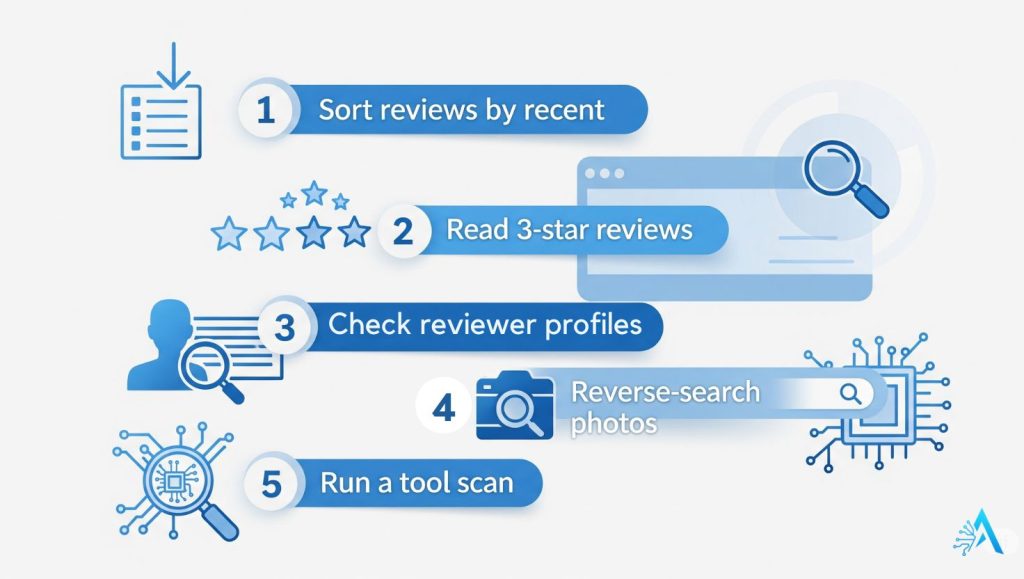
1. Sort by “Most Recent” — a sudden burst of identical 5-star feedback in the last two weeks is the fastest red flag to spot.
2. Read the 3-star reviews first — balanced opinions with real pros and cons are nearly impossible for AI to fake convincingly.
3. Check 3 reviewer profiles — if they’ve reviewed baby food, car parts, and headphones in the same week, you’re looking at a fake network.
4. Look for lived details — usage duration, specific model mentions, unique photos. AI-generated product reviews stay vague because they need to work across multiple listings.
5. Run a 30-second tool scan — paste the link into ReviewMeta or Keepa and compare the adjusted score to the displayed rating.
6. Protect your data too — fake review campaigns don’t just target your wallet. Many track your browsing and purchase behavior to serve you more manipulated listings. Our guide on how to stop AI from reading your private data covers how to shut that down.
That’s it. Six checks, no apps to install, no expertise needed. Do this three times and it becomes automatic — the kind of habit that saves you hundreds over a year.
10. FTC Rules & the Future of AI Review Regulation
The fight against AI-generated product reviews isn’t just a consumer issue anymore — it’s now a legal one.
What’s already in effect. The FTC’s Consumer Review Rule took effect in October 2024, making it illegal to create, buy, or distribute fake reviews — including those generated by AI. Penalties reach up to $53,088 per violation, and they stack. In December 2025, the FTC sent its first wave of warning letters to companies, signaling that the grace period is over.
The FTC has also taken direct action against AI tools enabling the problem. Rytr, an AI writing platform, was charged for providing users with the means to mass-produce fake reviews — some accounts generated tens of thousands of fabricated testimonials.
What’s coming next. The EU’s Digital Services Act now requires platforms to prove they’re actively removing AI-generated product reviews or face heavy fines. Stricter verified-purchase systems and optional identity verification for reviewers are being tested. Expect more visible “suspicious review” badges and adjusted ratings across major marketplaces by late 2026.
What this means for you. Regulation is catching up, but enforcement takes time. The platforms and laws will get better at filtering fakes — but right now, your own detection habits are still faster than any regulation. The six-step checklist you built in this guide works today, regardless of what lawmakers do tomorrow.
The law is moving — but your habits are faster. Regulation will improve over time, but your 60-second checklist works right now, on every platform, in every country.
11. Quick Recap – Your AI Review Detection Toolkit
Here’s everything you’ve learned, compressed into a save-worthy reference you can pull up next time you shop.
Spotting AI-generated product reviews comes down to three layers: recognize the patterns, use the right tools, and verify before you buy. Master those three and you’ll never fall for a fake review again.
The red flags to watch: generic praise with no specifics, burst posting, recycled phrases across reviewers, flat enthusiasm without emotional progression, and praise for packaging over performance.
The tools to use: ReviewMeta for adjusted ratings, Keepa for price-review correlation, Google Lens for image verification, and Reddit for unfiltered real-world opinions.
The habit to build: sort by most recent, read 3-star reviews first, check three profiles, scan for lived details, run one tool check. Sixty seconds. Every purchase.
That’s your complete toolkit against AI-generated product reviews — no expertise required, no apps to install, no cost.
12. Final Thoughts – Shopping Smarter in the Age of AI
AI-generated product reviews aren’t going away. They’re getting cheaper to produce, harder to detect, and more widespread every month. That’s the reality of shopping in 2026.
But here’s what’s changed: you now know exactly how to beat them.
You can spot the patterns — generic praise, burst posting, flat enthusiasm, recycled phrases. You have the tools — ReviewMeta, Keepa, Google Lens. You’ve built the habit — sixty seconds, six steps, every purchase.
The goal was never to distrust every review. It was to develop a filter that separates real experiences from manufactured ones. That filter is now yours.
One last thing: share this guide with someone who shops online. The more people learn to recognize AI-generated product reviews, the less profitable they become for the sellers producing them. That’s how we clean up the review ecosystem — one informed shopper at a time.
Stay curious. Stay skeptical. Keep your wallet safe.
Are AI-generated product reviews illegal?
+Yes. The FTC's Consumer Review Rule, effective since October 2024, bans the creation, purchase, and distribution of fake reviews — including AI-generated product reviews. Violations carry penalties of up to $53,088 per fake review, and the FTC sent its first enforcement warning letters in December 2025.
The EU's Digital Services Act adds further accountability, requiring platforms to actively remove manipulated reviews or face fines. Learn more at the FTC's official Q&A page.
What's the best free tool to detect fake AI reviews?
+ReviewMeta is the most reliable free option for Amazon listings. Paste any product link to get an adjusted rating that filters out suspicious patterns, phrase repetition, and unnatural review velocity.
For price-review correlation (spotting coordinated campaigns), Keepa is our top pick. Combining both gives you the most complete picture in under 60 seconds.
Can Amazon detect AI-generated product reviews?
+Amazon uses machine learning to scan every new review in real time and reported blocking over 200 million suspected fake reviews in 2024 alone. They also pursue legal action against fake review brokers.
However, sophisticated AI-generated product reviews still slip through — especially those using advanced language models that mimic natural writing patterns. Your own detection habits remain the most reliable filter.
How common are fake AI reviews in 2026?
+Research suggests over 38% of verified-purchase reviews on major platforms show linguistic patterns consistent with AI generation. Categories like budget electronics, skincare, and smart home devices are hit the hardest.
The problem is growing because generative AI tools make it possible to produce hundreds of unique, natural-sounding reviews in minutes — for almost no cost.
What's the fastest way to spot a fake review?
+Sort by "Most Recent" and scan the last two weeks. A sudden burst of near-identical 5-star reviews is the single fastest red flag. Then check if the reviews mention specific details — model numbers, usage duration, or unique photos.
AI-generated product reviews stay deliberately vague so the same text can work across multiple listings. If a review could apply to any product in the same category, it's almost certainly fake.
Can I report fake reviews?
+Yes — and you should. Amazon, eBay, Google, and Walmart all have "Report abuse" or "Report review" options. The FTC also encourages consumers to report suspicious reviews directly.
Reporting helps platforms improve their detection systems and contributes to a cleaner review ecosystem for everyone.
Do fake reviews only affect cheap products?
+No. AI-generated product reviews appear across all price ranges and categories — from $10 phone cables to $500 appliances. Premium and mid-range products are increasingly targeted because higher prices mean higher profit margins for sellers willing to invest in fake reviews.
Health supplements, skincare actives, and smart home devices are among the most affected categories, where inflated trust can lead to safety risks.
How do I protect my personal data from fake review campaigns?
+Fake review campaigns often track your browsing and purchase behavior to serve you more manipulated listings. Use privacy-focused browsers, disable personalized ad tracking, and review your data sharing settings regularly.
For a complete walkthrough, see our guide on how to stop AI from reading your private data — it covers the tools and settings that lock down your information.
You’re now better equipped than 90% of online shoppers. Most people never question a 5-star rating — you know exactly how to look behind it. Whether you’re buying a $15 phone case or a $500 appliance, the detection habits you’ve built here will pay for themselves many times over. Bookmark this guide, share it with a friend, and make every purchase a smart one.
📚 Keep Reading on AI Digital Space
Protect yourself further and discover the AI tools worth your money
AI Tool Scams to Watch Out For
Fake reviews are just one piece of the puzzle. Learn how to spot AI tool scams before they cost you money or compromise your data.
Read the Guide → 🛒Best AI Gadgets on Amazon — Tested & Ranked
Now that you can spot fake reviews, here are the AI gadgets that actually deliver — verified by our team, not by bots.
See Our Picks → ⚡Top AI Tools — Curated & Honest Reviews
Browse our full collection of expert-tested AI tools across productivity, creativity, and automation — no fake hype, just real results.
Explore All Tools →