

Streaming subscriptions don't get expensive because one service costs too much. They get expensive because all of them run at the same time, every month, whether you watch or not. I built a free planner with AI to answer one question: how little can you pay and still watch everything you care about?
⚡ Short answer: Keep one service you use every day and rotate the rest, one per month: subscribe, cancel the same day, watch until the paid period ends, then switch. With six typical ad-free plans, that cuts the yearly bill from $1,229 to about $445, a 64% saving, without giving up a single platform.
Some links are affiliate links · they support this site at no extra cost to you · Full disclosure
How Much Do Streaming Subscriptions Cost Now?
The fastest way to see the problem is to put all your streaming subscriptions in one table. Netflix, Disney+, Hulu, Peacock and Apple TV have all raised prices in the last twelve months, and most ad-free tiers now sit between $18 and $22 a month.
| Service | With ads | Ad-free | Top tier |
|---|---|---|---|
| Netflix | $8.99 | $19.99 Standard | $26.99 Premium |
| Disney+ | $12.49 | $21.49 Premium | — |
| Hulu | $12.49 | $21.49 Premium | — |
| Disney+ & Hulu bundle | $12.99 | $21.99 | — |
| HBO Max | $10.99 Basic | $18.49 Standard | $22.99 Premium |
| Prime Video (standalone) | $8.99 | $13.98 with Ultra | — |
| Peacock | $8.99 Select · $12.99 Premium | $19.99 Premium Plus | — |
| Paramount+ | $8.99 Essential | $13.99 Premium | — |
| Apple TV | — | $14.99 | — |
Monthly US prices before tax, checked October 2, 2026. Existing subscribers may see new prices on their next bill. Amazon Prime ($14.99/month) already includes Prime Video with ads. Lineups and prices differ in the EU, UK and other regions; Peacock, for example, isn't sold in most of Europe.
Now add it up. Keeping seven big streaming subscriptions on their ad-free tiers (Netflix Standard, the Disney+ & Hulu bundle, HBO Max Standard, Prime Video with Ultra, Peacock Premium Plus, Paramount+ Premium and Apple TV) costs $123.42 a month, or $1,481 a year. Nobody watches seven platforms at once, yet that's what stacked streaming subscriptions charge you for.
Free Streaming Rotation Planner: Your 12-Month Plan
Tick the streaming subscriptions you pay for, pick your plan, and choose whether each one stays all year or joins the rotation. The planner shows what you spend today, builds a month-by-month calendar, and tells you exactly which streaming subscriptions to start and cancel each month. It runs in your browser; nothing you enter is sent anywhere.
🗓️ Streaming Rotation Planner
Your streaming subscriptions → your yearly plan. Prices last checked October 2, 2026 (US).
Reminders land in Google Calendar, Apple Calendar or Outlook as one event per switch day. Prices change often: check the sign-up screen before you pay.
How Does Rotating Streaming Subscriptions Save Money?
Rotating streaming subscriptions works because shows arrive in seasons, not every day. A new season of your favorite drama lands, you watch it in two or three weeks, and then the service sits idle until the next one. Paying for that idle time is where streaming subscriptions leak money.
Here is the plan the planner builds from a common stack of six streaming subscriptions:
| Approach | Monthly | Per year | Saving |
|---|---|---|---|
| All six on, every month | $102.44 | $1,229.28 | — |
| Netflix all year + rotate 5, one at a time | ~$37 avg | $445.26 | $784.02 (64%) |
| Rotate all 6, one at a time | ~$17 avg | $204.88 | $1,024.40 (83%) |
Stack: Netflix Standard, Disney+ & Hulu bundle (no ads), HBO Max Standard, Peacock Premium, Paramount+ Premium, Apple TV. My own calculation from the prices above.
The trade-off is timing, not access to your streaming subscriptions. You still watch every platform at least twice a year; you just watch them in turns. If two services matter to you at the same time, set the planner to 2 at a time and on the stack above you still save about two-thirds.
How Do I Rotate Streaming Subscriptions Without Missing My Shows?
A plan for your streaming subscriptions only saves money if you follow it. These are the rules I use, in the order they matter.
- Cancel the same day you subscribe. On Netflix, canceling with time left in your billing period still lets you watch until that period ends, per Netflix's own help page. You get the full month and nothing renews by surprise. Check the end date on the cancellation screen of every other service before you close it.
- Start the next service on the day the last one expires. The planner's calendar file adds a reminder for every switch, so you never pay for two by accident.
- Binge when a season is complete. Weekly shows trickle out over two months. Join when the finale is out and watch it all in one paid month.
- Keep a watchlist outside the apps. A note on your phone with "show · service · when it's complete" tells you which platform deserves next month.
- Pick the bundle over two singles. Disney+ and Hulu cost $24.98 a month separately with ads, or $12.99 together. The planner flags this if you tick both.
- Mind free trials in app stores. Apple tells subscribers to cancel a trial at least 24 hours before it ends, so set your reminder a day early.
- Pay with one card. One card for all streaming subscriptions makes one line on your statement to check each month.
Your profile survives the gap. Netflix keeps your viewing activity, recommendations and ratings for 24 months after your account closes, so rejoining picks up where you left off.
Which Streaming Service Should I Keep All Year?
Most households have one platform they open almost every evening, and that's the one of your streaming subscriptions to protect. That one earns a permanent slot; everything else rotates. Here is how I would pick it:
Choose your keeper by daily habit
Choose Netflix if several people in your home watch different things every night; it gives the most titles per dollar in Reelgood's value tracking. Choose the Disney+ & Hulu bundle if you have kids or follow next-day network TV; at $12.99 with ads it's two services for the price of one. Choose Prime Video if you already pay for Amazon Prime for shipping, because then it costs you nothing extra.
Pay yearly only for the keeper
Annual billing saves money only on a service you keep twelve months. HBO Max Standard costs $184.99 a year instead of $221.88 on monthly billing; Peacock Premium is $129.99 instead of $155.88. Never pay yearly for streaming subscriptions in your rotation; you'd be prepaying the idle months you're trying to avoid.
How I Built This Streaming Planner with AI
I'm not a developer. I described the problem to Claude AI in plain English: list my services, let me mark keepers, spread the rest over twelve months, and give me reminders. It wrote the rotation logic, the month calendar and the calendar-file export, and I checked each output against my own spreadsheet until the totals matched to the cent.
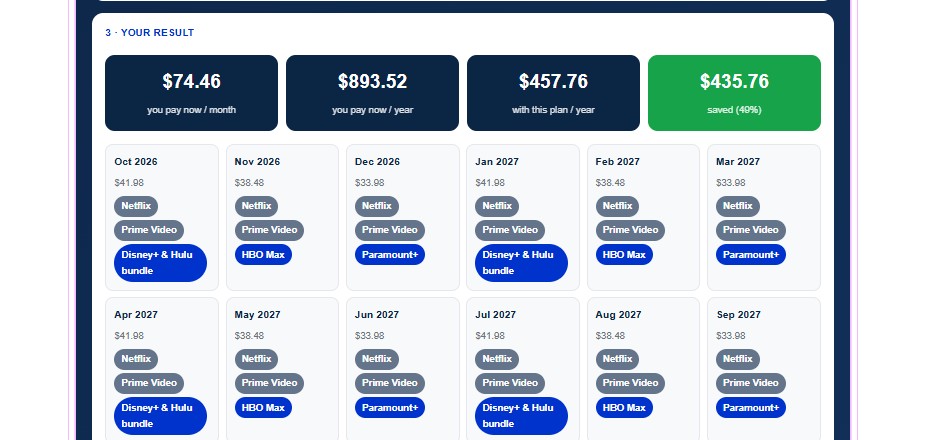
The AI did not pick the prices. Every number in the planner comes from a vendor page I checked by hand, because AI models can be confidently wrong about prices that change every few months. That split works well for everyday money management: let AI build the tool, and keep the facts under your own control.
You can use the same approach on any recurring cost, not only streaming subscriptions. Ask an assistant to list every charge on last month's card statement, flag the subscriptions, and total them per year. I walk through a spreadsheet version of this in my Copilot Excel expense tracker guide, and the AI subscription cost calculator does the same for AI tools.
Frequently Asked Questions — Streaming Subscriptions
Is it allowed to cancel and resubscribe to streaming services?
+Do I lose my watch history if I cancel Netflix?
+Does canceling right after subscribing end my access?
+Will I lose my price if I cancel a streaming subscription?
+What is the cheapest way to get Disney+ and Hulu?
+How many streaming services should I keep at once?
+Should I rotate Amazon Prime Video?
+How was this streaming planner built with AI?
+Streaming subscriptions are rarely the only bills running in the background. These help you find the others.