Mirko
AI Tech Writer
For three years, "best AI voice generator" had one right answer: ElevenLabs. Then in mid-2025 Fish Audio's OpenAudio S1 model ranked #1 on TTS-Arena2 — the community-blind quality leaderboard ElevenLabs used to dominate. I've spent time inside both in 2026. Here's what actually holds up when you get past the leaderboard headline.
Some links are affiliate links · they support this site at no extra cost to you · Full disclosure
Why Fish Audio Changed the ElevenLabs Comparison
The ElevenLabs vs Fish Audio question wouldn't have existed 18 months ago. ElevenLabs owned the top of the AI voice space so completely that "best TTS platform" and "ElevenLabs" were basically the same sentence. Then Fish Audio's OpenAudio S1 model launched in June 2025 and ranked #1 on TTS-Arena2 — the community-blind listening benchmark where users vote on which voice sounds more human without knowing which platform generated it.
That's not a marketing claim. It's a leaderboard result on an independent evaluation. Independent testing also documents a word error rate of 0.008 on English text for Fish Audio — lower than most competing TTS engines on the same benchmark. In under a year, the ElevenLabs vs Fish Audio comparison shifted from "is there really a challenger?" to a genuine tradeoff decision.
If you're still comparing ElevenLabs to whatever the "premium alternative" was in 2024, you're solving a problem that no longer exists. The real 2026 ElevenLabs vs Fish Audio question is whether the open-model challenger is worth switching to.
My take after actually using both: the leaderboard headline is real, but it doesn't tell the full story. There are cases where ElevenLabs still clearly wins — and cases where Fish Audio's advantages compound into a different tool entirely. This post walks the ElevenLabs vs Fish Audio decision through real testing rather than headline reads.
ElevenLabs in 2026: v3, Flash, and What Ships Now
ElevenLabs released Eleven v3 to general availability on March 14, 2026. Headline features: 74-language support, an Audio Tags system for inline emotional direction ([sighs], [whispers], [laughs]), and a documented 68% reduction in complex-text errors over previous models. In the ElevenLabs vs Fish Audio comparison, this is what ElevenLabs is bringing to the table.
The tradeoff most posts skip
v3 uses a larger model with a higher-fidelity codec — which means better quality and no real-time streaming. For any conversational agent, live dubbing, or interactive gaming use case, the fallback is Flash v2.5, which generates in under 75ms but covers only 32 languages and drops emotional range noticeably. In my testing, the expressive gap between v3 and Flash was audible within the first 20 seconds of the same script.
Where ElevenLabs still leads outright
Ecosystem maturity. Instant Voice Cloning ships from the $5 Starter tier. Professional Voice Cloning, projects for long-form editing, and enterprise SLAs all sit under one polished platform. For anyone weighing ElevenLabs vs Fish Audio where production tooling matters as much as the voice model, ElevenLabs is still the safer commercial pick. My complete ElevenLabs walkthrough covers setup end-to-end.
Fish Audio in 2026: The Open-Model Contender
Fish Audio is built by Hanabi AI, founded by Shijia Liao — the same person behind the open-source voice models So-VITS-SVC, GPT-SoVITS, and Bert-VITS2. That heritage matters in the ElevenLabs vs Fish Audio conversation. The flagship OpenAudio S1 and S2 Pro models are trained on 2 million hours of audio and open-sourced on GitHub. You can self-host them if you want to.
What makes it different from ElevenLabs
Three things: a 2M+ voice community library you can pull from without cloning, 15-second voice cloning (versus ElevenLabs' 1-minute sample requirement), and emotion tags like [angry], [sad], [whispering] that work similarly to ElevenLabs' Audio Tags. The community library alone is a genuinely different value proposition — you're not limited to what one platform's team recorded. That's what makes the ElevenLabs vs Fish Audio question genuinely open in 2026 rather than settled.
Fish Audio's advantage isn't that it's cheaper. It's that it's genuinely different — open models, faster cloning, community library, and 11x lower API costs at scale.
What it doesn't have
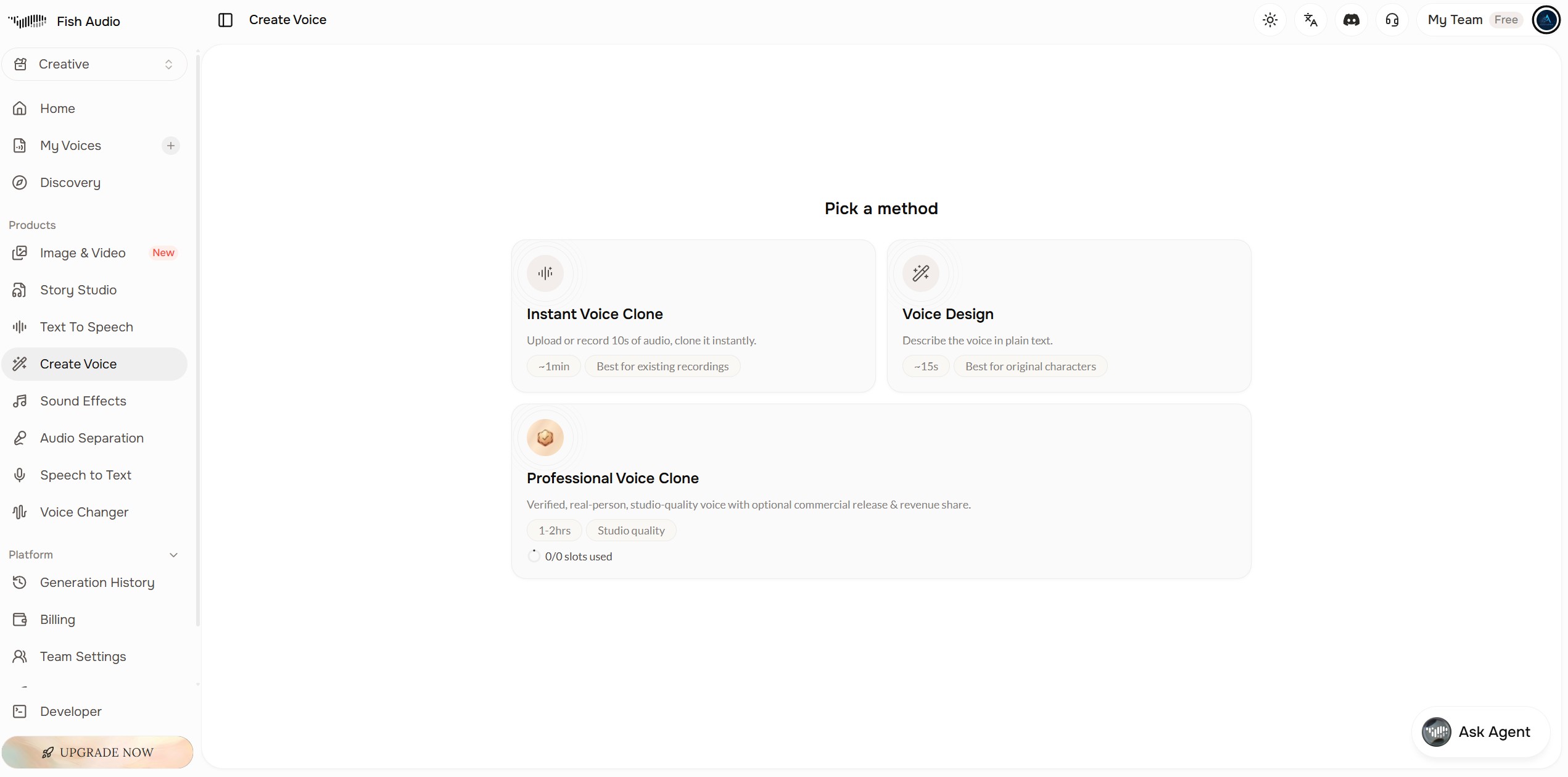
A polished studio interface. The fish.audio web app works but skews basic — for serious production workflows you'll want to use the API directly. Also worth naming in any honest ElevenLabs vs Fish Audio comparison: Fish Audio is a fast-growing company but not a $330M ARR operation like ElevenLabs. Vendor risk matters if you're building critical infrastructure on it (the open-source model partially offsets this).
Voice Quality & Multilingual: What I Heard in Testing
I ran identical 200-word scripts through Eleven v3, ElevenLabs' Multilingual v2, and Fish Audio's S2 Pro. Three passages: a calm documentary line, an emotional monologue, and a fast conversational exchange in English, plus one Spanish and one Italian test. This is where the ElevenLabs vs Fish Audio quality gap actually gets measurable, not just claimed.
"ElevenLabs always sounds more human than the alternatives — quality gap is huge."
On calm and conversational passages, Fish Audio S2 Pro was indistinguishable from Eleven v3 to my ear. The gap only opens on high-emotion content.
Where Fish Audio genuinely surprised me
On the calm documentary line and the conversational exchange, Fish Audio S2 Pro was indistinguishable from Eleven v3 to my ear. The #1 TTS-Arena2 ranking held up on the material I tested. On the Italian passage, Fish Audio actually had less English-accent bleed than ElevenLabs' default Italian voice — a known ElevenLabs limitation where training-data bias carries English pronunciation into other languages. Fish Audio wins
Where ElevenLabs still edges ahead
The emotional monologue. Eleven v3's Audio Tags let me place a [sighs] mid-sentence and the model handled the transition without breaking pacing. Fish Audio's emotion tags worked but the emotional depth on the same passage sat one notch below. If your content leans hard on dramatic delivery, ElevenLabs still has the edge — smaller than the marketing suggests, but real. ElevenLabs wins
In my ElevenLabs vs Fish Audio testing, the quality gap that used to define this comparison has quietly collapsed for most everyday content. What's left is a narrower question about emotional performance.
One thing I couldn't fully verify: whether the quality parity holds across every voice in each platform's library. I tested flagship voices on both. Your mileage may vary on less-featured voices — test the specific voice you'll actually use before committing.
Voice Cloning: 60 Seconds vs 15 Seconds
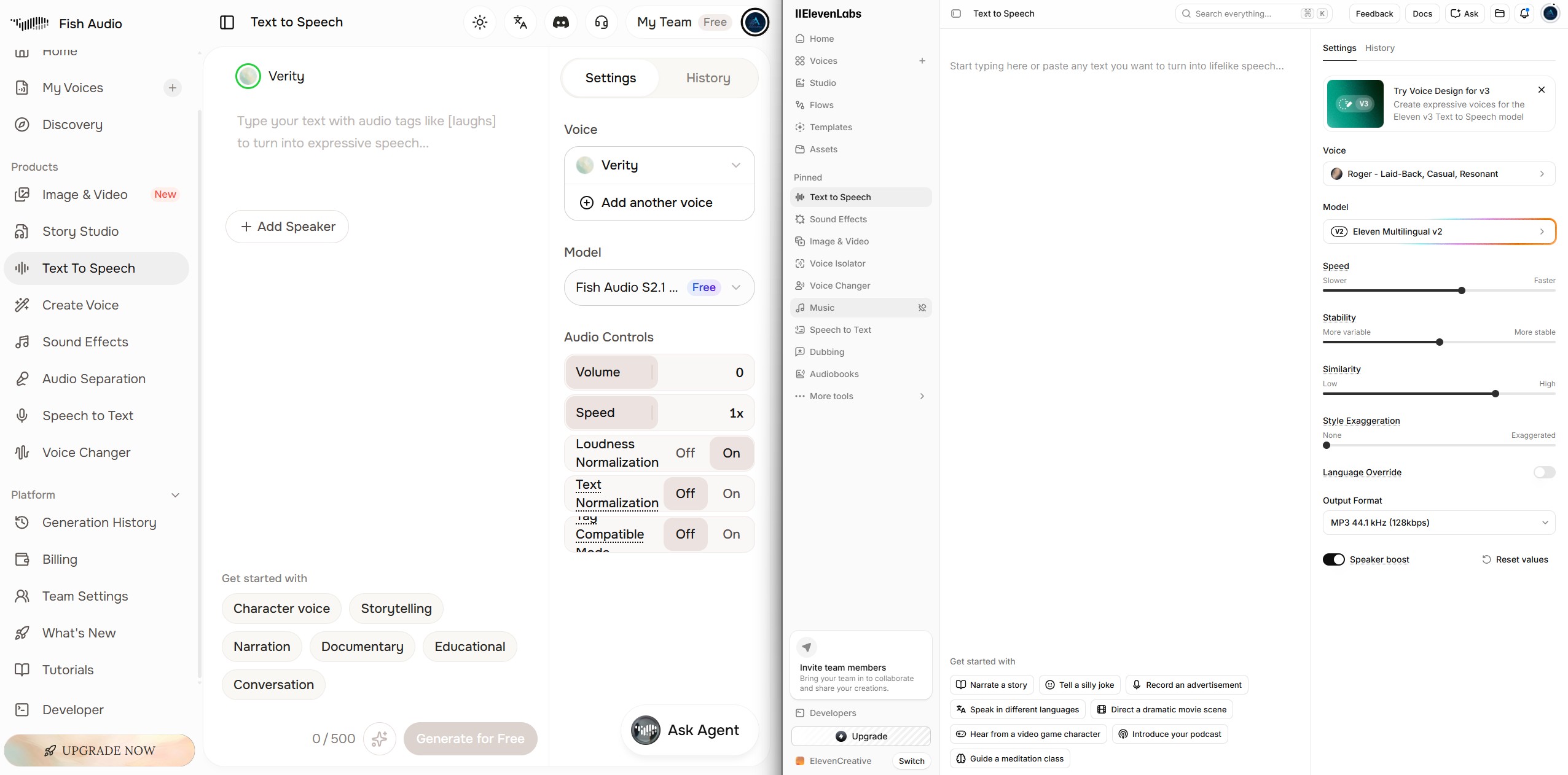
This is where the two platforms diverge most concretely in the ElevenLabs vs Fish Audio comparison. ElevenLabs Instant Voice Cloning asks for roughly a 1-minute sample and processes in 2–5 minutes. Fish Audio clones from as little as 15 seconds and returns a usable custom voice in around 22 seconds by independent testing.
What I heard when I cloned my own voice on both
Same 60-second recording fed into ElevenLabs at the Starter tier and a 15-second slice of it fed into Fish Audio. ElevenLabs' clone caught a slight rasp in my delivery and held identity through longer emotional passages. Fish Audio's clone from a quarter of the audio was remarkably close — recognizable as me, natural pacing, though slightly smoother than the source. For most creator use cases (voiceovers, product explainers, YouTube narration) the difference wouldn't matter.
The practical implication
If you have limited source audio — a short interview clip, a brief video snippet, a single podcast intro — Fish Audio actually gives you the option to clone that ElevenLabs technically wouldn't. That's not just a speed win in the ElevenLabs vs Fish Audio comparison; it's a different capability. For safeguarding against misuse of this exact capability, my post on AI voice cloning scams covers the warning signs both platforms warn users about.
Latency & Real-Time Use
For real-time voice agents or conversational AI, the choice inside each platform matters more than the choice between them. In the ElevenLabs vs Fish Audio latency comparison, model selection drives the answer, not brand.
ElevenLabs for real-time
Flash v2.5 generates in under 75ms. Business tier adds sub-200ms low-latency TTS at roughly 5 cents per minute. Eleven v3, the highest-quality model, does not support real-time streaming — documented directly by ElevenLabs.
Fish Audio for real-time
Fish Audio's streaming API is genuinely fast, though I couldn't find a published TTFB number as consistently cited as ElevenLabs' 75ms figure. The pricing advantage compounds here: at 11x lower API cost than ElevenLabs on Fish Audio's S2 Pro endpoint, voice-agent teams building on LiveKit, Twilio, or Pipecat can afford much higher volumes at the same monthly spend.
Pricing: The Real Cost Per Minute (Aug 2026)
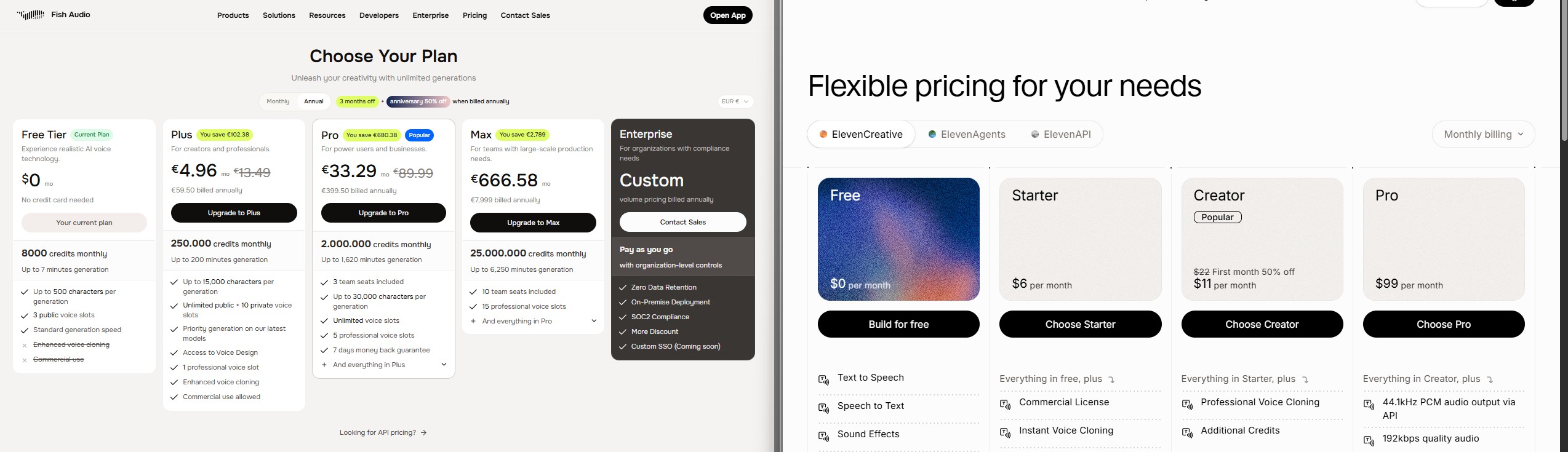
Both platforms restructured pricing in the past year. ElevenLabs added a Business tier in the November 2025 reshuffle. Fish Audio maintains a much simpler four-tier structure. Here's the ElevenLabs vs Fish Audio price comparison as of August 2026.
| Tier | ElevenLabs | Fish Audio |
|---|---|---|
| Free | $0 · 10k credits/mo · no commercial use | $0 · 8k credits/mo (~7 min) · no commercial use · 500 char/gen cap |
| Entry paid | Starter: $5/mo 🏆 · 30k chars · Instant Voice Cloning · commercial use | Plus: $15/mo · 250k credits (~200 min) · commercial use · 10 private clones |
| Most popular | Creator: $22/mo ($11 first month) · 100k chars · Professional Voice Cloning | Plus tier covers most creator use cases 🏆 |
| Pro tier | Pro: $99/mo · 500k chars · 10 concurrent requests | Pro: $100/mo · 2M credits · 3 team seats |
| Enterprise | Scale: $299/mo · Business: $990/mo · Enterprise custom | Max: ~$749/mo · Enterprise custom (SOC 2, on-prem) |
| API rate | ~$0.05 per 1k chars (Flash) · ~$0.10 per 1k (Multilingual) | ~$15 per 1M UTF-8 bytes 🏆 · ~11x cheaper at scale |
Both platforms adjust pricing periodically. Verify current numbers on the official ElevenLabs pricing page and Fish Audio's plan page before subscribing.
The ElevenLabs vs Fish Audio cost analysis flips depending on volume: ElevenLabs wins the entry tier, Fish Audio wins at scale, and the API gap becomes decisive above 500k characters/month.
The cost-per-finished-minute math strongly favors Fish Audio at API scale — this is where the 11x figure comes from. For studio use (web interface, single-user creator workflows), ElevenLabs' Starter tier at $5 is actually cheaper than Fish Audio's $15 Plus, but caps you at 30k characters without commercial cloning parity.
Ethics, Safety & Commercial Rights
Voice AI's downside is real. Scammers are actively using cloned voices to impersonate family members in urgent phone calls, and both platforms have had to build guardrails around consent and misuse. In the ElevenLabs vs Fish Audio safety comparison, the approaches differ meaningfully.
ElevenLabs
Built-in AI-speech classifier to detect ElevenLabs-generated audio, audio watermarking, and consent verification required for professional voice cloning. Moderation features flag attempts to generate impersonation or harmful content. Per official ElevenLabs documentation, these safeguards run across all tiers.
Fish Audio
Requires proof of rights for commercial use of cloned voices — if you clone a voice for a client project, they enforce that you have written permission. The free tier is explicitly restricted to personal, non-commercial use; publishing free-tier audio to a monetized YouTube channel or client deliverable puts you outside terms of service. Less built-in detection tech than ElevenLabs, but tighter licensing enforcement.
Rule regardless of platform: Get explicit consent before cloning anyone's voice. Label AI-generated content clearly. Never use synthetic voices to impersonate, mislead, or defraud. The platforms give you the tools; the responsibility for how they're used lives with you.
Verdict: Choose ElevenLabs If, Choose Fish Audio If
After the testing and the pricing math, the ElevenLabs vs Fish Audio decision splits cleanly along what you're actually building. There's no universal winner — the platforms are increasingly optimized for different jobs.
Choose ElevenLabs if…
- Emotional depth on dramatic content is critical
- You need real-time voice agents (Flash v2.5, sub-75ms)
- Ecosystem maturity and studio tooling matter to you
- You want the safest commercial vendor (SLAs, enterprise support)
- Budget can absorb $22–$99/mo for polish
Choose Fish Audio if…
- You have short source audio for cloning (15s vs 60s)
- API cost at scale is a deciding factor (11x cheaper)
- You want access to a 2M+ community voice library
- Self-hosting an open model is a real option for you
- Non-English languages are core to your content
A pattern I've seen in creator workflows: use ElevenLabs for polished commercial deliverables (client work, published audiobooks, brand videos) and Fish Audio for high-volume production or multilingual work where cost and cloning speed compound. That's the same "right tool per job" pattern from my broader best AI voice replication tools roundup, and it holds up in the ElevenLabs vs Fish Audio pair too.
The 2026 ElevenLabs vs Fish Audio story isn't ElevenLabs losing — it's that Fish Audio genuinely arrived. The right pick is now a real question, not a default.
Frequently Asked Questions — ElevenLabs vs Fish Audio
The eight questions I get asked most about the ElevenLabs vs Fish Audio comparison, answered from actual testing rather than marketing copy.
Is Fish Audio actually better than ElevenLabs in 2026?
On the TTS-Arena2 community-blind leaderboard, Fish Audio's OpenAudio S1 ranks #1 for naturalness. In my testing on calm and conversational passages, S2 Pro was indistinguishable from Eleven v3 to my ear.
ElevenLabs still edges ahead on dramatic emotional content — where Audio Tags carry more weight than Fish Audio's emotion tags. Small gap in the ElevenLabs vs Fish Audio quality comparison, but real.
How much cheaper is Fish Audio compared to ElevenLabs?
At the API level, Fish Audio's S2 Pro runs roughly 11x cheaper than ElevenLabs' Multilingual models per character generated.
On subscriptions, ElevenLabs Starter at $5/mo undercuts Fish Audio Plus at $15/mo — but caps character volume tighter and offers less generous cloning.
Can I clone my voice on Fish Audio faster than on ElevenLabs?
Yes. Fish Audio requires just 15 seconds of source audio and returns a usable clone in around 22 seconds. ElevenLabs Instant Voice Cloning asks for a 1-minute sample and processes in 2–5 minutes.
If you have limited source audio — a short interview clip, a brief podcast intro — Fish Audio may be your only real option.
Which is better for real-time voice agents?
ElevenLabs Flash v2.5 generates under 75ms and is the recommended real-time option in the ElevenLabs ecosystem.
Fish Audio's streaming API is fast and aggressively priced — attractive for voice-agent builds on LiveKit, Twilio, or Pipecat where per-request cost compounds quickly.
Is Fish Audio really open source?
The core models — Fish Speech, OpenAudio S1, and S2 — are available on GitHub and can be self-hosted. The commercial platform at fish.audio wraps those models with a cloud API, voice library, and cloning tools.
That gives you a real fallback if the commercial service ever changes terms — something ElevenLabs users don't have.
How many languages does each platform support?
ElevenLabs Eleven v3 supports 74 languages; Flash v2.5 covers 32. Fish Audio supports around 83 languages via S2 Pro.
For both platforms, only a subset of advertised languages hits truly native-sounding quality. Always test with a 15-second render in your target language before committing.
Which is better for YouTube voiceovers?
For polished storytelling channels, ElevenLabs' emotional depth is worth the higher cost. For high-volume faceless channels or multilingual content, Fish Audio's cheaper per-minute cost and faster cloning win.
Test the same 60-second script through both before committing at scale. My Best AI Voice Generator for YouTube guide covers when a different tier fits better.
Can I use both platforms for commercial projects?
Yes, on paid tiers. ElevenLabs unlocks commercial use from the $5 Starter tier. Fish Audio unlocks it from the $15 Plus plan — the free tier is explicitly non-commercial.
Both platforms require proof of rights before you commercially deploy a cloned voice. Publishing free-tier audio to a monetized YouTube channel or client project puts you outside their terms.
🎙️ Go Deeper on AI Voice
With the ElevenLabs vs Fish Audio pick sorted, here's where I'd go next in the voice AI space — a broader comparison, a full ElevenLabs walkthrough, and the wider cloning landscape: