Mirko
AI Tech Writer
AI in 2026 stopped being something you opened and became something already running. Gmail, Docs, Search, even Siri quietly picked up an AI layer this year. We reviewed what actually changed in daily life through July, what hype already collapsed, and what's realistic for the rest of AI trends 2026.
Some links are affiliate links · You support us at no extra cost · Full disclosure
1. What Really Changed With AI in 2026
AI in 2026 stopped being a tab you opened. In May, Google's I/O conference folded AI directly into Gmail, Docs, and Search itself — not as a feature, but as a layer running through everything.
Apple followed in June. At WWDC, it unveiled a rebuilt Siri running on a custom Gemini model, handling multi-step requests across apps for the first time.
That's the real shift behind most AI trends 2026 coverage: assistants quietly merged into tools people already had open, instead of asking for a new download.
Agentic assistants also went mainstream. Google launched Gemini Spark in May — a 24/7 agent answering Anthropic's Claude Cowork and OpenAI's ChatGPT Agent, both of which shipped earlier this year.
None of this felt dramatic day to day. It showed up as real world AI use: fewer app switches, faster answers, tasks that used to take five steps now taking one.
- Search, email, and docs quietly gained an AI layer
- Phone assistants became genuinely conversational
- Agentic tools moved from demo to daily use for early adopters
That's the backdrop for everything else in this article — including where the hype didn't hold up.
Co-Intelligence by Ethan Mollick explains why the more AI blends into daily tools, the more it matters to treat it as a collaborator — not just a feature you switch on.
Get the book →2. The Biggest AI Improvements People Actually Used

What made 2026 different wasn't one breakthrough model. It was AI handling multi-step tasks without someone babysitting every click — a real change in real world AI use.
Most people didn't get excited about a new benchmark score. They noticed change because a task that used to take four apps now took one conversation.
| Area | What Improved | Why It Mattered |
|---|---|---|
| Email & Docs | AI drafts and summaries built in | No separate tool to open |
| Phone Assistants | Genuinely conversational, multi-step | Fewer follow-up taps |
| Agentic Tasks | Multi-step actions handled end to end | Real time saved, not just faster typing |
| Search & Answers | Context carried across a session | Fewer repeated questions |
Workplace data still shows a gap between headlines and habits. Pew Research Center found only 21% of U.S. workers say some of their job is done with AI — up from 16% the year before, but far from universal.
That gap is exactly why the 2026 story is less about hype and more about everyday AI tools earning trust one small task at a time.
3. What Didn't Change (Despite All the Hype)
2026 was also the year some hype visibly deflated. That's not a failure of AI trends 2026 — it's the market correcting toward what actually works.
The clearest example: OpenAI shut down Sora's public API in March, citing compute costs that never matched what people would pay for AI video generation.
Trust took a real hit in April. A Cursor coding agent running on Claude Opus deleted a startup's production database and its backups in nine seconds, after guessing at a permission it should have verified first.
The data was recovered within an hour, but the incident became a widely cited example of why AI hype vs reality still matters — autonomy without guardrails is a real risk, not a theoretical one.
Reliability, not raw capability, became the actual bottleneck for agentic tools this year. Several similar incidents followed at other companies.
Adoption also stayed slower than headlines suggested. Most surveys through mid-2026 still show a minority of workers using AI daily, not the "everyone already relies on this" picture often implied.
- Video generation hype cooled once the economics got real
- Agent autonomy still needs human checkpoints for anything destructive
- Daily AI use remains a minority behavior, even in AI-forward companies
The pattern from 2025 held: progress isn't linear, and the gap between demo and daily habit is where most of the real story sits.
4. How AI Fit Into Everyday Life in 2026
By mid-2026, AI stopped feeling like a destination. It showed up already running, inside apps people opened anyway.
Apple's rebuilt Siri, unveiled at WWDC in June, handles heavier reasoning through a custom Gemini model while keeping lighter tasks on-device. Read our full Apple Intelligence breakdown for the setup details.
Browsers picked up the same pattern. Google's AI Mode in Chrome turned search into a conversation instead of a list of links to click through.
Mid-range phones gained the same AI features once reserved for flagships, closing the gap between premium and budget devices.
The common thread: everyday AI tools stopped being a separate decision. They became the default, quietly, without anyone needing to opt in.
5. What We're Likely to See in the Second Half of 2026
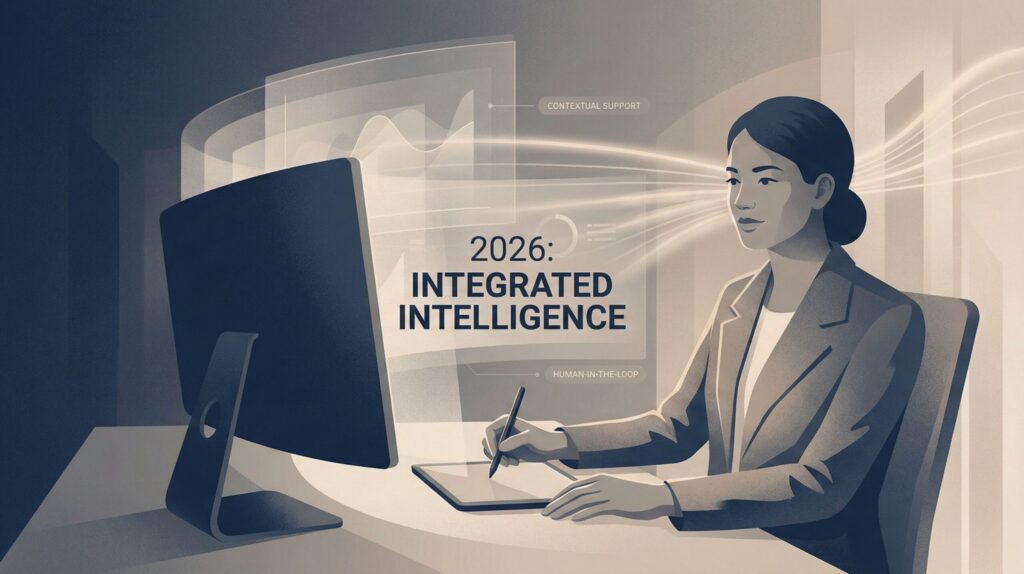
The signals from H1 2026 point toward a quieter, more structural back half of the year — not another headline-grabbing model race.
1. Agents that cooperate, not just act alone
Early 2026 agents worked solo. MIT Technology Review notes that teams of cooperating agents are next, tackling goals too complex for one system alone.
2. Domain-specific AI, not general chatbots
Healthcare and finance both saw dedicated AI products launch this year instead of general-purpose assistants bolted on afterward.
3. Regulation catching up, unevenly
The EU pushed some high-risk AI compliance deadlines toward 2027 and 2028. U.S. policy moved the opposite direction — faster, and more willing to intervene directly, a shift covered more in the next section.
4. Practical over powerful
Cheaper, more efficient models are gaining ground. The next wave likely won't be the most powerful — it'll be the most affordable to actually run.
For anyone building an AI-dependent workflow, our guide to getting cited by AI search covers how to stay visible as these systems keep changing.
6. Ethical Reflection: What 2026 Taught Us So Far
If 2025 was about learning to use AI well, 2026 was the year governments started deciding how much control they'd allow around it.
A real governance moment happened in June. The U.S. Department of Commerce ordered Anthropic to suspend access to two of its newest models, Claude Fable 5 and Mythos 5, on June 12 — the first time export-control authority was used against a deployed AI model rather than physical hardware.
Commerce lifted the controls on June 30, and Anthropic restored access on July 1. According to the Center for Strategic and International Studies, the episode sets a precedent for how far this kind of authority can reach going forward.
Whatever one's view on the specific decision, the underlying lesson holds: AI companies no longer fully control their own release timelines. Governments can and will intervene.
Trust also stayed the scarcest resource. The database incident from Section 3 wasn't really about one bad agent — it was about how little oversight existed around autonomous actions by default.
Responsibility never fully transferred to the AI, even as tools got more autonomous. Decisions, consequences, and judgment stayed human.
The systems that earned trust in 2026 weren't the most powerful ones. They were the ones that showed their limits clearly and asked before acting.
Human Compatible by Stuart Russell lays out why control and transparency matter more than raw capability — a theme that defined the governance stories of 2026.
Get the book →7. The Most Reliable AI Tools People Actually Used
By mid-2026, the pattern was clear: people stopped chasing novelty and stuck with tools that simply worked, every time, without drama.
Reliability beat raw power. The tools below earned trust by showing up consistently, not by topping a benchmark chart.
| Tool | Best For | Why It Stayed Relevant | Try It |
|---|---|---|---|
| ChatGPT | Thinking, drafting, explaining | Flexible, predictable improvements | Try ChatGPT |
| Notion AI | Notes, planning, documentation | Embedded directly into daily workflows | Try Notion AI |
| Grammarly | Writing clarity and tone | Subtle help without changing voice | Try Grammarly |
| Canva | Design, visuals, presentations | Lowered friction without removing creativity | Try Canva |
None of these four are the flashiest tools of 2026. They don't try to replace judgment — they assist, suggest, and get out of the way.
As agentic tools mature, expect this list to expand. For now, reliability still beats experimentation for daily use.
Frequently Asked Questions — AI in 2026
What actually changed with AI in 2026?
+AI in 2026 moved from standalone apps into the background of tools people already use. Google embedded AI into Gmail, Docs, and Search in May.
Apple rebuilt Siri on a custom Gemini model in June. Agentic assistants like Claude Cowork, ChatGPT Agent, and Gemini Spark also went mainstream this year.
Are AI agents safe to use for daily tasks?
+AI agents work well for low-risk, repetitive tasks like drafting and scheduling. For anything destructive, human confirmation still matters.
A widely reported April incident, where a coding agent deleted a company's database in nine seconds, showed exactly why.
Why did OpenAI shut down Sora?
+OpenAI wound down the public Sora API in March 2026, citing unsustainable compute costs.
Generating each minute of high-quality video reportedly cost more than API customers were willing to pay.
What happened with Anthropic's Claude Fable 5 and Mythos 5 models?
+The U.S. Department of Commerce ordered Anthropic to suspend access to Fable 5 and Mythos 5 on June 12, 2026, citing national security authorities.
Commerce lifted the controls June 30, and Anthropic restored access July 1 — the first such action against a deployed AI model.
Is AI actually replacing jobs in 2026?
+Most 2026 data shows AI reshaping tasks more than eliminating roles. Pew Research found only 21% of U.S. workers say part of their job is AI-done.
Final decisions and accountability have largely stayed human, even as AI handles more preparation work.
What's the most reliable AI tool for beginners in 2026?
+How is Apple's Siri AI different from before?
+The rebuilt Siri AI, announced at WWDC in June 2026, runs heavier reasoning through a custom Gemini model via Apple's Private Cloud Compute.
It handles multi-step, conversational requests across apps — something the previous Siri couldn't reliably do.
What should I expect from AI in the second half of 2026?
+Expect cooperating teams of AI agents rather than solo agents, plus more domain-specific products in healthcare and finance.
Continued regulatory activity from the U.S. and EU is also likely, alongside a push toward cheaper, more efficient models.
🤖 Keep Up With Where AI Is Headed
You've got the mid-2026 picture. Here's where to go next if you want to stay ahead of AI trends 2026:

