

Mirko
AI Tech Writer
Every roundup of creative writing with AI lists the same features. None of them show you the fiction. So I gave four tools one identical thriller prompt and read what came back.
Some links are affiliate links · they support this site at no extra cost to you · Full disclosure
The Test — One Prompt, Four Tools
Feature lists tell you nothing about creative writing with AI. Only the output does. So I wrote one brief and sent it to all four tools unchanged.
The premise: a man returns home after 15 years because his estranged father died. Cleaning the house, he finds a photograph from the summer a friend vanished.
In the background of that photo, through a window, he sees himself watching. He has no memory of being there.
The constraints mattered more than the plot, and they are what makes creative writing with AI worth testing. No clichés. End on a question, not an answer.
Why one shared prompt: it exposes each tool's default instincts in creative writing with AI — pacing, restraint, cliché habits — before any custom setup can mask them.
How each tool handled creative writing with AI, at a glance:
| Tool | Followed the brief? | Biggest miss | Winner on |
|---|---|---|---|
| Claude | Closest of the four | Dense prose asks patience | Restraint & atmosphere |
| ChatGPT | Until the final page | Named a suspect in chapter one | Dialogue rhythm |
| NovelCrafter | Beats yes, style no | Stock imagery the brief banned | Project organisation |
| Sudowrite | Couldn't run the test | Wants a project before a scene | Long-form structure |
What Each Tool Got Wrong — and Right
Four outputs, four different failures. Here is what each tool actually produced from the same creative writing with AI brief.
Claude — the one that trusted the reader
Claude opened with smell — Old Spice and pipe tobacco pressed into wallpaper — and built its protagonist through avoidance. He takes the kitchen so he won't face the study.
It was the only output that ended on atmosphere instead of information. The house feels less like grief and more like waiting. No suspect, no explanation.
The miss: density. Nearly every sentence carries a metaphor. In my testing of creative writing with AI, that richness needs trimming before a draft breathes.
ChatGPT — the one that couldn't hold a secret
ChatGPT went minimal: one-line paragraphs, clipped exchanges, a rhythm closer to a screenplay. Its banter between two old friends was the most natural dialogue in the test.
Then it broke the rule that mattered. On the final page it revealed a note hidden in the photograph reading “DON'T TRUST EDWARD” — naming a suspect in chapter one.
The brief said not to explain the mystery immediately. It traded a slow burn for a cliffhanger, which is its consistent instinct in creative writing with AI.
NovelCrafter — the one that wrote like a template
NovelCrafter hit every plot beat but reached for the exact imagery the prompt banned: trees like old sentinels, dust motes like ghosts revisiting their haunts.
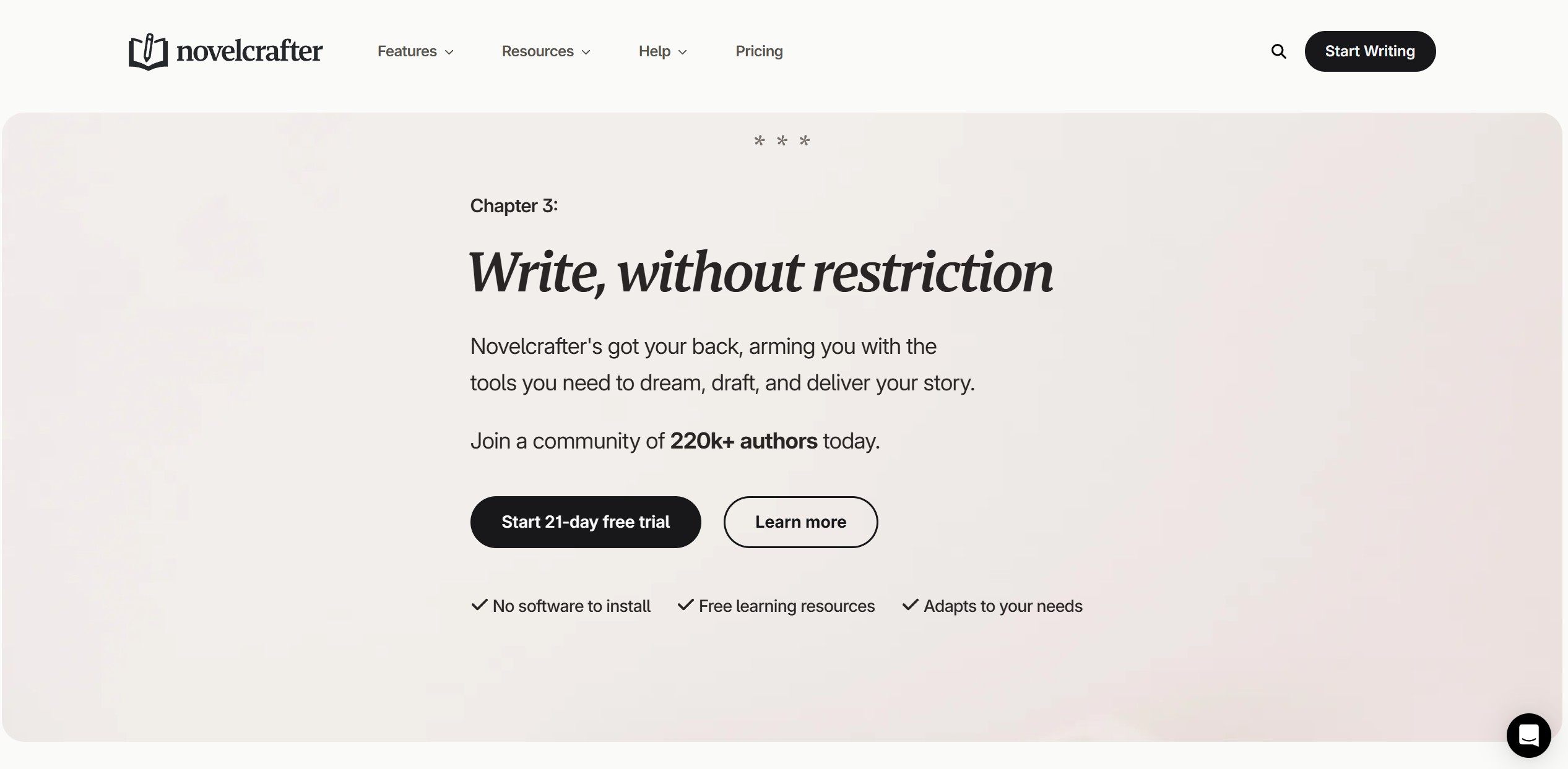
It closed on stacked rhetorical questions — what had he lost, and who had yet to be found — the generic ending the brief specifically ruled out.
In fairness: NovelCrafter is a workspace wrapped around a model, not a creative writing with AI prose engine. On a bare prompt, that scaffolding cannot help.
Sudowrite — the one that wouldn't take the test
I tried the identical premise in Sudowrite, and its Story Bible wanted Braindump, Genre, Style, Synopsis, Characters and Worldbuilding filled in first.
That is more scaffolding than a single scene justifies, so it sat this round out. Honest data, though: Sudowrite assumes a whole book.
The core distinction: in creative writing with AI these tools didn't differ on plot. They differed on restraint. Claude withheld, ChatGPT overshared, NovelCrafter defaulted to cliché.
Which Tool Fits Which Kind of Writing
One prompt can't rank every creative writing with AI job. What it does show is where each tool's instincts pull, which is the useful part when choosing.

| Writing task | My pick | Why |
|---|---|---|
| Literary scenes, atmosphere | Claude | Holds back information on purpose |
| Dialogue and scripts | ChatGPT | Clipped, natural back-and-forth |
| Full novel drafting | Sudowrite | Story Bible pays off past chapter three |
| Managing a long manuscript | NovelCrafter | Bring your own model, keep the workspace |
Pricing for creative writing with AI sits close enough that it rarely decides this. Claude and ChatGPT both run free tiers with paid plans around $20 monthly. Sudowrite starts near $10.
Start with one tool and one genre. If you want a broader starting point first, my guide to AI writing tools for non-writers covers the basics.
The Prompt Rules That Changed the Output
The single biggest lever in creative writing with AI isn't the tool. It's what you forbid. Three of my constraints did most of the work.
Ban the clichés by name
I listed what I didn't want: no “little did he know,” no generic darkness, no obvious thriller phrasing. The tools that read that instruction closely produced noticeably fresher lines.
Withhold on purpose
“Do not explain the mystery immediately” was the line that separated the outputs most sharply. Without it, every model I tried rushed to a reveal.
Ask for character through behaviour
Requesting personality through actions rather than description is what produced Claude's kitchen-versus-study detail — a whole character established without one adjective about him.
A prompt skeleton worth reusing:
- Genre, length, and point of view
- One premise, stated plainly
- Three things the writing must not do
- How the piece should end — question or answer
For layering prompts into longer projects, my walkthrough on AI prompt chains goes further than a single brief can.
What Every Tool Still Gets Wrong
None of the four produced a chapter I would publish unedited. Creative writing with AI fails in predictable places, worth knowing before you rely on it.
Every model over-explained emotion somewhere. Characters were told to be sad rather than shown doing something a sad person does.
Pacing was the second recurring flaw. Left alone, these tools escalate. Tension gets replaced with events, and the quiet middle of a chapter disappears.
The ownership question
Most platforms say output belongs to you. Copyright is a separate matter: the U.S. Copyright Office requires human authorship, and purely machine-generated material can't be registered.
In practice your edits are the asset. With creative writing with AI, the more of the final text you actually wrote, the stronger your claim.
What I couldn't verify: whether these tools train on your submitted manuscript text differs by plan and setting, and none publish it clearly enough for a straight comparison.
My Verdict — Which One to Pick
There is no single creative writing with AI winner here, because these tools aren't solving the same problem. The choice comes down to your stage.
Choose Claude if you care most about prose quality and want a tool that resists the urge to explain everything on page one.
Choose ChatGPT if you write dialogue-heavy work — scripts, scenes, exchanges — and you're willing to rein in its instinct to reveal.
Choose Sudowrite if you're committed to a whole manuscript, where the setup cost that blocked my test becomes the reason it works.
Choose NovelCrafter if you already have a model you like and want a workspace to organise a long project around it.
The real split isn't which tool writes best. It's whether you need one scene now or a book over months — everything else follows from that.
FAQ — Creative Writing with AI Tools
🚀 Keep Sharpening Your Writing Stack
One prompt told me more than a month of feature comparisons. Here's where I'd take creative writing with AI next: