📌 Table of Contents
- Intro – ChatGPT’s Learning Impact: Smarter or Slower?
- MIT's 2025 Study: What They Found About ChatGPT and Learning
- Why This Matters – The Real Impact of AI on Learning
- How to Use ChatGPT Without Losing Brain Power
- For Students, Educators, and Professionals: What You Should Do Now
- Final Takeaway – AI Is Powerful, But So Are You
- 📌 Bonus: Smarter AI Use Starts Here
Is ChatGPT Making Us Smarter—Or Just Quicker at Thinking Less?
In a world where AI tools like ChatGPT are just a tab away, it’s easy to feel like we’re getting smarter by the minute. But are we actually learning more—or just getting faster at avoiding real thinking? A new MIT 2025 study tackles this exact dilemma, shedding light on the true ChatGPT learning impact. It asks a question many of us haven’t dared to confront: is this powerful tool helping us grow intellectually, or is it subtly rewiring how we think—and how much we think?
Researchers observed that while ChatGPT improves task speed and boosts user confidence, it also encourages shallow learning. Instead of grappling with tough concepts, users often accept whatever the AI provides—accurate or not. The real concern? We’re beginning to rely on it like a mental shortcut, and that shift might be diminishing our ability to think deeply and independently.
As someone who uses AI daily, I find the ChatGPT learning impact both fascinating and a little unsettling. This research isn’t just about students—it’s a mirror for how all of us are adapting to AI. So let’s unpack what this means—and what we should be doing about it.
MIT’s 2025 Study: What They Found About ChatGPT and Learning
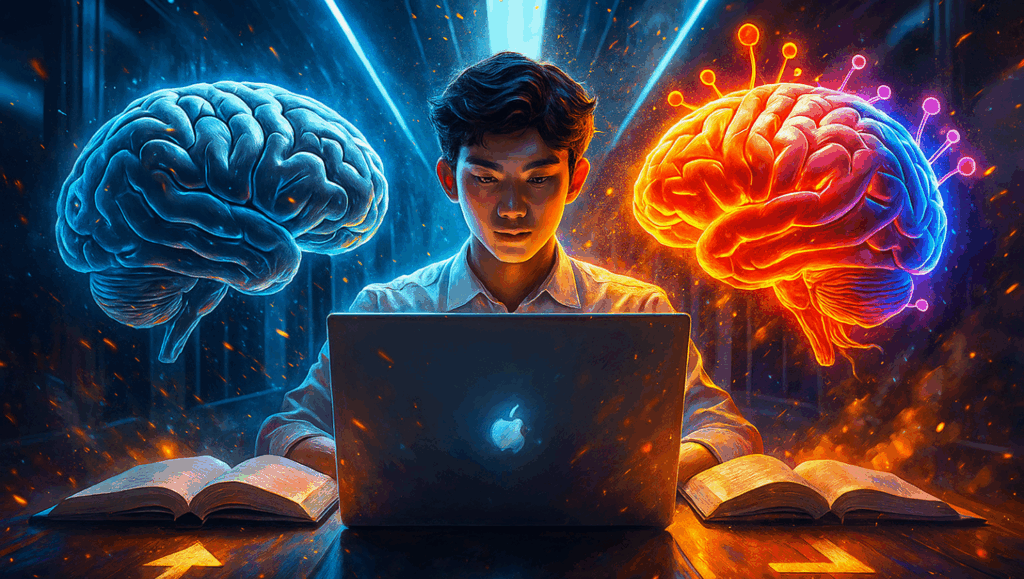
To truly understand the ChatGPT learning impact, MIT researchers conducted a bold and revealing experiment. They split participants into three groups—one using ChatGPT, another using Google, and a third relying solely on manual thinking with no digital assistance. What they discovered offers a powerful glimpse into how AI might be quietly changing the way we learn.
Here’s what stood out:
🧠 Lowest Brain Activity
EEG scans revealed that the ChatGPT group experienced the least brain engagement. Compared to the Google and manual thinking groups, users depending on ChatGPT showed significantly lower cognitive activity. The implication? The ChatGPT learning impact may include a measurable reduction in mental effort—because people are beginning to outsource their thinking.
📝 Forgettable Writing
Participants who used ChatGPT often forgot what they had written just minutes later. Their essays were factually correct, but lacked ownership, personal style, or long-term recall. Like fast food for the brain—quick to consume, but light on substance—this aspect of the ChatGPT learning impact suggests we may be sacrificing memory retention for speed.
😐 Flat Tone, Less Depth
Essays produced with ChatGPT came out clean and coherent, but many were flat and impersonal. They lacked emotional tone, creative structure, or deeper reflection. In contrast, AI-free essays—while less polished—showed more authentic thought and originality. Another reminder that the ChatGPT learning impact might be flattening our intellectual voice.
These findings go far beyond productivity. They raise serious concerns about how we learn, how deeply we process ideas, and whether AI is nudging us toward superficial understanding rather than true mastery.
Read the full MIT research summary via Time Magazine
Why This Matters – The Real Impact of AI on Learning
At the core of this conversation is something called cognitive offloading—when we rely on external tools (like smartphones or AI) to remember, calculate, or even think for us. It’s not a new phenomenon, but with ChatGPT becoming deeply embedded in education, it’s happening more than ever. The ChatGPT learning impact is reshaping how students engage with information—and not always in good ways.
The ChatGPT learning impact isn’t just about speed or convenience. It’s about how our brains adapt—or fail to adapt—when we let AI take over the tasks we used to do ourselves. And that has long-term implications.
Here’s why that’s a problem:
🧠 We Remember Less
When students rely on ChatGPT to write essays or solve problems, they often skip the hard work of processing and understanding. The result? Lower memory retention. The task may get done quickly, but the knowledge doesn’t stick. That’s a clear example of the ChatGPT learning impact in action.
🧩 We Think Less Critically
Critical thinking develops through effort, mistakes, and curiosity. But when AI delivers polished answers instantly, users stop questioning and stop pushing their own reasoning. Over time, that weakens core cognitive abilities. Another subtle but serious effect of the ChatGPT learning impact.
🏫 The Rise of AI in Learning Environments
With ChatGPT school usage growing rapidly, teachers are divided. Some appreciate the boost in speed and organization, while others worry that it encourages shallow thinking. The right approach isn’t banning the tool—but building AI literacy and guiding students to use it wisely.
Yes, the benefits of AI in learning are real. But so are the risks. When we lean too heavily on ChatGPT, we don’t just change how we work—we change how we think. And the ChatGPT learning impact reminds us that without balance, we may be gaining efficiency while losing depth.
How to Use ChatGPT Without Losing Brain Power
Let’s be real—ChatGPT isn’t going anywhere, and banning it from learning environments isn’t the answer. What we can do is learn how to use ChatGPT wisely to avoid negative learning impact. Like any tool, it’s not about if you use it—but how. The ChatGPT learning impact can be either a setback or a springboard depending on the approach.
Here are four science-backed ways to keep your brain in the driver’s seat while still benefiting from AI:
1.
Start with ChatGPT—But Finish with Your Brain
Use ChatGPT to brainstorm, structure ideas, or speed up research. But when it’s time for the final version—writing that essay, solving that problem, or pitching that idea—turn off the AI and finish it yourself. This activates memory, improves retention, and reduces the passive side of the ChatGPT learning impact.
2.
Don’t Copy-Paste—Summarize and Rewrite
Copying kills learning. Instead, read ChatGPT’s output, close the window, and rewrite it in your own words. This forces your brain to engage with the content and make it meaningful. You’ll sound more authentic, and you’ll learn more. This habit directly combats the shallow effects linked to the ChatGPT learning impact.
3.
Ask for Counterarguments
One major issue tied to the ChatGPT learning impact is how it can reinforce one-sided thinking. Flip the script. Ask: “What would the opposite argument be?” or “How would someone challenge this?” This trains your critical thinking and opens up perspective.
4.
Always Reflect on Its Suggestions
Don’t assume ChatGPT is always right. Reflect: Do you agree? Does it make sense in context? What’s missing? This moment of pause turns AI from an answer machine into a thinking companion—and minimizes the passive effects of the ChatGPT learning impact.
Takeaway:
ChatGPT is powerful—but it’s not a replacement for your brain. Use it to spark ideas, not to skip effort. The more intentionally you engage with it, the more you sharpen your mind—not dull it.
Want smarter ways to learn with AI? Explore our AI Tools That Boost Productivity

For Students, Educators, and Professionals: What You Should Do Now
The ChatGPT learning impact is being felt well beyond classrooms. Whether you’re a student trying to stay sharp, a teacher rethinking your approach, or a professional using AI to boost efficiency, this is a critical time to rethink how we engage with AI—before we start relying on it too much.
Students – Build Skills, Not Shortcuts
The temptation to let ChatGPT do the heavy lifting is real—but it can cost you in the long run. To avoid the negative ChatGPT learning impact:
Use ChatGPT to brainstorm, not to copy.
Rewrite everything in your own words to improve retention.
Push yourself to solve part of each task without AI first.
Reflect on what you’re learning—not just what you’re producing.
Learning sticks best when you’re doing the thinking.
Educators – Teach Students to Think With AI, Not Instead of It
The classroom is ground zero for the ChatGPT learning impact. Educators can lead the way by shifting from restriction to guidance:
Introduce AI literacy as part of your curriculum.
Encourage students to question AI output, not blindly accept it.
Create assignments that require analysis, not just regurgitation.
Make space for conversations about how AI is shaping their thinking.
Used well, ChatGPT can be a critical thinking tool—not a shortcut to surface-level answers.
Teams and Professionals – Keep the Human Edge
In the workplace, AI boosts speed—but creativity and strategy still come from people. To avoid a dulling ChatGPT learning impact:
Don’t let AI replace team brainstorming—use it to enhance it.
Review and refine AI outputs with human context.
Create processes that prioritize original insight, not just output.
Encourage ongoing learning beyond AI tools.
The best teams don’t just use AI—they stay sharp despite it.
Final Takeaway – AI Is Powerful, But So Are You
The ChatGPT learning impact has sparked a conversation we can’t afford to ignore. AI is here, and it’s changing how we access information, solve problems, and create. But no matter how advanced it becomes, it’s still just a tool—you are the thinker.
The danger isn’t in using ChatGPT. The danger is in forgetting to think alongside it.
When we use AI intentionally, it becomes a partner for growth. When we overuse it, we risk losing the very skills that make us human: curiosity, creativity, and critical thinking.
💡 Whether you’re a student, educator, or lifelong learner, the goal isn’t to ban AI. It’s to train your brain to use it wisely, question what it says, and build on it with your own insight.
“The best learners will be the ones who ask smarter questions—not the ones who copy faster answers.”
So let’s not just keep up with AI—let’s stay ahead of it, by staying thoughtful, aware, and always ready to learn.
📌 Bonus: Smarter AI Use Starts Here
Want to keep using AI without losing your edge? The key is to stay curious, intentional, and in control of your learning. We’ve curated some powerful resources to help you do just that:
Explore: AI Productivity Tools
Discover smart tools that boost efficiency without dulling your thinking.
Read: Write Smarter, Not Harder: How to Use AI Without Losing Your Soul
A hands-on playbook with strategies to use AI as a creative multiplier—not a crutch
Subscribe: Weekly tips to use AI without burning out your brain
No spam—just practical advice, new tools, and smart ways to stay sharp in an AI-powered world.

