What content needs an AI label?
Content needs an AI label when AI generated it or changed it in a way that matters, and a normal viewer could believe it's real. That is the shared test across YouTube, TikTok and Meta. The two questions in steps 3 and 4 of the checker are that test: what did AI do, and could someone mistake it for real?
The four cases that trigger an AI label almost everywhere are the same ones YouTube spells out in its GenAI disclosure rules:
If your content is obviously fantasy or animation, the realism test fails and the main platforms don't require an AI label. Etsy and Amazon KDP are the exceptions: they ask about AI creation whether it looks real or not.
When does each platform require an AI label?
YouTube, TikTok and Meta require an AI label on realistic AI content, including realistic photos on Instagram. Etsy and KDP require disclosure for AI-created items or books. Pinterest and X don't require it but label content themselves. Google requires AI metadata on Shopping images, plus a checkbox on election ads.
| Platform | AI label required when | Where to switch it on | Auto-labels? |
|---|---|---|---|
| YouTube | Required Realistic AI or AI-altered video and audio, and AI music that's the focus | YouTube Studio → upload → Attributes → "AI use" | Yes: C2PA data, YouTube AI tools, internal detection |
| TikTok | Required AI-generated or significantly edited content showing realistic scenes or people | More options → "AI-generated content", or a caption or sticker | Yes: TikTok AI effects and Content Credentials |
| Instagram, Facebook, Threads | Required Realistic AI photos and video, and realistic-sounding audio | Share screen → "Add AI label" | Yes: "AI info" from industry metadata |
| Optional No must-label rule found | "Mark as AI-Modified" toggles when creating a Pin | Yes: IPTC metadata plus classifiers | |
| X | Optional No AI label rule; deceptive harmful media is banned | Write it in the post | May add "Manipulated media" |
| Etsy | Required Any item created with AI | Listing description | Detects AI images in new listings |
| Amazon KDP | Required AI-generated text, images or translations | KDP publishing flow | Not stated |
| Google Shopping & Ads | Required Keep AI metadata on product images; election ads with synthetic content | Merchant Center data; Google Ads campaign settings | Requires the metadata |
| Your own site | Optional in the US; EU rules can apply | A visible note near the content | No |
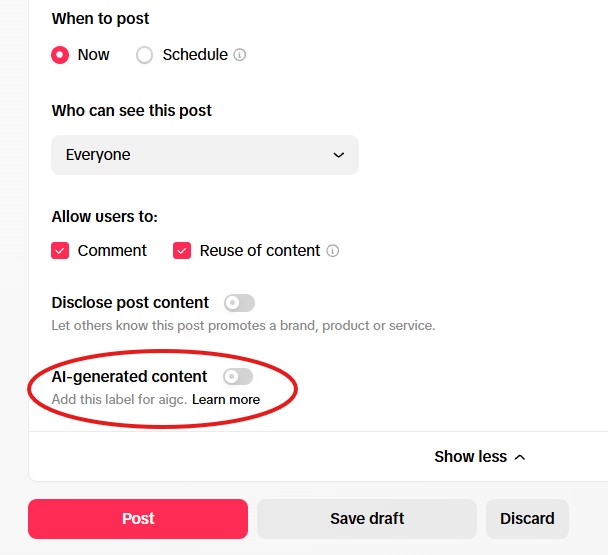
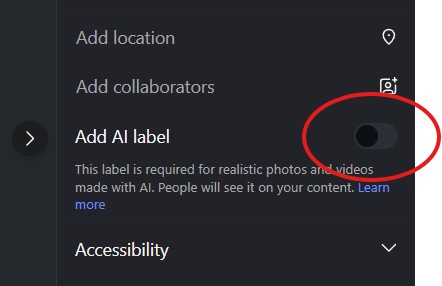
Where the AI label switch is, from my own accounts
The rules most people get wrong
Meta's written misinformation policy names photorealistic video and realistic-sounding audio. The Instagram app goes further: next to the "Add AI label" switch it says the label is required for realistic photos and videos made with AI. Follow the app. Meta also adds an "AI info" tag on its own when it reads AI metadata in the file.
TikTok's bar is lower. Its Community Guidelines require a label on AI-generated or significantly edited content showing realistic scenes or people, and unlabeled posts can be removed, restricted or labeled by TikTok's team. A caption or hashtag sticker counts as a label there, which YouTube's toggle-only process doesn't accept.
Etsy goes further than any social platform. Its updated AI rules require disclosure in the listing for any AI-created item, at least one unedited photo of the real product, and they ban AI-generated patterns, recipes and instructions outright.
Amazon KDP counts a text "AI-generated" even if you rewrote it heavily afterwards. Only work you created yourself and then polished with AI counts as "AI-assisted," which needs no declaration.
What doesn't need an AI label?
You don't need an AI label for production help or cosmetic edits: AI-written scripts and outlines, idea generation, auto captions, thumbnails and titles, color and lighting fixes, beauty filters, background blur, upscaling and audio cleanup. YouTube also lists cloning your own voice for voiceovers or dubs as exempt.
Which US laws require AI disclosure?
I found no US federal law that requires an AI label on everyday posts. The rules that bite are narrower: the FTC bans fake reviews, AI-written ones included, and New York requires a disclosure on ads with AI-generated people. California adds the same rule from January 1, 2027, and about 31 states regulate AI in election content.
FTC: fake reviews and paid posts
The FTC's Consumer Review Rule took effect on October 21, 2024 and covers reviews or testimonials from people who don't exist, AI-generated ones included. FTC warning letters put civil penalties at up to $53,088 per violation. An AI label doesn't make a fake review legal: the only fix is to remove it.
A second FTC point trips creators up: an AI label isn't an ad disclosure. If a brand paid you or sent free products, you still need "#ad" or the platform's paid partnership tag, as the FTC's endorsement guidance explains. The latest update of those guides also brought virtual influencers under the rules.
New York and California: AI people in ads
Since June 9, 2026, New York has required a conspicuous disclosure on visual and audiovisual ads that feature a "synthetic performer," meaning an AI-made human who isn't a real, identifiable person. Audio-only ads are excluded there, and law firm summaries list fines of $1,000 for a first violation and $5,000 after.
California's SB 1050, signed on September 16, 2026, starts January 1, 2027. It covers AI voices and audio ads too, applies when the synthetic performer is used prominently, and asks for wording like "This performance features a synthetic performer." The checker writes that line for you when you tick the ad and AI person boxes.
Election content
About 31 states have election deepfake laws, according to NCSL counts reported by Axios. Most require a disclaimer on AI-altered political ads, while Minnesota and Texas ban deceptive deepfakes close to an election and Maryland bans some year round. Google and Meta add their own ad checkboxes on top.
Does the EU AI Act apply to US creators?
It can. Since August 2, 2026, Article 50 of the EU AI Act has required anyone using AI professionally to label deepfakes shown to people in the EU, and the Act reaches businesses outside the EU when their AI output is used there. Purely personal, non-commercial use is out of scope. Art and satire only need a light disclosure.
The European Commission's Article 50 FAQ treats a person who earns regular income from AI content as a professional "deployer." That covers most monetized creators and every business. The label has to be visible or audible at first exposure, so the hidden watermark your AI tool adds doesn't count.
Text is a separate case. AI-written text published to inform the public on topics like politics, health or the economy needs a label, unless a person reviews it, fact-checks it and takes editorial responsibility. Content published before August 2, 2026 doesn't need retroactive labels.
If you sell or publish to EU audiences, tick the EU box in step 5. The checker then adds an Article 50 card and switches your website advice from "optional" to "required" where a deepfake is involved.
Will an AI label hurt my reach?
YouTube and TikTok both say no. YouTube's help page states that disclosing AI content won't limit a video's audience or its eligibility to earn money. TikTok says turning on its AI-generated content setting won't affect distribution, as long as the post follows its Community Guidelines. Meta doesn't publish a statement either way.
The bigger reach risk runs the other way. Both YouTube and TikTok can add a label you didn't choose, and TikTok's automatic labels can't be removed. On YouTube, creators who keep skipping the disclosure risk removal or suspension from the Partner Program.
What if my real content gets an AI label by mistake?
On YouTube, open YouTube Studio and change the AI disclosure answer to "No" under Attributes; that works in most cases, but not for labels from C2PA data, YouTube's own AI tools or manual review. TikTok reviews platform labels case by case. On Pinterest, contact support to appeal.
- Find the trigger. Most wrong labels come from metadata. Some phones and editing apps write Content Credentials into the file.
- Re-export cleanly from the original. If the edit was cosmetic, export the original capture rather than the AI-edited version.
- Appeal on the platform. Use YouTube Studio's Attributes setting, TikTok's appeal flow or Pinterest support.
- Never strip metadata to hide real AI use. Google Merchant Center requires you to keep it, and TikTok treats unlabeled realistic AI as a violation.
What are the biggest AI label mistakes?
The most common AI label mistakes: using one rule for every platform, treating an AI label as an ad disclosure, labeling a prohibited fake instead of deleting it, and assuming realistic AI photos are exempt on Instagram. Each platform measures something different, and the checker gives a separate card for each one.
If deepfakes are your worry rather than your workflow, read my guide on how AI watermarks work and how to verify media, then set up a family safe word against voice-clone calls.
The labeling rules in this checker exist because of the problem this book maps: synthetic media that people can't tell from the real thing. Schick explains why AI labels and provenance data matter, in plain language that creators and small business owners can follow.
Get the book →AI label FAQ: what people ask most
Do I need to label AI-generated images on Instagram?
Yes, if the image looks real. Instagram's "Add AI label" switch on the share screen says the label is required for realistic photos and videos made with AI. Cartoon or obviously fantasy images don't need it, though Meta may still tag them "AI info" from the file's metadata.
Do I have to disclose that ChatGPT wrote my script?
Not on YouTube or TikTok: scripts, outlines and ideas count as production help. Two exceptions: Amazon KDP if AI wrote the book's text, and EU audiences if AI text informs the public on a public-interest topic without human editorial review.
Does my own AI-cloned voice need a label on YouTube?
YouTube lists cloning your own voice for voiceovers or dubs as an example that doesn't need disclosure. TikTok's rule is about people shown saying things they didn't say, so if the clone says words you never recorded, a label there is the safer choice.
Will TikTok remove my video if I don't label AI?
It can. TikTok's Community Guidelines say unlabeled realistic AI content may be removed, restricted or labeled by its team, depending on the harm it could cause. Using the AI-generated content setting doesn't reduce distribution on its own.
Is "#AI" in the caption enough as a label?
On TikTok, a caption, hashtag sticker or on-screen text counts. On YouTube you need the "AI use" setting in YouTube Studio, and on Instagram you turn on "Add AI label" on the share screen. Use the built-in setting wherever one exists.
Do I need to disclose AI product photos on Etsy?
If the item itself was created with AI, yes, in the listing description. If you only used AI to fix lighting or swap a background, you don't need an AI label, but the listing still needs one unedited photo of the real item.
Do AI label rules apply to old posts?
The EU says content published before August 2, 2026 doesn't need retroactive labels. I didn't find a platform that asks you to go back and label old uploads, but YouTube and TikTok can add automatic labels to existing videos.
Does this checker save my answers?
No. It runs in your browser, sends nothing to a server and uses no cookies or storage. Refreshing the page clears it. "Download plan" saves a text file to your own device only.
The real question is "could it pass as real?"
Most AI label rules come down to that one question. If the answer is yes and AI made or changed it, label it with each platform's own setting. If it's a script, a caption or a color fix, you can skip the badge. Run the AI label checker before every campaign that uses AI people, voices or political themes.