

Mirko
AI Tech Writer
The ChatGPT brain study out of MIT went viral for a scary reason: it seemed to prove ChatGPT is rotting your brain. Most of the coverage traces back to the same preprint from June 2025. I read the actual paper, now revised in December 2025, along with the lead researcher's own pushback on how it got covered, and three 2026 studies that complicate the story. Here's what the ChatGPT brain study actually found, and four ways to use ChatGPT without the downside it measured.
Not exactly what the headlines said. MIT's own team has pushed back on the "brain damage" framing — the study tested one narrow habit (letting ChatGPT write an entire essay), not ChatGPT use in general.
What MIT's ChatGPT Brain Study Actually Tested
The ChatGPT brain study came out of MIT Media Lab, led by research scientist Nataliya Kosmyna, and it tested essay writing specifically — not ChatGPT use in general. Fifty-four participants, aged 18 to 39 and based around Boston, split into three groups: one wrote SAT-style essays using ChatGPT, one used Google Search, and one used only their own memory.
Each group repeated the task across several sessions while researchers tracked brain activity with EEG across 32 regions. In a fourth session, some ChatGPT users switched to writing solo, and some solo writers got ChatGPT access for the first time, to see whether the effects carried over. Eighteen of the original 54 participants completed that final round of the ChatGPT brain study.
Fifty-four people, three groups, one EEG cap — that's the entire dataset behind six months of viral ChatGPT brain study headlines.
The ChatGPT Brain Study, in One Table
| Group | Brain connectivity | Could quote own essay after |
|---|---|---|
| Brain-only (no tools) | Strongest, widest-ranging | 89% |
| Search Engine (Google) | Moderate | Not reported separately in the paper |
| ChatGPT (LLM) | Weakest overall | 17% |
The ChatGPT Brain Study Findings That Made Headlines
The headline numbers from the ChatGPT brain study are real. Brain connectivity scaled down with how much external help a group used: the brain-only group showed the strongest networks, the search group came in the middle, and the ChatGPT group showed the weakest coupling of the three. The researchers coined the term "cognitive debt" for this pattern — AI saves mental effort now, at a measurable cost later.
The Term That Stuck: "Cognitive Debt"
In the ChatGPT brain study, the essays told a similar story: ChatGPT-written essays were more repetitive in structure, argument, and word choice than the other two groups' work. By the third essay, Kosmyna has said, many participants were just handing the prompt to ChatGPT and asking it to polish whatever came back, rather than writing and then revising.
The stat that matters from the ChatGPT brain study: only 17% of ChatGPT users could quote a sentence from an essay they had written minutes earlier, versus 89% of the brain-only group.
That gap is the clearest evidence in the whole paper that offloading the writing also offloaded the memory of having written it.
What the Study's Own Authors Say Got Lost in Translation
Common misreading: "MIT proved ChatGPT causes brain damage" — the study's own lead author says that's not what it found.
Here's the part most ChatGPT brain study coverage skipped. Asked directly about the "brain rot" framing that spread across social media, Kosmyna told the education outlet TechLearning: "We didn't find any brain rot." She's also been clear the study never measured IQ, despite plenty of secondhand write-ups implying otherwise.
MIT Media Lab's own project page for the ChatGPT brain study carries an explicit warning against describing the results as brain damage or as proof that AI makes people dumber. The paper itself is still a preprint, unreviewed by any journal, and it was substantially revised in December 2025 after the original June 2025 version went viral.
Why 54 People Isn't "Proof" of Anything Yet
A published methodological commentary on the ChatGPT brain study raised real concerns too: figures not fully described in the text, interpretations offered without accompanying statistical tests, and a sample too small and too narrow (54 people, one age range, one city, one essay-writing task) to generalize from. None of that erases the finding. It does mean "MIT proved ChatGPT makes you dumber" is a stronger claim than the study itself makes.
🔊 What the Headlines Said
- "ChatGPT causes brain damage"
- "MIT proves AI makes you dumber"
- Treated as settled science
🔬 What the Paper Actually Says
- Lower engagement in one specific task (letting AI write the whole essay)
- A small, unreviewed preprint — not a diagnosis
- The lead author has said this on the record

The 2026 Research That Complicates the ChatGPT Brain Study
Two more recent studies push back on the simple reading of the ChatGPT brain study. A 2026 meta-analysis by Wu and colleagues pooled 35 experimental studies covering 4,193 participants and found an overall positive learning effect from ChatGPT use — one that depended heavily on how the AI was built into the lesson, not automatic in either direction.
One meta-analysis outweighs one preprint — and it found ChatGPT helping people learn when the habit this ChatGPT brain study flagged is avoided.
Retention vs. Transfer — and What Effort Actually Looks Like
A separate 2026 EEG study by Zhang and colleagues, published in Acta Psychologica, compared ChatGPT-based teaching with human instruction directly, unlike the ChatGPT brain study's essay-only setup. Retention came out similar between the two, though knowledge transfer — applying what was learned to a new situation — was weaker with ChatGPT, even with higher activity in some EEG frequency bands.
A third study, from Lee and colleagues at CHI 2025, looked at 319 knowledge workers using generative AI at their jobs and found something more specific than the "less thinking" the ChatGPT brain study measured: people shifted their effort from generating ideas to verifying and supervising the AI's output. That's a different kind of cognitive work, not necessarily less of it.
How to Use ChatGPT Without the Downside the ChatGPT Brain Study Found
None of this means avoid ChatGPT. It means use it in a way the ChatGPT brain study never actually tested, since every participant in the LLM group used ChatGPT to produce the entire essay from the start. Here's what I'd do differently.
1. Think First, Then Open ChatGPT
Write your first draft or outline before you open ChatGPT, even a rough one. Then use the AI to speed up structure, phrasing, or research — not to generate the thinking. This is closer to the workflow the ChatGPT brain study's brain-only and search groups used than to its ChatGPT group.
2. Never Copy-Paste the Final Answer
Read it, close the tab, and rewrite it in your own words. This single habit is what separates the 89% recall group from the 17% recall group — rewriting forces your brain to reprocess the idea instead of just relocating text.
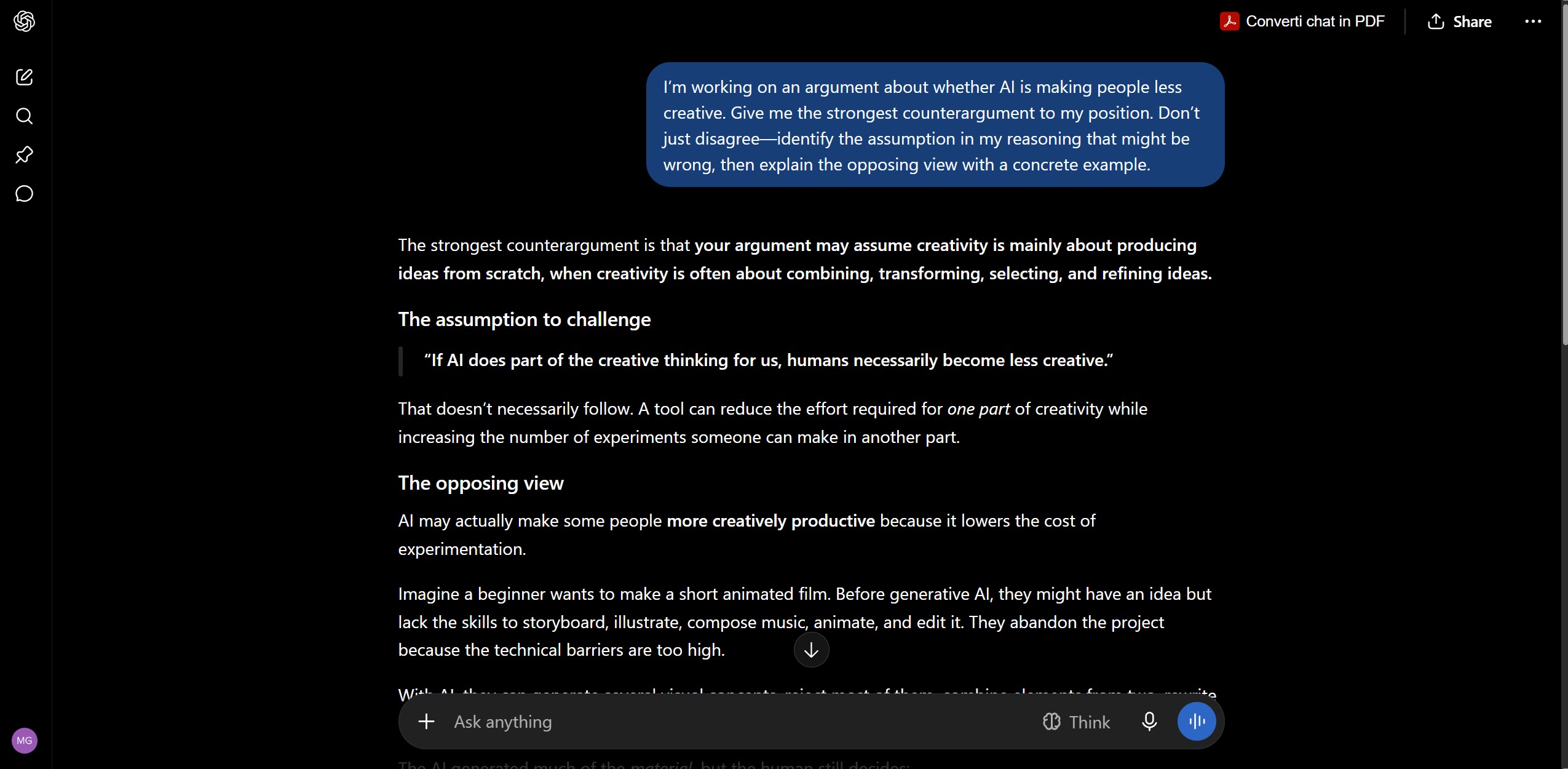
3. Ask It to Argue Against Itself
A prompt as simple as "what's the strongest case against this?" pushes you back into the verification-and-supervision mode the CHI 2025 study found in effective AI users, instead of the passive-acceptance mode the essay study flagged.
4. Treat Every Answer as a Draft, Not a Verdict
Ask yourself what's missing, what you'd challenge, and whether it actually fits your situation. That short pause is the difference between AI as a thinking partner and AI as a replacement for thinking.
🎓 For Students
Use ChatGPT to brainstorm and check your own reasoning, targeting the exact habit the ChatGPT brain study flagged, instead of using it to write the assignment.
💼 For Teams
Keep human brainstorming first, then bring in AI to speed up drafting — closing the same gap the ChatGPT brain study found, with real context the model doesn't have.
Key takeaway from the ChatGPT brain study: the cost was in ONE habit — letting ChatGPT write the whole thing — not in ChatGPT itself. Change the habit, keep the tool.
Frequently Asked Questions — ChatGPT Brain Study
🧠 Put the ChatGPT Brain Study Into Practice
The ChatGPT brain study isn't proof that AI is quietly breaking your brain — it's a small, preliminary study of one narrow habit. The fix isn't avoiding ChatGPT. It's making sure your brain still does the part that matters. Here's where I'd go next:
Some links are affiliate links · they support this site at no extra cost to you · Full disclosure