

Mirko
AI Tech Writer
Almost every Deep Research vs Claude post online is comparing the wrong things — a single OpenAI feature against an entire company's model lineup. So instead of repeating that, I ran the exact same research prompt through OpenAI's Deep Research and Claude's Research feature, back to back, and I'm publishing both raw reports for you to download below. This is that fair, feature-vs-feature version of Deep Research vs Claude.
Some links in this post are affiliate links · they support this site at no extra cost to you · Full disclosure
Why This Comparison Gets Framed Wrong
Deep Research is OpenAI's name for one specific feature inside ChatGPT. Claude is the name of Anthropic's entire AI assistant — a whole product line, not a single tool. Treating those as equivalent is the reason so many Deep Research vs Claude posts read strangely: they're stacking a feature against a company.
That mismatch stopped being necessary once Anthropic shipped its own dedicated research capability, which it calls, plainly, Research. OpenAI launched Deep Research in February 2025; Anthropic's Research feature followed in April 2025, then expanded a month later to run for up to 45 minutes with Google Workspace access built in.
What "Winning" Even Means Here
Neither tool wins outright. One is stronger at breadth and raw source count; the other is stronger at reading dense material and staying accurate under pressure. Section 5 below is the real evidence for that — everything before it is context for reading those results correctly.
What OpenAI's Deep Research Actually Does
Deep Research is an agentic feature inside ChatGPT that runs dozens of web searches on its own, reads through pages, PDFs, and images, and compiles everything into a structured, cited report — the kind of task that would otherwise take a human analyst a few hours.
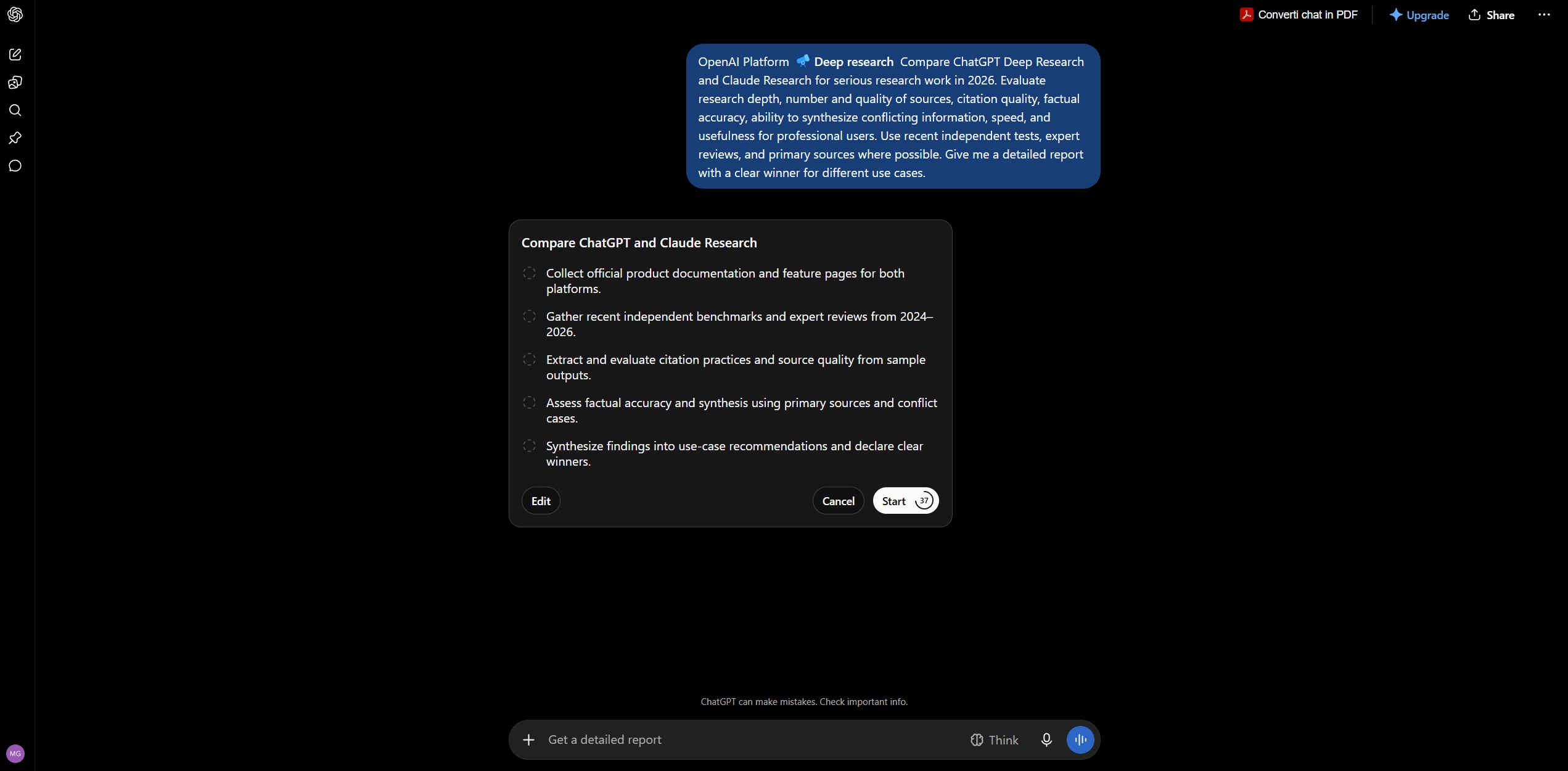
A February 2026 update let OpenAI restrict Deep Research to trusted sites only, track its progress live, and interrupt it mid-run with a follow-up instruction instead of waiting for the full report — per OpenAI's own Deep Research announcement. It's a single-agent system: one model plans, searches, and writes the whole report itself.
The Catch: It's Rationed
Per OpenAI's own product page, Plus, Team, Enterprise, and Edu accounts get 25 full-depth Deep Research runs a month. Go over that and ChatGPT quietly drops you into a lighter version powered by a smaller model — still useful, just less thorough. Pro accounts get up to 250 runs a month, split across both versions.
If you're building an automated research pipeline, that ceiling matters more than any feature comparison. For a broader look at agentic research setups, I walked through the DIY version in how to build your first AI research agent without coding.
What Claude's Research Mode Actually Does
Claude's Research mode works completely differently under the hood: a lead agent reads your question, writes a plan, then spawns three to five subagents that each chase a different angle in parallel before a dedicated citation step reconciles everything into one report.
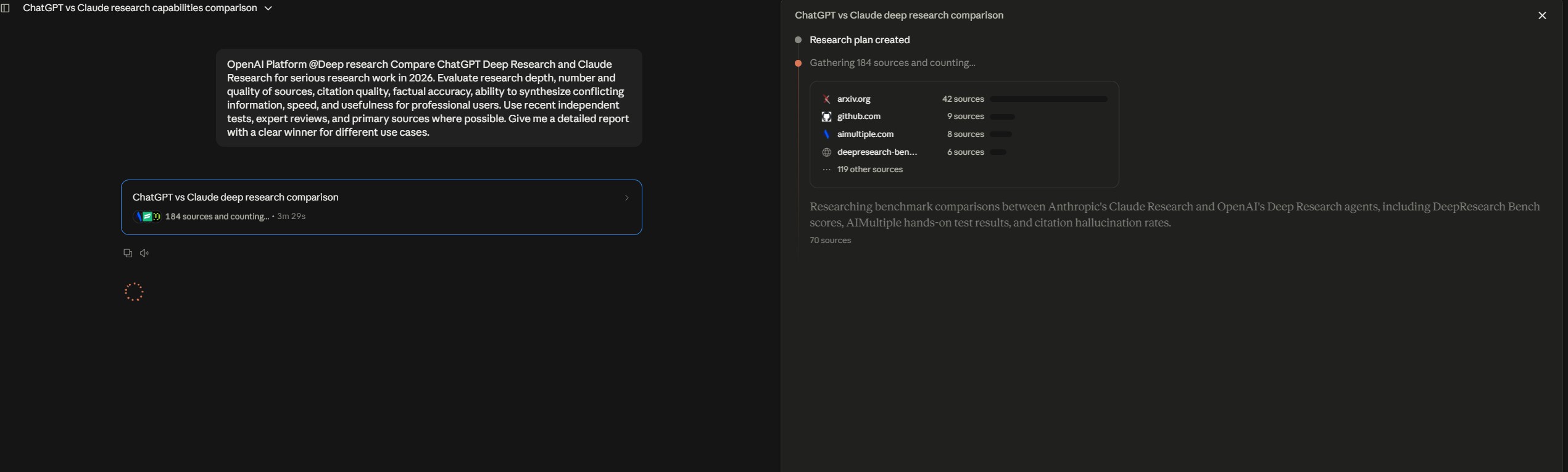
Most reports land in five to 15 minutes; Anthropic says the advanced mode can run for up to 45 minutes on genuinely hard investigations, per Anthropic's own Integrations announcement. One detail that's easy to miss: once you connect Google Workspace, Research searches your Gmail, Calendar, and Docs alongside the open web — something Deep Research doesn't do natively.
Which Plan You Need
Research isn't on Claude's free tier. It ships starting on Claude Pro ($20/month), alongside Sonnet 5, Opus 5, Claude Code, and Cowork — a lineup I broke down in more depth in my Claude Opus write-up on what changed and who should use it. If you're still on basic Claude chat, my 17 practical ways to work faster with Claude guide is a good next stop before you touch Research at all.
Feature-by-Feature: Deep Research vs Claude
Side by side, the two tools split along a predictable line: Deep Research goes wider, Claude's Research goes deeper into what you already have open.
I Ran the Same Prompt Through Both — Real Results
Everything above is how the two tools describe themselves. Here's the part most Deep Research vs Claude posts skip: I actually ran an identical research prompt through both — OpenAI's Deep Research and Claude's Research — and I'm publishing both full reports below so you can judge the output yourself, not just take my summary of it.
"Compare ChatGPT Deep Research and Claude Research for serious research work in 2026. Evaluate research depth, number and quality of sources, citation quality, factual accuracy, ability to synthesize conflicting information, speed, and usefulness for professional users. Use recent independent tests, expert reviews, and primary sources where possible. Give me a detailed report with a clear winner for different use cases."
Both reports came back in about 10 minutes. The genuinely interesting part wasn't just what each tool said about itself — it's that Claude's own report cited real, named academic benchmarks with dates and authors, while ChatGPT's report leaned on a mix of similar sourcing with a noticeably more confident tone. Judge that for yourself from the downloads below; here's what both reports agreed and disagreed on.
Deep Research vs Claude, Dimension by Dimension
Both numbers on the top row come from DeepResearch Bench, an academic benchmark of 100 PhD-level research tasks — for context, category leader Gemini scores 48.88, so the entire top tier sits within about 4 points of each other. The citation-fabrication numbers come from an April 2026 arXiv study on reference hallucination in commercial LLMs and deep research agents specifically.
Both reports independently flag this: no deep research tool exceeds ~85% factual accuracy even on its best tasks, and 3–13% of citation URLs across commercial tools are fabricated or dead. A public legal-citation tracker had logged 1,227 court cases involving AI-hallucinated citations by April 2026 — rising to 1,397 within a month. Click through every citation you plan to rely on.
For anything you'll actually publish or make a decision on, run the same prompt through both and compare. Agreement between them is a decent signal you can trust the finding; disagreement tells you exactly where to go check primary sources yourself.
Download Both Full Reports
If you want more than my summary of this Deep Research vs Claude test, both complete executive summaries are below — unedited, exactly as each tool generated them.
Worth being upfront about: this is one run, not a large-scale study. I couldn't independently re-verify every citation in either PDF myself, and both tools were asked to research a topic they have an obvious interest in framing favorably. Treat this Deep Research vs Claude test as a real, useful data point — not the final word.
Pricing in 2026: Full Breakdown
Both companies gate their research feature behind a paid plan, but the entry price and what you get for it differ more than most Deep Research vs Claude comparisons admit.
The practical read: if you just want to try research features without committing, ChatGPT Plus's 25 monthly runs go further than Claude's usage-metered sessions for occasional use. If you're already living in Claude for writing or coding, Pro at the same $20 price adds Research for free rather than asking you to choose. See current Claude plans or check ChatGPT's plans directly, since both vendors change limits often.
Which One Should You Actually Use
Deep Research vs Claude isn't a pick-a-winner situation — the two tools are genuinely built for different starting points, and my own test above backs that up dimension by dimension.
Choose Deep Research If
You want the broadest possible sweep of the open web on a topic you don't have existing documents for — market sizing, competitor scans, academic literature reviews — and you want an editable plan and clickable PDF export when you're done.
Choose Claude Research If
Your deliverable is an analytical narrative for a human decision-maker rather than a raw discovery dump, or your question depends on your own inbox and Docs as much as the open web. If you're deciding between Claude's coding tools too, my GitHub Copilot vs Claude Code vs Cursor breakdown covers that separately.
The Third Option Most Posts Skip
Perplexity trades depth for speed — it won't produce a full report the way Deep Research or Claude's Research mode will, but it's genuinely useful when you just need a fast, sourced answer. I compared it directly in Perplexity vs ChatGPT for research and answers.
Frequently Asked Questions — Deep Research vs Claude
The questions I saw most often while running this Deep Research vs Claude test — starting with what each feature actually is.
🧠 Go Deeper on Whichever Tool You Picked
Once you've picked a lane between Deep Research and Claude, these go further into getting real use out of it: