
Mirko
AI Tech Writer
How AI controls what you see on TikTok and Instagram changed in a real way this year — not the underlying logic, but who runs it and how much of it you're now allowed to see for yourself.
TikTok's U.S. operations moved to new ownership in January 2026, and Instagram opened a direct settings panel into its own ranking logic a few months later. I went through both changes and pulled together what decides your feed now, the controls you already have, and where personalization still turns into manipulation.
AI controls what you see by scoring signals like watch time, replays, and pause length, then ranking content most likely to keep you engaged — not the most accurate or balanced. In 2026, TikTok's algorithm moved to new U.S. ownership and Instagram launched a settings panel that lets you edit its ranking logic directly. That's the short version of how AI controls what you see right now.
Some links are affiliate links · they support this site at no extra cost to you · Full disclosure
What TikTok and Instagram Actually Track
Before getting into how AI controls what you see, it helps to know what these platforms are working from — and it's more than your likes. TikTok and Instagram log watch time down to the second, replay count, scroll speed, and how long you hesitate before tapping a video open. None of that requires a single click.
This is how AI controls what you see before you've made a single choice: both platforms layer in device and account signals too — language, general location, and for Instagram, activity across Facebook and WhatsApp under Meta's shared data policy. TikTok has faced repeated scrutiny over device-level data collection that goes beyond typical app permissions, something Forbes reported on in detail.
None of this is unique to TikTok or Instagram — it's the standard model behind how AI controls what you see across most ad-funded recommendation systems. I cover the shopping version of the same mechanics in How AI Recommends What You Buy Online. What's different here is the sheer volume of passive signal, and how fast it updates.
How AI controls what you see starts here: every silent second you spend on a video is training data — this is step one of how AI controls what you see, before a single like happens.

The 6 Signals That Decide What You See
Once you get past the theory, how AI controls what you see comes down to a short, constantly re-weighted list of behavioral inputs. Here's the actual breakdown:
- Engagement patterns — likes, comments, saves, and rewatches.
- Session duration — how long you stay on the app each visit.
- Content format — video length, carousel vs. single image, Reels vs. static posts.
- Relationship signals — who you interact with, and how often.
- Topical affinity — the hashtags, sounds, and themes you linger on.
- Declared preference — new for 2026: what you tell the algorithm directly, through Instagram's "Your Algorithm" panel or TikTok's "Manage topics" and "Not Interested" controls.
The first five signals are passive — you generate them just by using the app normally. The sixth is the one worth paying attention to, because for the first time, both platforms are treating what you say you want at roughly the same weight as what you unconsciously do.
Key takeaway: how AI controls what you see now runs on 6 signals, not 5 — the new "declared preference" input is the one you can actually steer. Section 6 shows exactly where.
What Changed in 2026: New Owners, New Controls
Two changes this year matter more than any single ranking tweak in how AI controls what you see.
TikTok's Algorithm Now Runs Under U.S. Ownership
As of January 22, 2026, TikTok's American operations moved to the TikTok USDS Joint Venture LLC — Oracle, Silver Lake, and MGX each hold roughly 15%, and ByteDance's stake dropped to 19.9%. The recommendation model is still licensed from ByteDance, but as of August 2026 it runs on Oracle-managed, U.S.-only infrastructure — the mechanism that resolved the years-long divestiture standoff. Reach and rankings have reportedly shifted while the retrained U.S. model settles, so don't benchmark current performance against last year's numbers.
Instagram Opened Its Ranking Logic to Direct Editing
Meta's "Your Algorithm" feature launched in Reels and Explore in late 2025 and, per several 2026 trade reports, has since extended toward the main Feed. Look for the slider icon (two hearts) top-right in Reels or Explore, or check Settings → Content Preferences on your account — you'll see the topic categories Instagram's AI has assigned you, and can add or remove them directly.
Neither change makes the underlying system neutral. The EU's Digital Services Act has an open 2026 investigation into TikTok's "addictive design" and recommendation practices, and in July 2026 EU regulators separately moved to limit For You recommendations shown to minors' accounts. New ownership and new settings change how much of the machinery you're allowed to see and nudge — not whether it's still optimizing for your attention first.
The 2026 shift in how AI controls what you see: ownership and settings changed. The underlying goal — your attention — didn't.
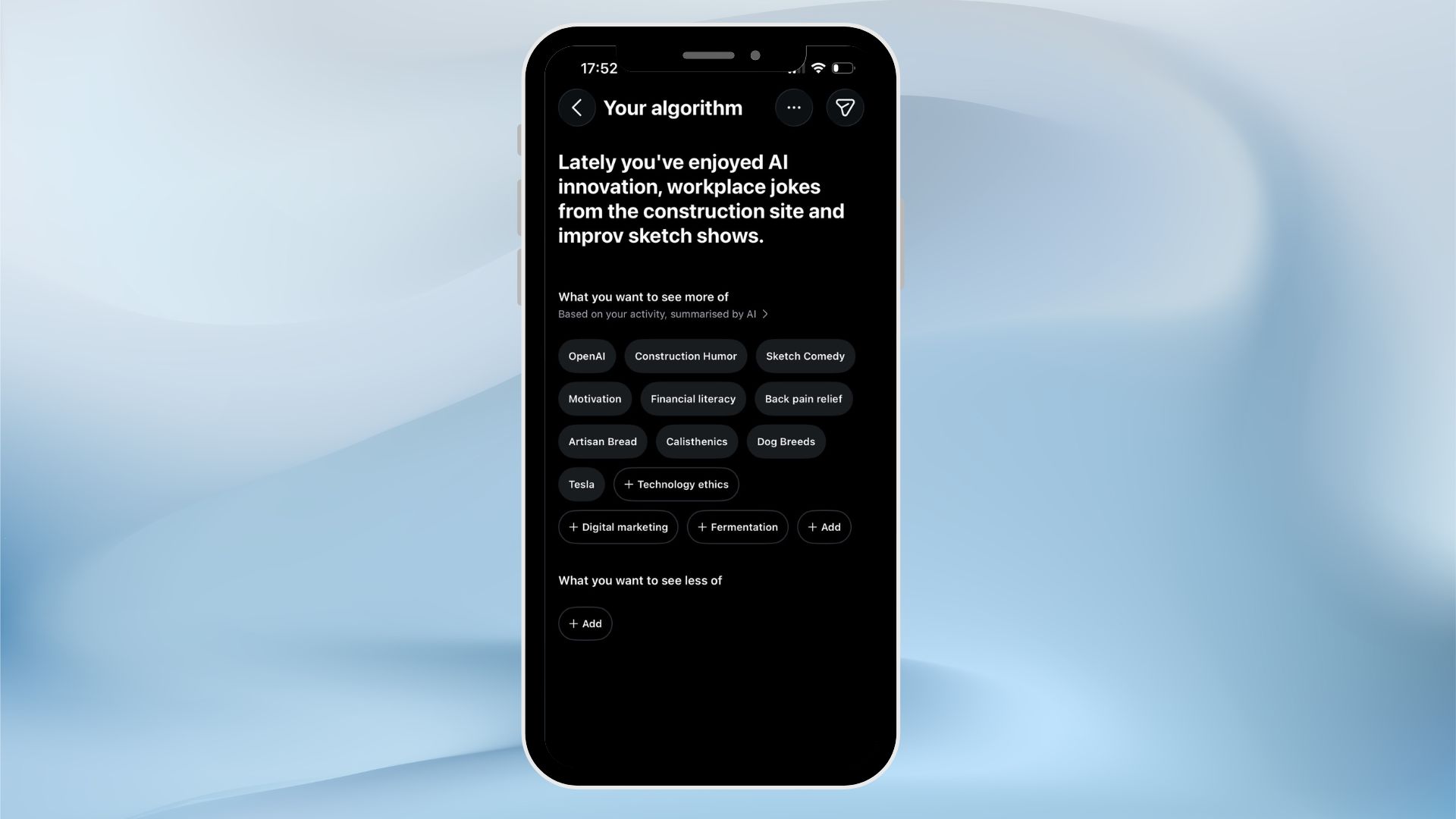
Screenshot from my own Instagram account, September 2026.
Where Personalization Turns Into Manipulation
Personalization sounds like a good thing, and in a lot of cases it is — I don't mind a feed that feels tailored to me. This is also where how AI controls what you see starts to get complicated: the problem begins the moment "tailored" turns into a cage, invisible and hard to leave.
The same system that recommends something genuinely useful after a bad day can also filter out dissenting opinions or nudge behavior without you ever realizing it happened.
Digital psychologists point to three specific risks: echo chambers that form when the algorithm filters out anything that challenges your views, over-personalization that stalls exposure to new ideas, and subtle nudges that shape what you buy or believe without your awareness. This is the part of how AI controls what you see that goes beyond relevance — it's optimizing for whatever triggers emotion, engagement, or conversion, in that order.
Follow the money and the incentive gets clearer. TikTok's ad business was reported at more than $18 billion globally in 2024 (Insider Intelligence), and Meta's is larger still. Longer sessions mean more ad impressions — the algorithm isn't optimized to make you calmer or better informed, it's optimized to keep the session going.
The line that matters in how AI controls what you see: relevance vs. revenue. The system can't tell the difference, so neither can you unless you check.
Shadow Bans and Filter Bubbles, Explained
One of the more controversial parts of how AI controls what you see is what it hides, not just what it shows. Creators sometimes notice views or comments drop without warning — commonly called a shadow ban, when content is quietly suppressed with no formal notice. Neither platform confirms it outright; their own documentation refers instead to "reduced reach" for content that doesn't align with recommendation guidelines.
As a creator myself, I've had posts underperform with no clear reason attached — not because the content was weak, but because some automated flag didn't like a phrase or a background sound. That's the frustrating part: you rarely get told why.
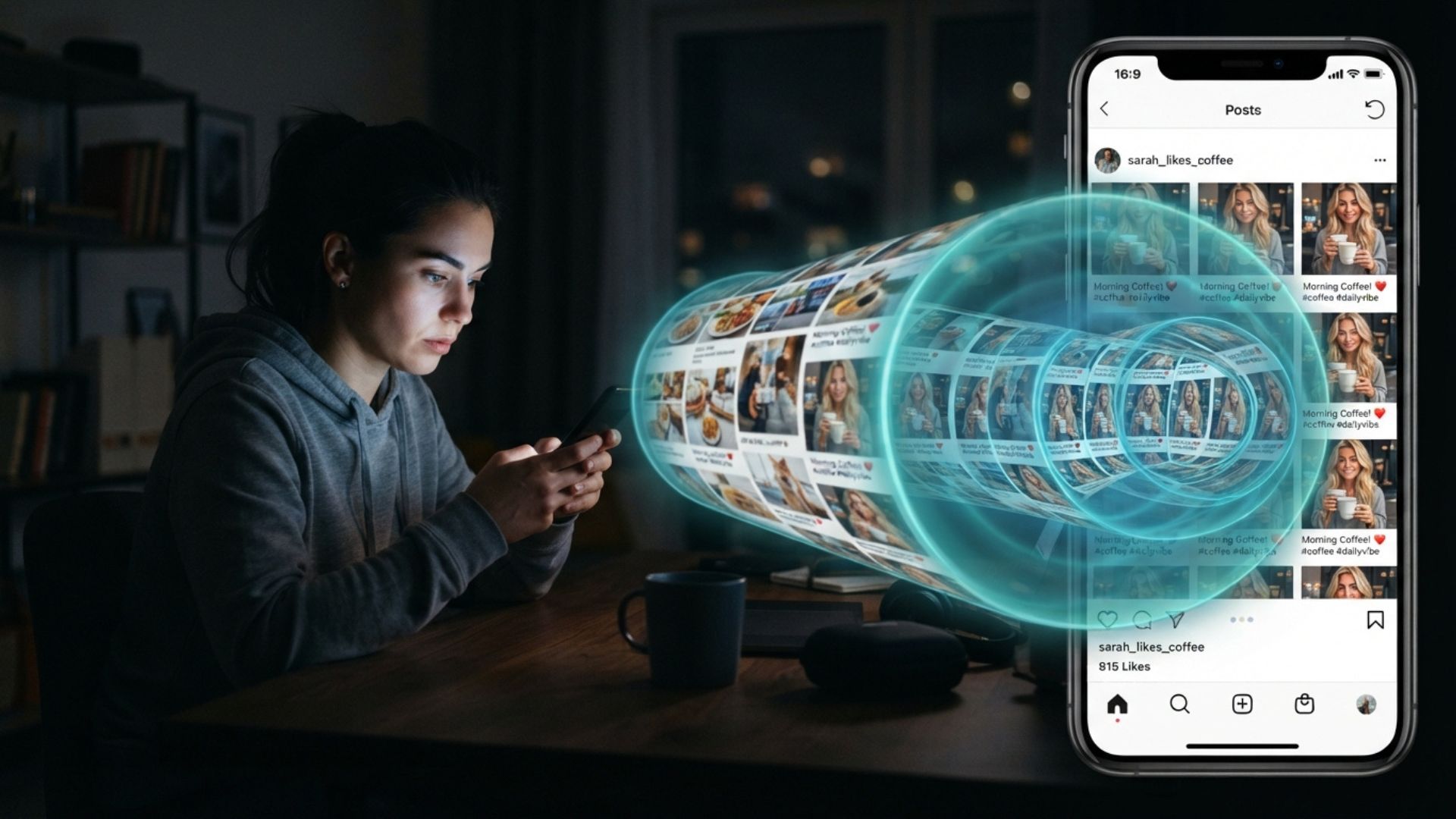
Filter bubbles form through a simpler loop: the algorithm rewards high engagement, you're more likely to engage with what you already agree with, and the cycle repeats until your feed reflects your existing beliefs rather than anything close to a balanced picture. A 2024 New York Times investigation found certain terms were systematically deprioritized across regions — not for violating rules, but for being "less monetizable."
If you're curious how this compares to platform-specific tracking, my breakdown of what your apps learn about you goes further into the data side of this.
What's easy to miss: shadow bans and filter bubbles are two sides of how AI controls what you see — one hides content from others, the other narrows what reaches you.
How to Actually Regain Control of Your Feed
You can't switch the algorithm off, but 2026 gave both platforms real, native controls that change how AI controls what you see in practice, worth using deliberately instead of scrolling past them.
1. Use the Declared-Preference Tools Directly
This is the most direct way to change how AI controls what you see. On Instagram: the slider icon (two hearts) in Reels or Explore, or Settings → Content Preferences, opens "Your Algorithm," where you can add or remove assigned topics. On TikTok: Settings and privacy → Content preferences → Manage topics, plus the "Not Interested" long-press on any video in your feed.
2. Engage Like You Mean It
Passive watch time trains the algorithm just as much as a like does — even a video left running while you're not paying attention. Skip fast past what you don't want, and finish or save what you do. TikTok's own support documentation lists this alongside "Not interested" as a direct ranking input.
3. Reset When It's Genuinely Off
Both platforms now offer a native reset: TikTok's Content preferences → Refresh your For You feed, and Instagram's Reset suggested content option under the same menu. Neither erases your account or followers — they only clear the recommendation weights.
4. If You're Creating, Work With Intent Instead of Chasing the Feed
For creators trying to beat the algorithm fairly rather than guess at it, planning hooks in advance beats reacting to a settings panel every week. This is the one tool I actually reach for on that front:
Bottom line on how AI controls what you see: you have more real, native control over it right now than at any point since these apps launched. Most people just never open the settings.
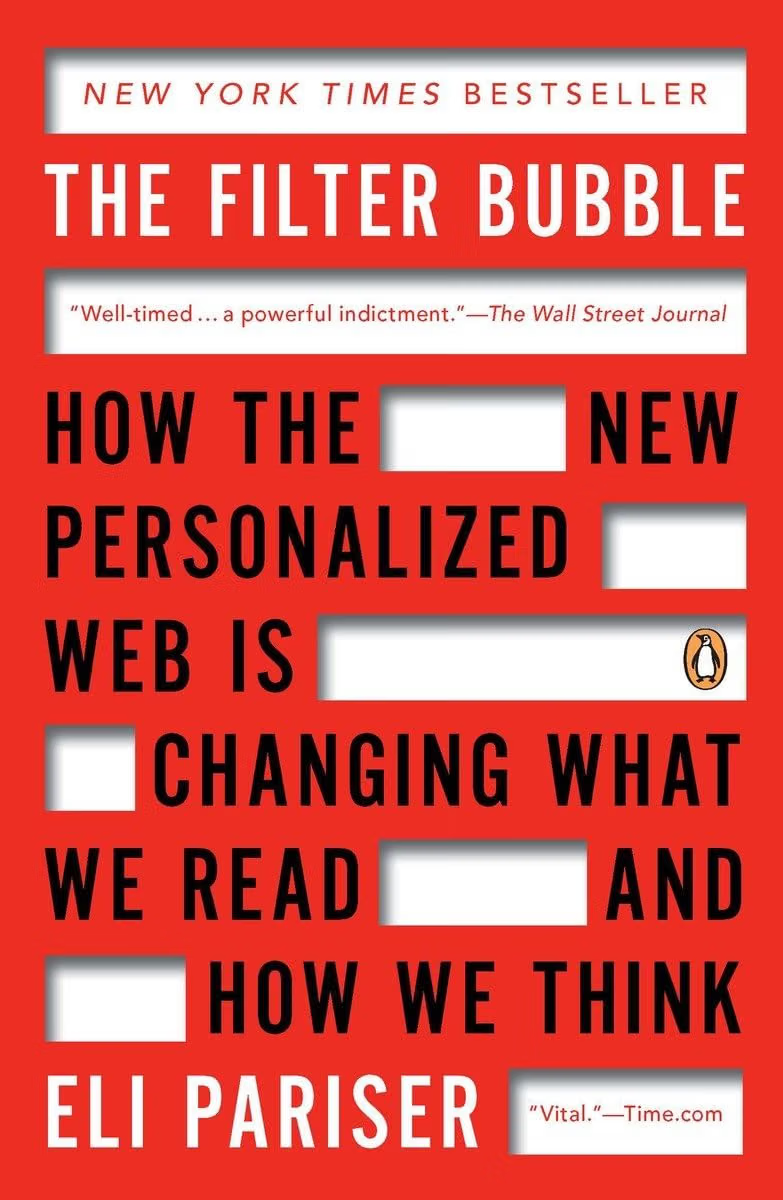
The Filter Bubble — Eli Pariser
The book that named this exact problem years before "algorithm transparency" became a 2026 headline. If Section 5 above bothered you, this is the deeper read.
- Why personalized ranking narrows what you're shown, one click at a time
- What gets lost when a machine decides what's "relevant" for you
Book link is a confirmed active affiliate placement (direct slug, per registry). StoryLab AI is confirmed active on the affiliate registry.
The specific questions readers ask most about how AI controls what you see in 2026:
FAQ — How AI Controls What You See in 2026
🧠 Go Deeper on How AI Controls What You See
Knowing how AI controls what you see is one piece. Here's where I'd go next to see the rest of the picture: