
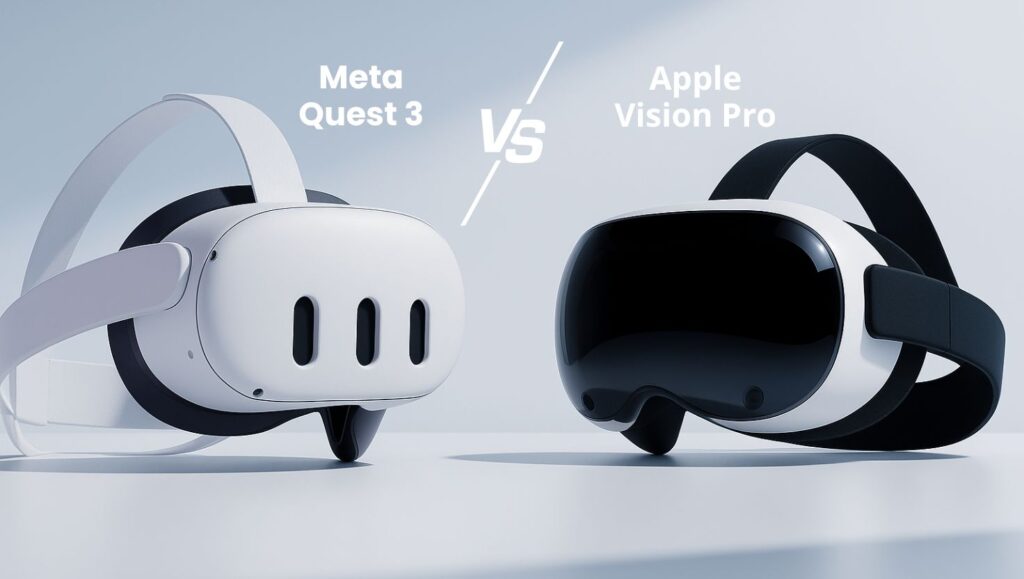
Mirko
AI Tech Writer
Every Meta Quest 3 vs Apple Vision Pro comparison you'll find right now is quoting last year's prices. Meta raised the Quest 3 to $599.99 in April 2026. Apple pushed the Vision Pro to $3,699 in June 2026. That's a real $3,100 gap between two headsets everyone still describes as "$499 vs $3,499." I rebuilt this comparison with what each one actually costs and does today, so you're deciding with real numbers, not a year-old snapshot.
Some links are affiliate links · they support this site at no extra cost to you · Full disclosure
1. Meta Quest 3 vs Apple Vision Pro in 2026: What Actually Changed
Most "Meta Quest 3 vs Apple Vision Pro" articles online still open with the same two numbers: $499 and $3,499. Neither one is accurate anymore.
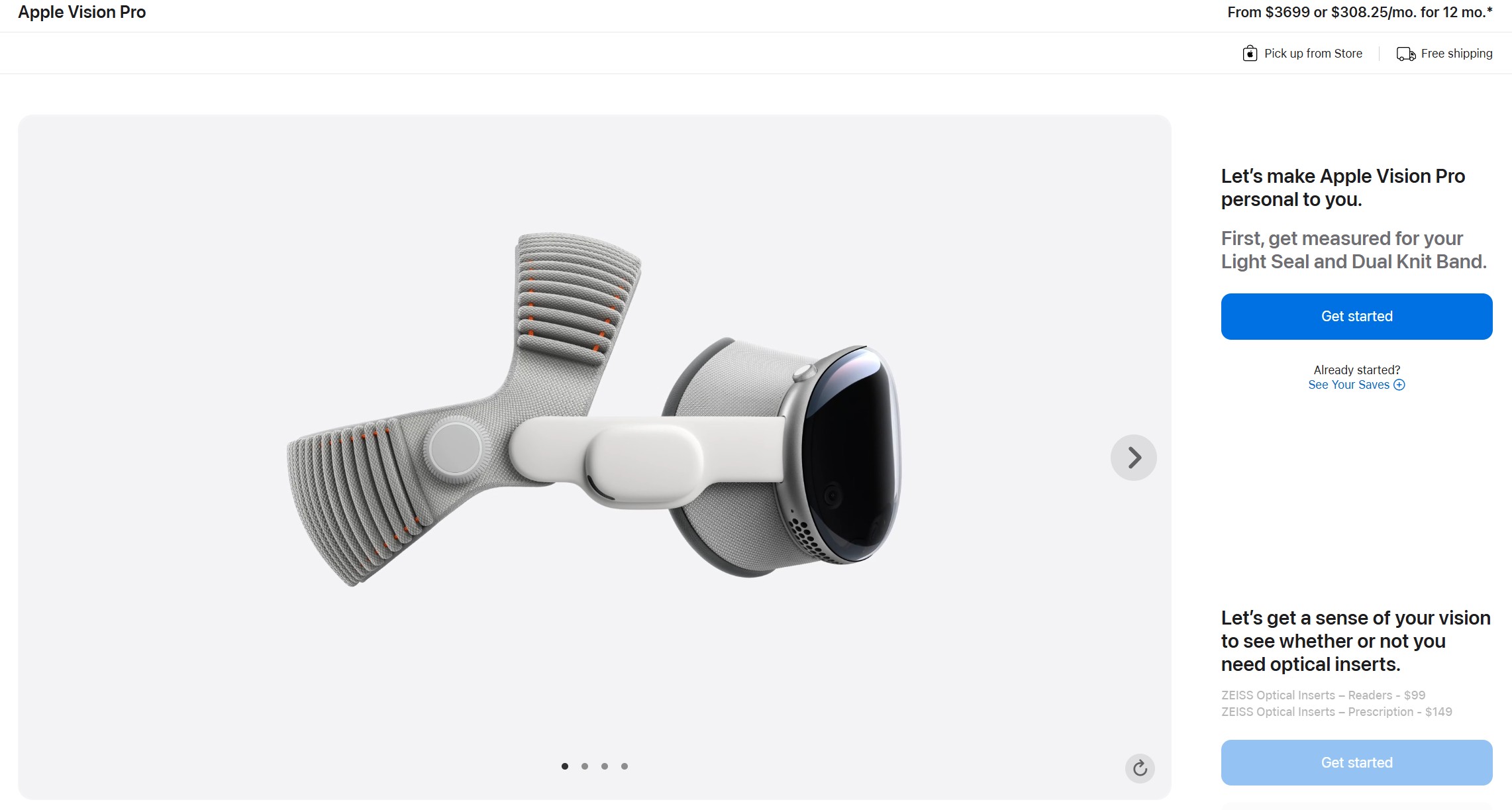
Meta raised Quest 3 pricing on April 19, 2026, and discontinued the 128GB model entirely — the only new Quest 3 you can buy today is the 512GB version at $599.99. Apple followed on June 25, 2026, raising the Vision Pro's base 256GB price from $3,499 to $3,699, with the 512GB and 1TB tiers climbing to $3,899 and $4,199. Apple has tied the increase to rising memory and storage chip costs across its whole lineup, not to anything specific to the headset itself.
One more thing worth knowing before you look at specs: a Meta Quest 4 isn't landing in 2026. Meta's own leadership has confirmed two next-generation devices are in development, but credible reporting points to a launch window of H2 2027 or later for the gaming-focused model. If you were waiting for a cheaper Quest to leapfrog the Vision Pro before buying either one, that wait just got longer.
2. Meta Quest 3 vs Apple Vision Pro Price: What Each One Actually Costs Right Now
Here's what each headset costs today, tier by tier — not the launch-day pricing that keeps getting recycled across the web.
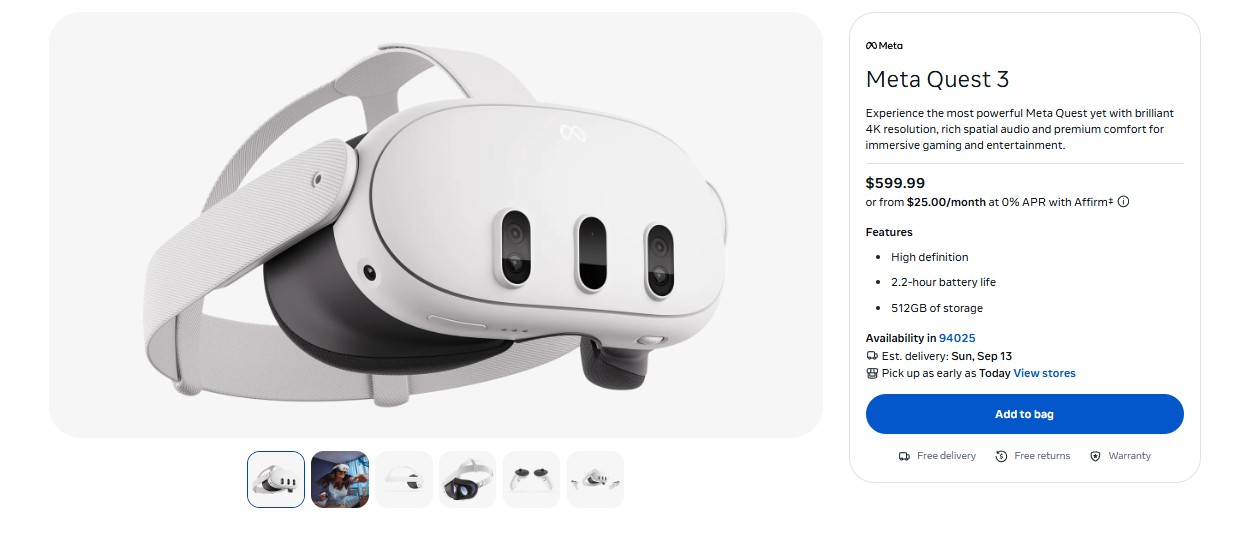
If $599.99 is still more than you want to spend, the Meta Quest 3S starts at $349.99. It runs the same Snapdragon XR2 Gen 2 chip as the Quest 3, just with Fresnel lenses instead of Quest 3's sharper pancake lenses and a narrower field of view — a real trade-off, not a footnote.
On the Vision Pro side, the storage jump costs $200 to $300 per tier. Put another way: the gap between Quest 3's entire lineup, from the $349.99 Quest 3S to the $599.99 Quest 3, is smaller than a single storage upgrade on the Vision Pro.
3. Display & Passthrough: Where the Price Gap Actually Shows Up
This is where the price gap in the Meta Quest 3 vs Apple Vision Pro matchup genuinely earns its keep.
Vision Pro's M5 refresh pushed its dual micro-OLED panels to roughly 23 million total pixels, with Apple citing 10% more pixels rendered than the original M2 model and a refresh rate that now scales up to 120Hz. Quest 3 uses dual fast-switch LCD panels at 2064×2208 pixels per eye — around 9.1 million pixels total — with pancake lenses and a 110° horizontal field of view.
Why the Spec Sheet Undersells How Different This Feels
Reviewers who've used both describe the same gap consistently: text and fine detail look sharper and more natural through the Vision Pro, and its color passthrough reads closer to looking through glass than looking through a camera feed. Quest 3's passthrough is genuinely good for a $599 headset — sharp enough for room-scale gaming and quick real-world checks — it just isn't in the same category.
4. Comfort & Weight: Built for Different Kinds of Sessions
In the Meta Quest 3 vs Apple Vision Pro matchup, weight tells only part of the story — but it's the part people underestimate before buying.
Quest 3 weighs about 515g as a single, self-contained unit — battery included, everything sits on your head. Vision Pro's headset alone weighs 750–800g on the M5 model, up from 600–650g on the original M2 version, and that's before adding its 353g external battery pack, which connects by cable and either sits in a pocket or clips to a waistband.
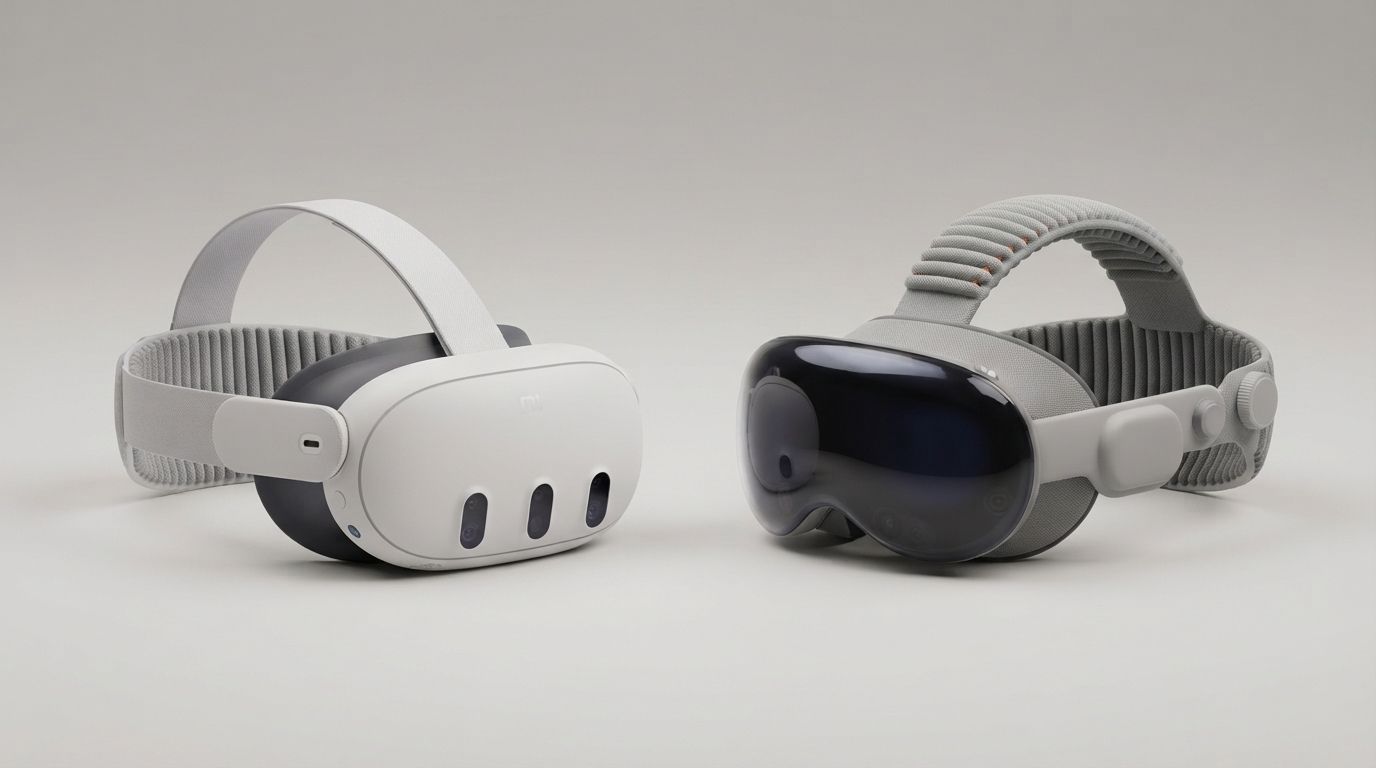
Apple rates the M5 Vision Pro for up to 2.5 hours of general use and up to 3 hours of video playback per charge. Quest 3's built-in battery is rated similarly at roughly 2.2–2.4 hours, though real-world gaming sessions on both devices tend to run shorter than the marketing numbers.
Which One Actually Survives a Workout
Quest 3's weight sits entirely on your face, but it's balanced and cable-free, which is why it's the headset people actually wear during fitness apps and active games. Vision Pro's tethered battery and heavier front assembly make it a seated-session device by design — nobody is doing a HIIT class in one.
5. Meta Quest 3 vs Apple Vision Pro Performance: Gaming Machine vs. Spatial Computer
Specs matter less here than what each chip was actually built to run.
Vision Pro's M5 chip is a 3-nanometer, 10-core CPU/GPU with hardware-accelerated ray tracing and a 16-core Neural Engine that Apple says handles on-device AI tasks up to 50% faster than the M2 model. Quest 3 runs the Snapdragon XR2 Gen 2, a mobile-class chip delivering roughly double the graphics performance of the Quest 2's silicon — genuinely strong for a standalone headset, built for a completely different job.
Where Each One Actually Wins
Quest 3 wins gaming outright: a standalone library running into the thousands of titles, PC VR support through Air Link and Oculus Link, and most of VR's biggest names — Beat Saber, Batman: Arkham Shadow, Alien: Rogue Incursion — are Quest-first or Quest-exclusive. Vision Pro isn't trying to compete there; visionOS is built around large virtual monitors, spatial FaceTime, native Mac screen mirroring, and productivity apps that treat the headset as a wearable Mac, not a game console.
Video: "Meta Quest 3 vs Apple Vision Pro: It's Not Even CLOSE!" — full review on the creator's YouTube channel, covering a month of real-world use across movies, gaming, and productivity.
6. Meta Quest 3 vs Apple Vision Pro Privacy: What Each Headset Actually Collects
In the Meta Quest 3 vs Apple Vision Pro matchup, both headsets are covered in cameras and sensors by design — that's how mixed reality works — but they handle what those sensors capture differently.
Meta Quest 3 collects head and hand tracking data, room-scan data for passthrough and boundary setup, and app usage patterns tied to your Meta account; you can review and limit some of this in account privacy settings, but core sensing is required for MR features to work at all. Apple states that Vision Pro's eye and hand tracking data is processed on-device and isn't shared with apps, websites, or Apple itself, and that Optic ID iris data never leaves the headset or gets backed up to iCloud.
What I Couldn't Verify
I couldn't find an independently audited, like-for-like comparison of how long each company actually retains room-scan or usage data once it leaves the device — both companies publish policy language, not raw retention timelines, and that gap is worth knowing before assuming either headset is fully private.
7. Final Verdict: Meta Quest 3 vs Apple Vision Pro — Choose X If / Choose Y If
The real 2026 gap between these headsets is $3,100, and by now you know exactly what that money buys.
🎮 Choose Meta Quest 3 if:
- You want VR gaming, fitness apps, or general mixed reality without a four-figure commitment
- You'll use it standing, moving, or working out, not just sitting still
- You want PC VR flexibility through Air Link or Oculus Link
- $599.99 (or $349.99 for the 3S) is a price you're comfortable paying today
🥽 Choose Apple Vision Pro if:
- You're already deep in the Apple ecosystem and want a wearable Mac display
- Display quality and passthrough realism matter more to you than price
- You need spatial productivity tools — large virtual monitors, spatial FaceTime — daily
- $3,699+ genuinely fits your budget without stretching it
I'd point you to The Future Is Faster Than You Think by Peter Diamandis and Steven Kotler. It maps how AR/VR convergence fits into the wider wave of exponential technology reshaping work and daily life — a useful frame for judging whether a headset generation like this one is a real leap or an incremental one.
8. FAQ — Meta Quest 3 vs Apple Vision Pro
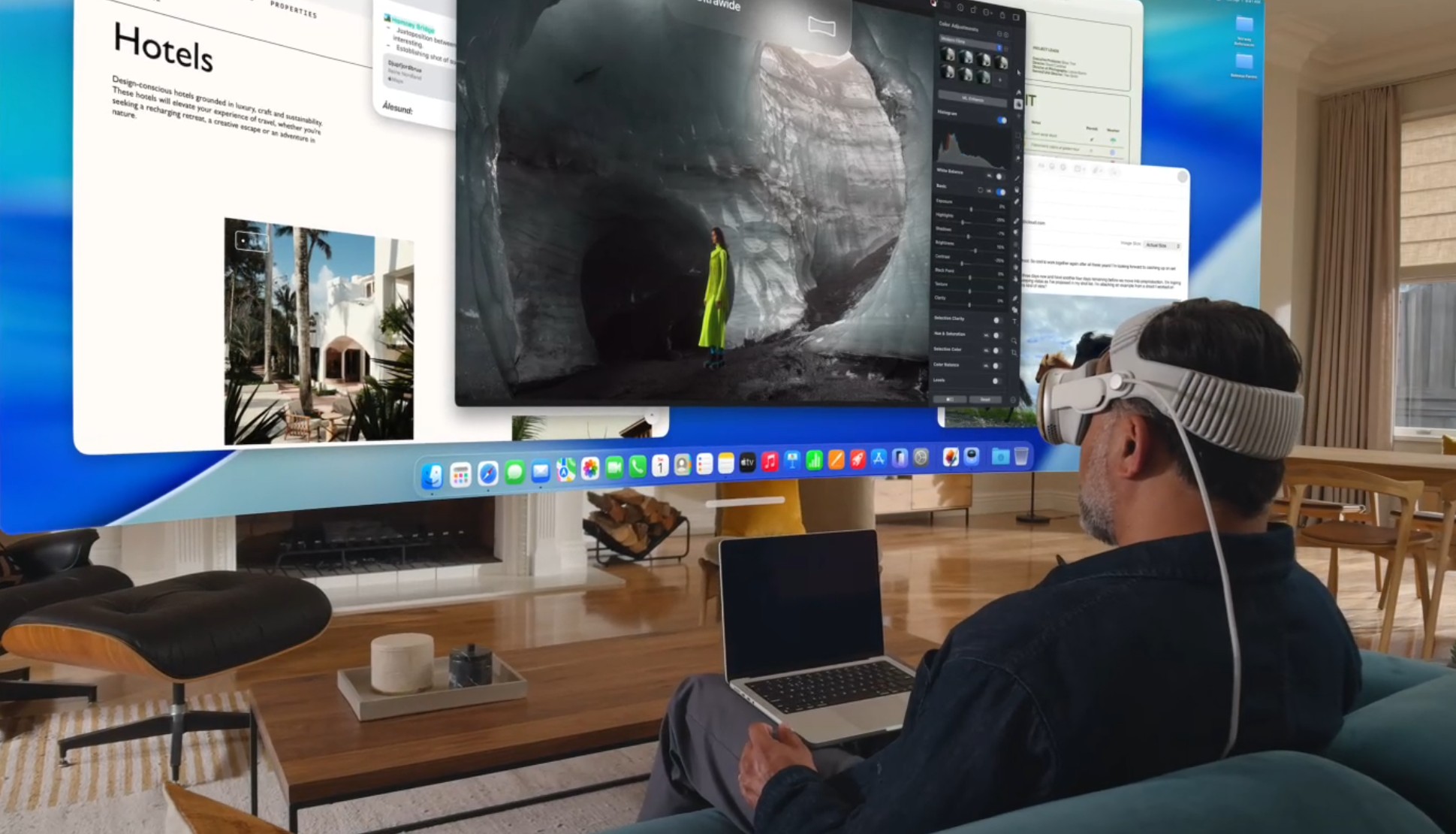
Mixed reality in 2026 still isn't one-size-fits-all, and the $3,100 gap in this Meta Quest 3 vs Apple Vision Pro comparison is exactly why. Meta Quest 3 gets you into VR gaming and fitness for under $600. Apple Vision Pro asks for a much bigger commitment in exchange for the sharpest passthrough and the deepest Apple integration on the market.
There's no universal winner here — just the headset that actually matches what you're going to do with it, at a price you're not going to regret next month.
🚀 Keep Exploring Wearable AI & Mixed Reality
If a $599 or $3,699 headset feels like the wrong entry point, here's where I'd look next: