
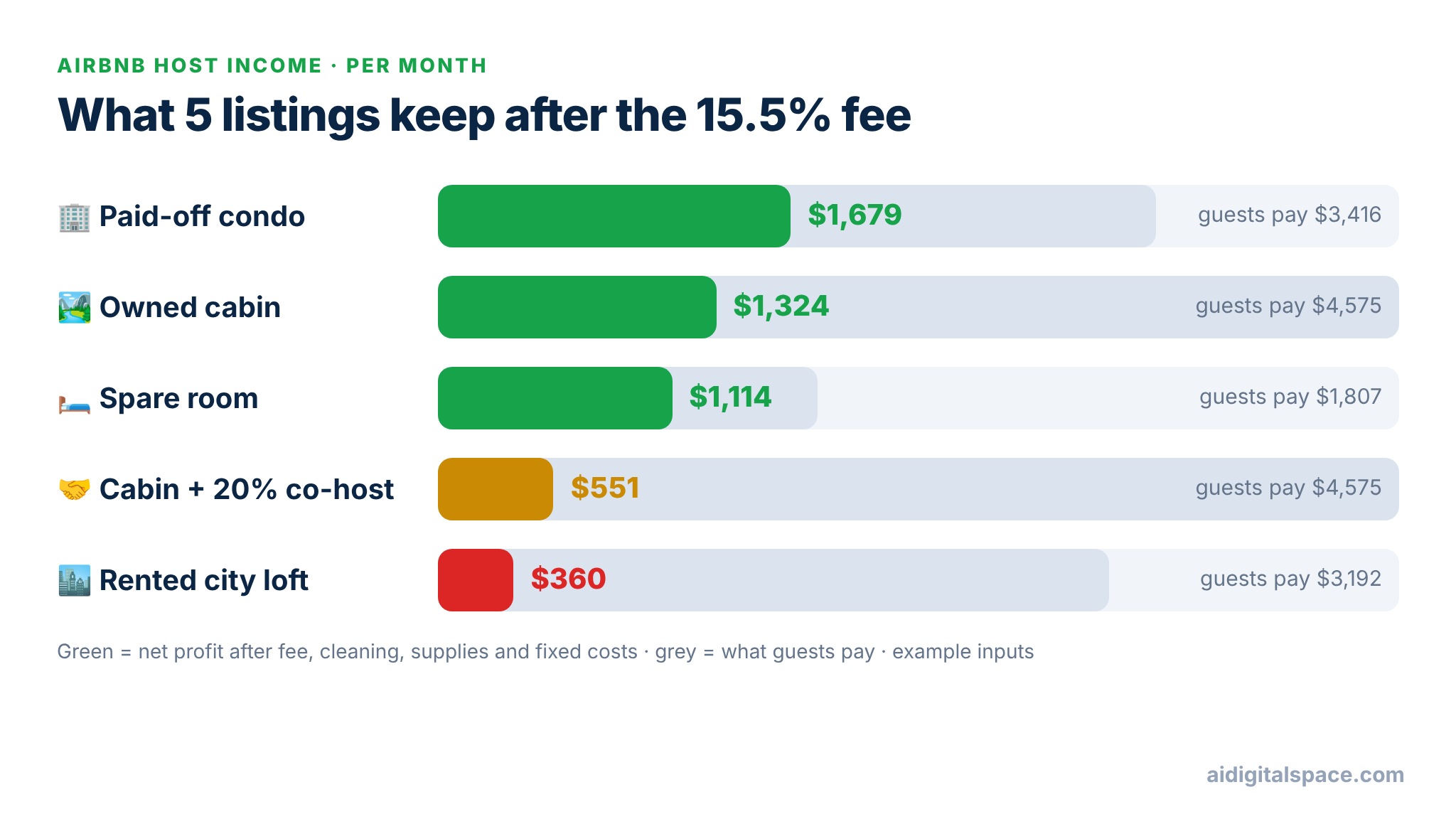
Airbnb host income is the money a listing keeps after the platform fee, cleaning, supplies and every monthly bill, and it's far smaller than the gross booking totals most income claims quote. I ran five common setups through the same math: they keep between $360 and $1,679 a month, and the biggest swing comes from rent or mortgage, not the nightly rate.
Two fee changes make old income numbers wrong. Airbnb now charges most hosts a single 15.5% fee instead of about 3%, and Vrbo moved to a flat 12% commission. Here is what that does to Airbnb host income for each type of listing, and how to check your own.
📋 Table of Contents
No affiliate links in this post · the Host Profit Kit mentioned below is my own product · Full disclosure
How much do Airbnb hosts make after fees?
In my five scenarios, Airbnb host income lands between $360 and $1,679 a month after Airbnb's 15.5% fee and all running costs, or roughly $4,300 to $20,100 a year before income tax. What guests paid was 1.6 to almost 9 times the net, which is why revenue figures alone mislead new hosts.
| Listing | Guests pay /mo | Airbnb fee | Net /mo | Net /yr |
|---|---|---|---|---|
| 🏢 Paid-off condo | $3,416 | −$529 | $1,679 | $20,144 |
| 🏞️ Owned cabin, self-managed | $4,575 | −$709 | $1,324 | $15,892 |
| 🛏️ Spare room | $1,807 | −$280 | $1,114 | $13,369 |
| 🤝 Same cabin, 20% co-host | $4,575 | −$709 | $551 | $6,613 |
| 🏙️ Rented city loft | $3,192 | −$495 | $360 | $4,320 |
"Guests pay" is nights times the nightly rate plus the cleaning fee, which is the number most Airbnb host income claims quote. The net column is what's left after the platform fee, cleaner pay, supplies, fixed bills and, for one scenario, a co-host.
Where does Airbnb host income go?
On the owned cabin, of every dollar guests pay, 45 cents goes to fixed costs, 16 cents to Airbnb, 11 cents to cleaning and supplies, and 29 cents stays with the host. Change the fixed-cost slice and the whole picture moves; the fee slice is the same for every listing.
■ Fixed costs $2,055 (45%) · ■ Airbnb fee $709 (15.5%) · ■ Cleaning + supplies $487 (10.6%) · ■ Profit $1,324 (28.9%)
The cabin's fixed costs are a $1,450 mortgage plus utilities, internet, insurance, software and lawn care. That is why hosts who own outright, or rent out a room in a home they already pay for, keep far more of each booking than investors carrying a fresh mortgage or a lease: Airbnb host income follows fixed costs.
💡 The cleaning fee is not profit. Airbnb takes 15.5% of it too, so $100 of cleaner pay and supplies needs about a $118 cleaning fee just to break even per stay.
How did the 15.5% fee change Airbnb host income?
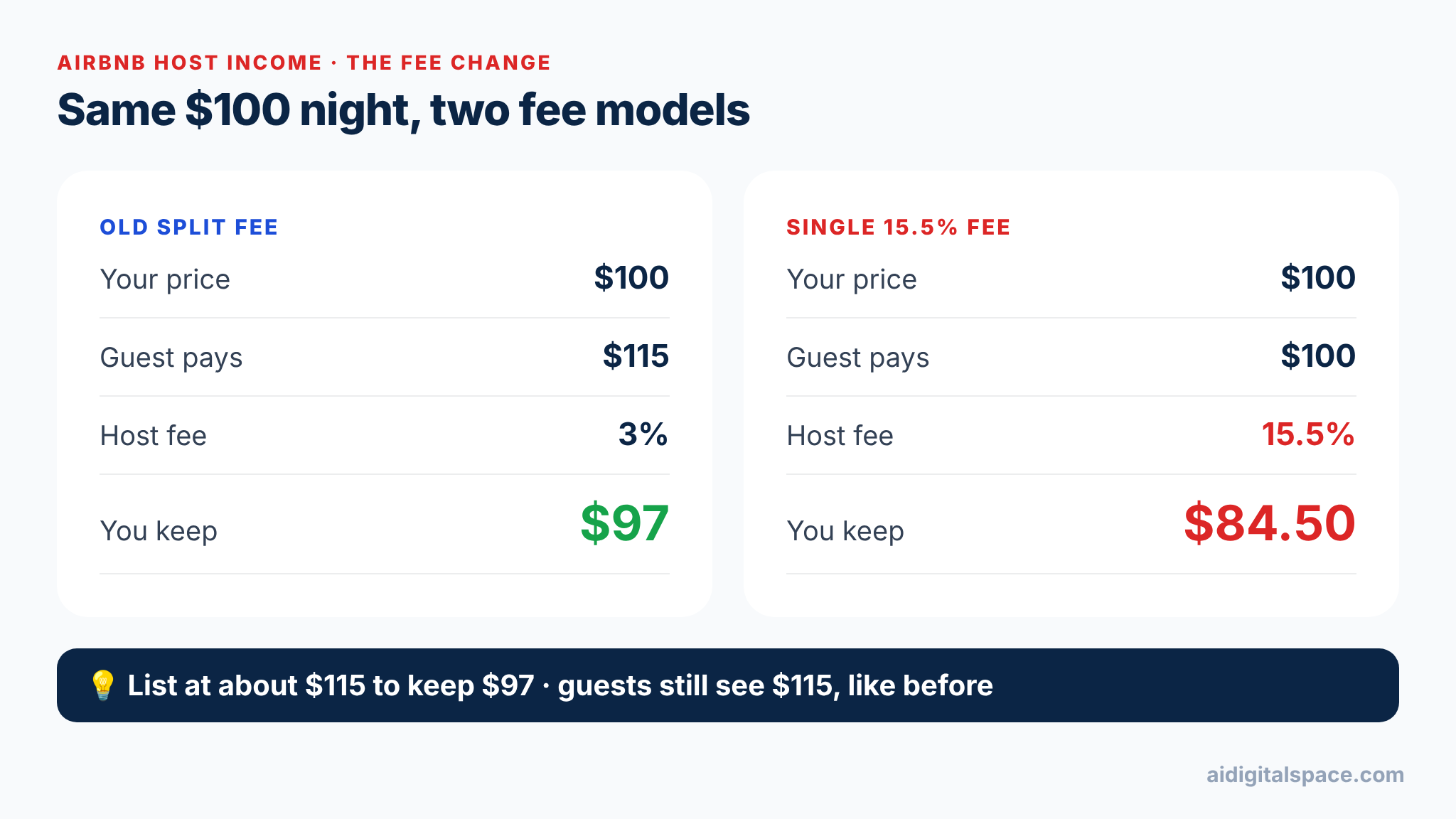
A host who kept the same nightly price after moving from the 3% split fee to Airbnb's single 15.5% fee loses about 12.9% of every payout. In my scenarios that cut to Airbnb host income is $2,712 to $6,864 a year. Raising the listed price by about 15% keeps the payout where it was.
Airbnb's own explanation uses a $100 night: on the split fee the host kept $97 and the guest paid $115; on the single fee the host must list at $115 to keep the same $97. Hosts on property management software were switched on October 13, and those who didn't change prices now earn $84.50 on that $100 night (Airbnb).
| Listing | Net on 3% fee | Net on 15.5%, same price | Lost per year |
|---|---|---|---|
| 🏞️ Owned cabin | $1,896/mo | $1,324/mo | −$6,864 |
| 🏙️ Rented loft | $759/mo | $360/mo | −$4,788 |
| 🛏️ Spare room | $1,340/mo | $1,114/mo | −$2,712 |
Vrbo went the other way on rate. Its new pay-per-booking commission is a flat 12% with payment processing included, for bookings made after its October 29 switch, replacing roughly 8% on older bookings (Expedia Group). The same cabin stays booked on Vrbo would keep $1,484 a month, but only if Vrbo fills as many nights.
Which hosts keep the most Airbnb host income? 5 scenarios
Hosts with low fixed costs keep the most: a paid-off condo or a spare room beats a busier listing with a mortgage or lease. A co-host roughly halves the cabin's income, and rental arbitrage works only with high occupancy and tight costs.
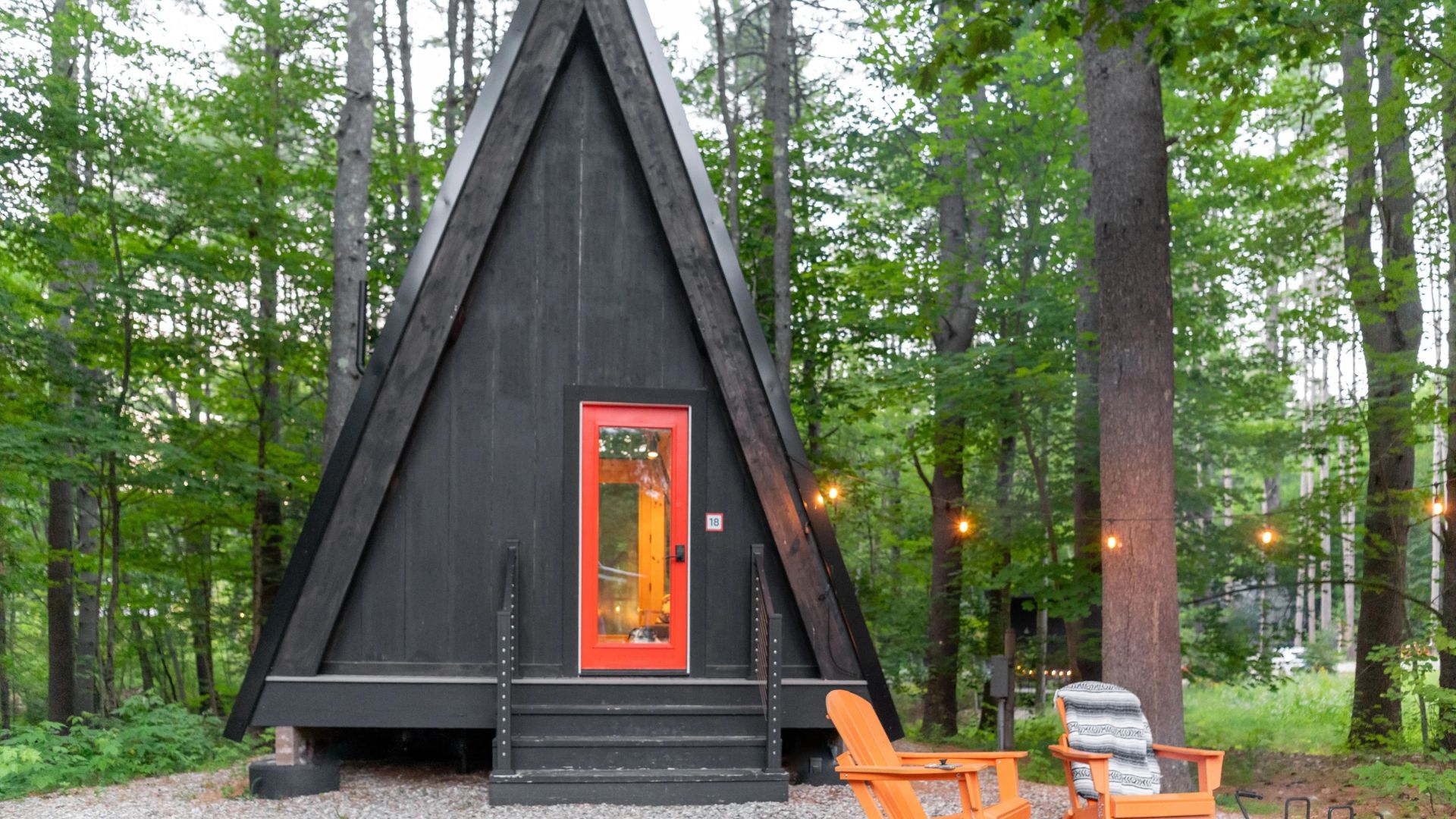
The costs in every scenario are my own example inputs: cleaner pay of $30 to $85 per turnover, $6 to $15 in supplies, and fixed bills that match each setup. Plug your real numbers in and the ranking of Airbnb host income can change, which is the point of running them.
What occupancy do you need to break even?
Break-even occupancy ranged from 7% for the spare room to 55% for the rented loft. Compare yours with AirDNA's forecast of about 57.4% average U.S. occupancy this year: a listing that needs 55% has almost no room for a bad month.
The forecast comes from AirDNA's midyear outlook, reported by Short Term Rentalz, which also says nightly rates, not extra bookings, are driving revenue growth. That favors hosts who reprice for fees and seasons over hosts who chase occupancy with discounts.
Is Airbnb host income taxed?
Yes. In the U.S., rental profit is taxable income, and the IRS has specific rules for homes you also use yourself and for short average stays. Every Airbnb host income figure in this post is before income tax, so set money aside and talk to a tax professional about your situation.
The IRS guide to residential rentals, Publication 527, covers deductible expenses and personal-use limits. Whether your activity counts as a rental or closer to a lodging business can depend on your average stay and the services you provide, which is one reason to log every stay's dates.
⚠️ Lodging taxes that Airbnb or Vrbo collect and remit for you are not income. Leave them out of every calculation, or your profit will look bigger than it is.
How do I work out my own Airbnb host income?
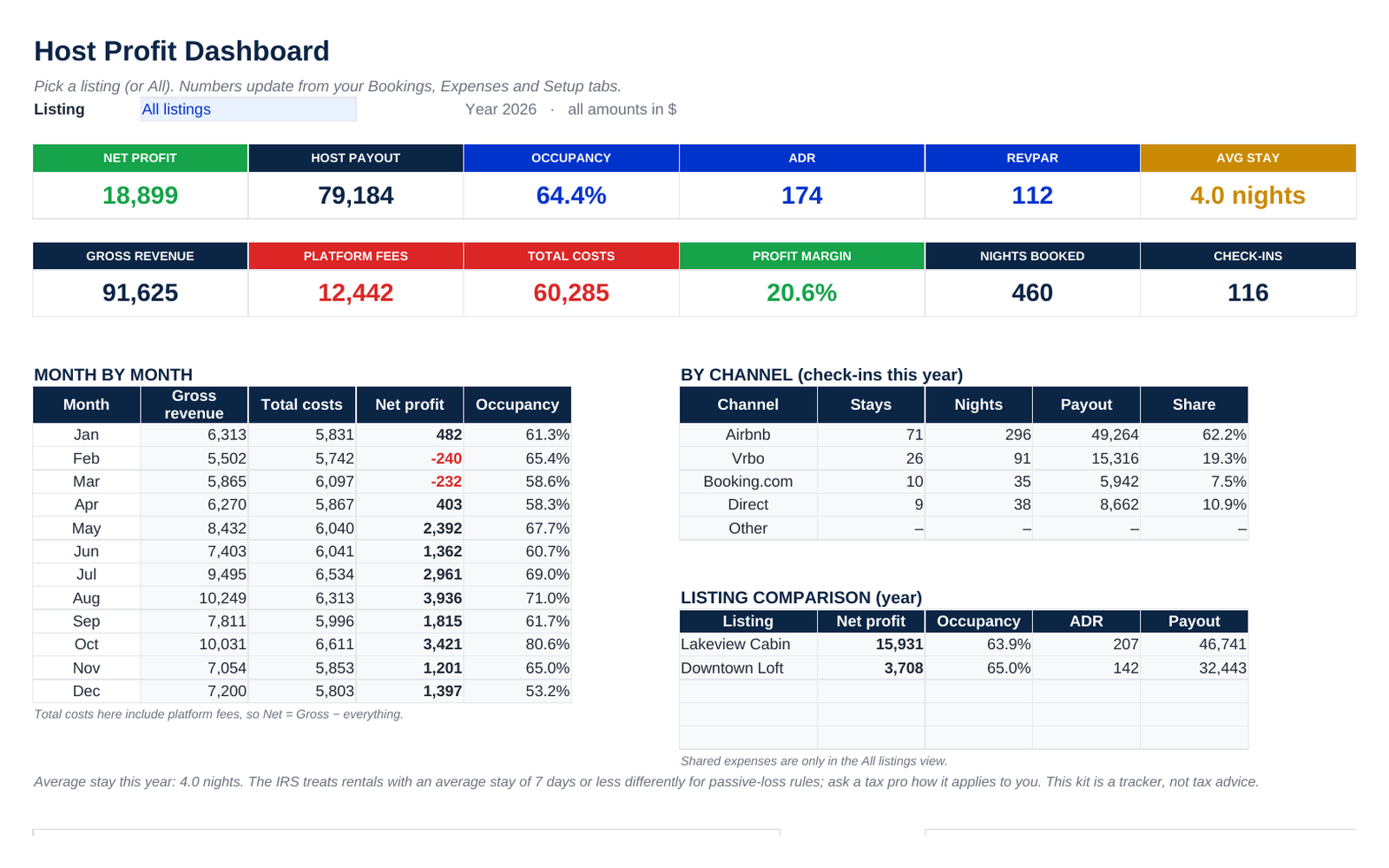
For a quick estimate, enter your nightly rate, occupancy, stay length and costs in a profit calculator. For your real Airbnb host income, log every booking with its channel, dates and fees, and subtract actual costs month by month.
My free Airbnb profit calculator runs the same formula as this post, shows your break-even occupancy and nightly rate, and prices the same stays on Airbnb, Vrbo, Booking.com and direct in one view.
To track what happens, I built the Host Profit Kit, an Excel and Google Sheets workbook with a booking log for up to 5 listings, a color-coded booking calendar, an expense log, a month-by-month P&L, a dashboard and a price calculator, with the new 15.5% and 12% fees as defaults. A free one-listing version tracks Airbnb host income for a single property for a full year.