Giorgio
AI Tech Writer
Most to-do apps just store your tasks. The best AI task managers actually schedule them — automatically, around your calendar, deadlines, and energy levels. After testing Motion, Akiflow, and several top alternatives, we found that not all AI scheduling software is built the same. If you're spending $15–$45/month on an AI productivity tool, this ranked guide tells you exactly which one is worth it — and which to skip.
We ranked every major AI task manager on real-world performance: auto-scheduling accuracy, calendar sync, team features, and pricing per seat. Whether you're a solo professional drowning in tasks or a team lead hunting for the best productivity apps for work, we cut through the noise — so you don't waste time or money on the wrong task automation app.
This post contains affiliate links · Supporting this blog costs you nothing extra · Full disclosure
1. Introduction – Why AI Task Managers Are Taking Over Productivity
Most professionals spend more time managing tasks than actually completing them. According to Asana's Anatomy of Work Index, workers lose nearly 60% of their day to "work about work" — chasing updates, reassigning tasks, and manually rebuilding plans after every overrun meeting. A standard to-do app stores your list. An AI task manager builds your day.
📊 The Productivity Gap — By the Numbers
The best AI task managers use machine learning to do what no passive list can: prioritise, reschedule, and adapt in real time. Tools like Motion and Akiflow connect to your calendar, estimate how long each task actually takes, and silently rebuild your week when priorities shift. This is exactly why more professionals are switching from manual planning to AI scheduling software that adapts to their real workload.
🆚 Standard To-Do App vs AI Task Manager
This shift is already underway. AI productivity tools that automate scheduling are growing fast — and for good reason. Whether you're a solopreneur, a remote team lead, or a freelancer juggling multiple clients, the right task automation app returns hours every single week. Below, we've ranked the best options so you can stop guessing and start working smarter.
2. Quick Picks – Our Top AI Task Managers of the Year

We tested over a dozen AI task manager tools across real workflows — evaluating scheduling accuracy, calendar sync, mobile usability, and actual hours saved per week. These three best AI task managers consistently outperformed the rest. They cover different budgets and work styles, so whether you're a solo professional or managing a distributed team, there's a strong pick below.
Motion
Best for: busy professionals who need full AI scheduling
- Automatically builds and rebuilds your daily schedule
- Merges tasks, meetings and deadlines in one view
- Reprioritises in real time when plans change
Akiflow
Best for: deep work professionals and remote teams
- Universal inbox pulls tasks from all your apps
- Time-blocking with a full calendar command center
- Keyboard-first workflow — faster than any other AI task manager
Reclaim AI
Best for: teams and budget-conscious professionals
- Auto-schedules habits, focus blocks and tasks
- Smart meeting scheduling across your whole team
- Deep task automation with Google Calendar and Slack
📌 Not sure which fits your workflow? These quick picks are summaries — full reviews of Motion and Akiflow are in sections 4 and 5. For a side-by-side breakdown of features and pricing, jump to Section 7: Comparison Table. If you're also evaluating broader AI productivity tools, our Notion AI vs Taskade vs ClickUp comparison covers the workspace angle.
3. What Makes an AI Task Manager Different from a Regular To-Do App
A standard to-do app is a passive list with a due date. It stores what you tell it and reminds you when something is overdue. An AI task manager works fundamentally differently: it reads your calendar, estimates how long each task takes, and actively decides when you do what — building a real schedule, not just a list. Harvard Business Review calls this the core failure of traditional apps — they create the illusion of productivity without protecting your time. This is the gap that separates the best AI task managers from every standard checklist tool on the market.
🤖 4 Things an AI Task Manager Does That To-Do Apps Can't
Auto-Scheduling Engine
Reads your calendar and places each task in a real available slot — no manual planning required. This is the core engine behind every serious AI scheduling software worth using in 2026.
Real-Time Replanning
A meeting overruns. A deadline shifts. A good AI task manager reschedules everything automatically — in seconds — so you never have to rebuild your day manually.
Duration Intelligence
Learns from your actual task history to estimate realistic completion times — not optimistic guesses. Your schedule finally reflects how long work actually takes.
Unified Task Layer
Pulls tasks from email, Slack, GitHub and project tools into a single view. Unlike basic task automation apps that store lists in isolation, these tools bridge every platform where work actually happens.
⚡ How AI Task Managers Change Your Day in Practice
This shift from passive storage to active planning is what defines the best AI task managers on the market today. You stop being the scheduler. The AI owns that layer — freeing you to focus on actual work rather than managing the AI productivity tools around it. The task automation apps in this guide all operate on this principle — but at very different levels of sophistication, price, and control. If you want to see it in action before choosing, our guide on turning notes into tasks with AI shows a real workflow that takes under five minutes to set up.
4. Motion AI – The Smart Scheduler for Busy Professionals
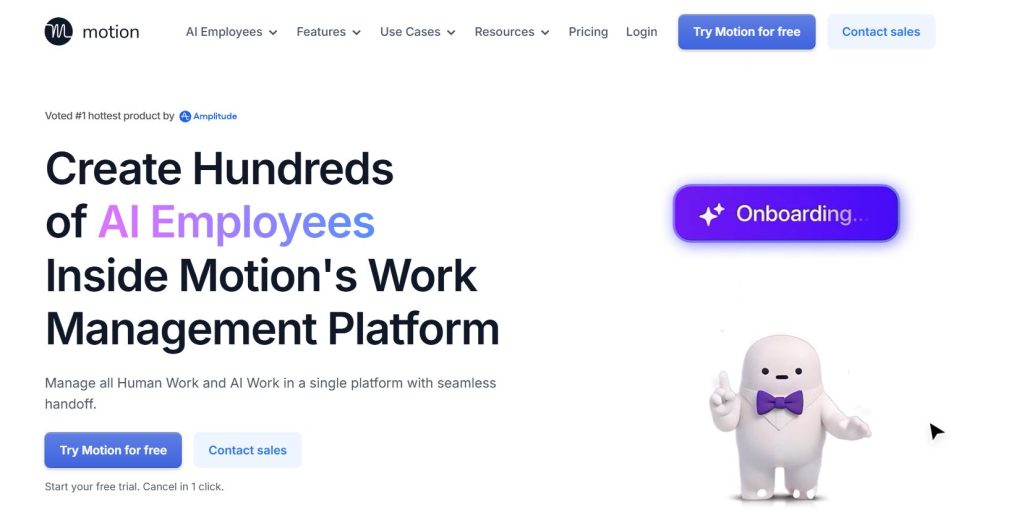
Motion is the most capable AI scheduling software we tested. Unlike tools that simply list your tasks, Motion's planning engine reads your entire calendar — every meeting, commitment, and open slot — then builds a prioritised daily schedule for you, automatically. Every morning, your day is already planned. Every time a meeting overruns or a deadline moves, your tasks reshuffle in the background. No manual intervention, no wasted time staring at a task list trying to decide what to do next.
⚡ Motion — At a Glance
★ 4.7 / 5 — Editor's Pick🔍 Key Features & Pricing
What Motion Includes
- AI auto-scheduling engine — builds your day automatically
- Smart meeting scheduler with shareable booking links
- Project management with task dependencies
- Recurring task scheduling with intelligent time-blocking
- Integrations: Google Calendar, Outlook, Zoom
- Full mobile app — iOS & Android
Pricing Plans
⚖️ Pros & Cons
What We Loved
- Best auto-scheduling engine in the category
- Calendar and tasks fully unified in one view
- Replans automatically when priorities shift
- Strong, fast mobile app
Watch Out For
- No permanent free plan
- Initial setup takes time to configure well
- Pricier than most alternatives
- Limited scheduling rule customisation
Motion is the right choice if your calendar is perpetually overloaded and manual replanning costs you real time every day. It's one of the best AI task managers for professionals handling 15+ active tasks across multiple projects simultaneously — the kind of workload where a passive to-do list simply breaks down. For a deeper dive, read our full Motion app review or check verified user reviews on G2 before committing.
Try Motion free for 7 days — no credit card needed to start
Start Your Free Trial →5. Akiflow AI – Your Command Center for Tasks and Calendar
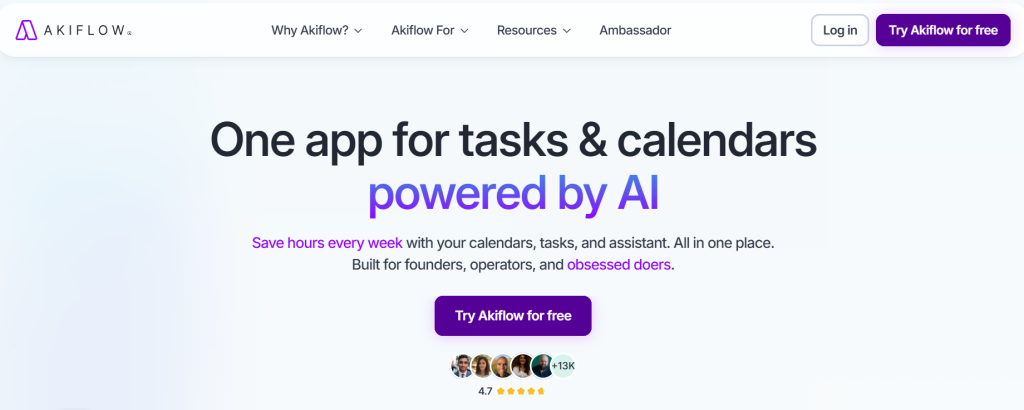
Where Motion auto-builds your schedule, Akiflow gives you total command over it. This AI task manager works by pulling every task from Gmail, Slack, Asana, ClickUp, Linear and 30+ other tools into a single unified inbox — then letting you drag each task directly onto your calendar with a keyboard shortcut. The result is less scattered thinking and more intentional time blocking. If you already know how to plan your day but waste time switching between apps to gather what needs doing, Akiflow solves exactly that problem.
🎯 Akiflow — At a Glance
★ 4.5 / 5 — Best for Focus🔍 Key Features & Pricing
What Akiflow Includes
- Universal inbox with 30+ app integrations
- Unified calendar with drag-and-drop time blocking
- Keyboard-first Command Center for rapid task capture
- Daily planning ritual — structured morning workflow
- Productivity analytics and weekly review
- Full mobile app — iOS & Android
Pricing Plans
⚖️ Pros & Cons
What We Loved
- Best unified inbox — every task in one place
- Keyboard-driven speed unmatched by any rival
- 30+ deep integrations out of the box
- Structured daily ritual builds planning consistency
Watch Out For
- Less "magic" auto-scheduling than Motion
- Keyboard shortcuts take time to master
- No permanent free plan
- Mobile experience lighter than desktop
Akiflow is the right pick if your problem is fragmentation — tasks living in too many tools — rather than a calendar that's out of control. It's one of the best productivity apps for work for freelancers and remote professionals who manage clients across multiple platforms simultaneously. For a deeper breakdown, see our Akiflow daily planner review or compare ratings on Capterra before committing.
Try Akiflow free for 7 days — no credit card required
Start Your Free Trial →6. Other Notable Alternatives Worth Trying (Todoist, Notion AI, Sunsama, and More)
Motion and Akiflow lead the best AI task managers category, but they're not the right fit for everyone. According to Asana's Anatomy of Work research, professionals now juggle an average of 10+ apps daily — and the right AI task manager is often the one that integrates best with the tools you're already using. These five task automation apps cover the budgets, work styles, and team sizes that Motion and Akiflow don't fully address.
Todoist
Free · Pro $4/moThe cleanest task automation app available. AI natural language entry and smart scheduling suggestions — no auto-planning engine, but zero learning curve. Best for minimalists who need reliable task capture without complexity.
Try Todoist Free →Notion AI
Free · Plus $10/moCombines AI writing, wikis, and task databases in one workspace. Not a dedicated AI task manager, but unbeatable when your team already lives in documents and shared notes. Best for knowledge workers and content teams.
Explore Notion AI →Sunsama
From $16/moOne of the best productivity apps for work if you value intentional planning over full automation. Guides you through a structured morning ritual that imports from all tools, then time-blocks your day deliberately. Best for deep work practitioners.
Try Sunsama →Reclaim AI
Free · Paid $8/moThe best free AI scheduling software in the category — auto-schedules habits, tasks, and focus blocks on Google Calendar at no cost. Best entry point into AI task management for individuals and budget-conscious teams.
Get Reclaim Free →Clockwise
Free · Teams $6.75/moAmong the strongest AI productivity tools for distributed teams — optimises the entire group's calendar to protect shared focus time and resolves scheduling conflicts automatically. Best for engineering and remote teams.
Try Clockwise →💬 Evaluating AI task managers beyond this list? Our Notion AI vs Taskade vs ClickUp breakdown covers the workspace angle in full. For getting the most out of Todoist specifically, see how to build a real AI workflow with Todoist.
7. Comparison Table – Features, Pricing, and Ideal Users
Every AI task manager in this guide targets a different type of professional. This table cuts through the feature noise and shows you what actually matters: auto-scheduling capability, free plan availability, price, and who each tool is genuinely built for.
| Tool | AI Auto-Scheduling | Calendar Sync | Free Plan | From Price | Best For |
|---|---|---|---|---|---|
| Motion ★ Top Pick | ✓ Full AI | ✓ | ✗ Trial only | $12/mo | Busy professionals |
| Akiflow | ⚡ Time-blocking | ✓ | ✗ Trial only | $9.99/mo | Focus & deep work |
| Reclaim AI | ✓ Full AI | ✓ | ✓ Free | $8/mo | Budget & teams |
| Todoist | ✗ | ⚡ Limited | ✓ Free | $4/mo | Simple task capture |
| Sunsama | ⚡ Daily ritual | ✓ | ✗ Trial only | $16/mo | Intentional planners |
| Notion AI | ✗ | ✗ | ✓ Free | $10/mo | Doc-based teams |
| Clockwise | ⚡ Team focus | ✓ | ✓ Free | $6.75/mo | Engineering teams |
✓ Full AI = automatically builds and rebuilds your schedule. ⚡ Partial = AI-assisted but requires manual input. The best AI task managers for most professionals remain Motion and Akiflow — but if budget is the deciding factor, Reclaim AI's free plan delivers genuine AI scheduling at zero cost. Need help choosing? Our guide to fixing AI productivity tools that aren't working covers the most common decision mistakes.
8. How to Choose the Right AI Task Manager for Your Workflow
Choosing the right AI task manager comes down to one question: where does your productivity break down? The tools in this guide solve different problems. Match your specific pain point to the right tool below — this takes less than a minute and saves you weeks of trial and error.
My calendar is overloaded and I can't plan my day manually anymore
You need full AI auto-scheduling. Motion reads your calendar, estimates task duration, and builds your daily plan without any input from you.
→ Use MotionMy tasks are scattered across Gmail, Slack, Asana and three other tools
You need a unified inbox. Akiflow pulls everything into one view and lets you time-block it directly onto your calendar with a keyboard shortcut.
→ Use AkiflowI want AI scheduling but can't justify a paid subscription right now
Reclaim AI's free plan auto-schedules habits, tasks, and focus blocks on Google Calendar. It's the best no-cost entry point into AI scheduling.
→ Use Reclaim FreeMy team works in Notion and documents — we don't need a separate task app
Notion AI integrates tasks directly inside your wikis and docs. Not a scheduler, but the right fit when your workflow is document-first.
→ Use Notion AII want to plan my day intentionally — with focus and structure, not automation
Sunsama is built around a morning planning ritual that imports tasks from all tools and guides you through deliberate time blocking each day.
→ Use SunsamaIf none of these scenarios describe you exactly, start with the best AI task managers free trials — Motion and Reclaim AI both let you test without a credit card. A week of real use tells you more than any comparison article. For troubleshooting if a tool isn't clicking, see our guide on fixing AI productivity tools that aren't working.
9. Ethical AI Reflection – How Much Should We Let Algorithms Plan Our Days?

There's a question worth sitting with before you hand your schedule to an algorithm: should you? The best AI task managers are remarkably capable — but when an AI task manager builds your day, you gain efficiency while also sharing sensitive calendar and task data with a third-party platform. The act of planning has value beyond the outcome. Deciding what matters, making trade-offs, thinking through priorities — these are judgment calls, not just scheduling problems. No AI scheduling software can fully replicate the intentionality behind a well-considered plan.
⚖️ Two Sides Worth Considering Before You Commit
Reasons to Be Thoughtful
- Your full calendar and task data is shared with the platform — AI task manager data policies vary significantly
- Over-reliance on task automation apps may erode your own planning instincts over time
- AI doesn't know your energy levels, emotional state, or what truly matters to you today
- Subscriptions create dependency — what happens if the service shuts down or raises prices?
The Case for AI Planning
- The best AI task managers free up cognitive load for higher-value decisions
- Reduces decision fatigue that accumulates across a long work day
- Handles repetitive scheduling logic that humans consistently get wrong under pressure
- Creates protected space for more intentional, focused deep work
The most effective approach treats AI productivity tools as a starting layer, not the final word. Let the AI task manager handle the mechanical work of scheduling — then review the output each morning and adjust based on how you actually feel and what genuinely matters that day. That's not a compromise. It's the best version of both approaches. For a thoughtful read on reclaiming intention in a distracted digital environment, Cal Newport's Digital Minimalism is worth your time — as is the Center for Humane Technology for the broader conversation on technology and human agency.
10. Final Thoughts + Recommended Resources
After testing over a dozen tools, the verdict is clear: the best AI task managers in this category are not interchangeable. Motion wins on automation. Akiflow wins on speed and integration breadth. Reclaim AI wins on value. The right choice depends on where your productivity actually breaks — not on which app has the best marketing.
🏆 Our Final Recommendations
Motion — Best Overall
Full AI auto-scheduling · Best for busy professionals with 15+ tasks daily · From $12/mo
Akiflow — Best for Focus Workers
Unified inbox + time-blocking · Best for deep work & multi-platform users · From $9.99/mo
Reclaim AI — Best Free Option
AI scheduling + habits · Best for teams and budget-conscious users · Free plan available
Whichever tool you choose, the real win comes from actually using it consistently for two weeks. Every AI productivity tool in this guide has a free trial — so the only cost is your time. Start with the tool that matches your scenario from Section 8, commit to it for a fortnight, and measure the difference in hours reclaimed.
📚 Dig Deeper — Recommended Guides
Faq
What is the best AI task manager in 2026?
+Motion is the best AI task manager in 2026 for most professionals due to its full auto-scheduling engine that builds and rebuilds your daily plan automatically.
Akiflow is the best choice for focus workers who need a unified inbox and keyboard-driven time-blocking workflow. Reclaim AI is the best free option, offering genuine AI scheduling at no cost. The right choice depends on whether your problem is calendar overload (Motion), task fragmentation (Akiflow), or budget (Reclaim AI).
What is the difference between Motion and Akiflow?
+Motion uses a full AI auto-scheduling engine that reads your entire calendar and builds your daily plan without any manual input — tasks appear automatically in available time slots.
Akiflow is a unified inbox and command center that pulls tasks from 30+ apps into one place, then lets you time-block them manually using keyboard shortcuts. Motion is better when you want AI to own the schedule. Akiflow is better when you want full control over when you work on what.
Is Motion AI worth the price?
+Motion is worth the price for professionals managing 15+ tasks alongside a dense meeting schedule. At $12/month (annual), it replaces the daily overhead of manually rescheduling work around calendar changes.
Users typically report saving 1–2 hours per day in planning time. It is less worth the price for users with simple task lists or few meetings — in that case, Reclaim AI's free plan or Todoist at $4/month is a smarter starting point.
Is there a free AI task manager?
+Yes. Reclaim AI offers a generous free plan that auto-schedules tasks, habits, and focus blocks on Google Calendar at no cost. Todoist also has a solid free tier with AI natural language entry.
Clockwise provides a free plan for teams focused on protecting shared focus time. Motion and Akiflow offer only 7-day free trials without a permanent free option. For anyone wanting real AI scheduling without spending money, Reclaim AI is the clear starting point.
How does AI auto-scheduling work?
+AI auto-scheduling connects your task list to your calendar and uses machine learning to place each task in a real available time slot. The AI reads your existing meetings, estimates how long each task will take based on historical patterns, and assigns work to open blocks throughout the day.
When a meeting overruns or a deadline changes, the system automatically reschedules affected tasks without any input from you. Tools like Motion use this approach to continuously optimise your daily plan in real time — replacing manual effort entirely.
Which AI task manager works best with Google Calendar?
+Reclaim AI integrates most deeply with Google Calendar, as it was built specifically around Google Workspace and places tasks, habits, and focus blocks directly into your existing calendar.
Motion also has strong Google Calendar sync and adds a full scheduling layer on top. Akiflow uses Google Calendar as the foundation for its time-blocking workflow. If you live entirely inside Google Workspace, Reclaim AI offers the smoothest native experience.
Can AI task managers replace tools like Asana or Trello?
+AI task managers and project management tools serve different purposes and work best together. Tools like Asana and Trello handle team coordination, project timelines, and shared workflows. AI task managers handle personal scheduling — finding the right time in your day to actually work on those tasks.
Akiflow, for example, integrates directly with Asana and ClickUp to pull individual tasks into your personal inbox. The most productive professionals use both: a team tool for collaboration and an AI task manager for personal time management.
What is the best AI task manager for solopreneurs?
+Motion is ideal for solopreneurs managing multiple client projects simultaneously — the auto-scheduling eliminates daily overhead of planning around deadlines and meetings. Akiflow suits solopreneurs operating across many tools who need a fast way to centralise tasks from Gmail, Slack, and project apps.
Reclaim AI is the best option for solopreneurs on a tight budget who still want genuine AI scheduling. See our full guide to AI tools for solopreneurs for a broader stack overview.
How much does an AI task manager cost per month?
+AI task manager pricing ranges from free to around $20/month. Reclaim AI, Todoist, and Clockwise offer solid free plans. Todoist Pro costs $4/month. Clockwise Teams starts at $6.75/user/month. Akiflow starts at $9.99/month (annual). Motion starts at $12/month (annual) or $19/month. Sunsama costs ~$16/month.
For most professionals, the $10–$20/month range delivers the strongest combination of AI scheduling, calendar integration, and cross-app compatibility.
Which AI task manager is best for remote and distributed teams?
+Clockwise is the strongest option for distributed teams — it optimises the entire group's calendar to protect shared focus time and reduces meeting conflicts across members automatically. Reclaim AI also offers team plans that coordinate scheduling across Google Workspace users.
Motion has team plans giving each member individual AI scheduling while keeping project timelines visible. For teams that live in documents, Notion AI provides task management inside the shared workspace without a separate tool.
Should I use Motion or Akiflow?
+Choose Motion if your calendar is always too full and you want AI to build your schedule automatically — Motion is the right fit when meetings and deadlines change constantly and you need real-time replanning.
Choose Akiflow if your problem is task fragmentation — work scattered across Gmail, Slack, Asana and other tools. Akiflow is the right fit when you know how to plan your day but waste time gathering tasks before you can start. Both offer 7-day free trials — testing both before committing is a reasonable approach. Read our full Motion review and Akiflow review side by side.
Keep Reading
Guides that pair well with this AI task manager comparison
Motion App Review: The Shocking Truth About This AI Tool
Full deep-dive into Motion's auto-scheduling engine, pricing, and whether it lives up to the hype for busy professionals.
Read the review Best PicksBest AI Calendar Apps: Save 10+ Hours Weekly
The top AI-powered calendar tools ranked by how much real time they return to you each week — tested and compared.
See the rankings How-To GuideTurn Notes Into Tasks With AI (Simple Workflow That Works)
A five-minute setup that converts your scattered notes, voice memos, and meeting outputs into actionable tasks automatically.
Read the guide WorkflowAI Agent Workflow Setup: Email, Calendar & Tasks Together
How to connect your AI task manager with email and calendar into a single autonomous workflow — step by step.
Build the workflowReady to try the top-ranked tools from this guide?