

The Claude models differ by up to 100x in price for the same task, so picking one out of habit gets expensive fast. Anthropic now sells four current models: Fable 5.1, Opus 5.5, Sonnet 5.5 and Haiku 5.5. Most people need only one of them for most of their work. This guide shows which one fits which job, what a typical task costs on each, and which plan unlocks them.
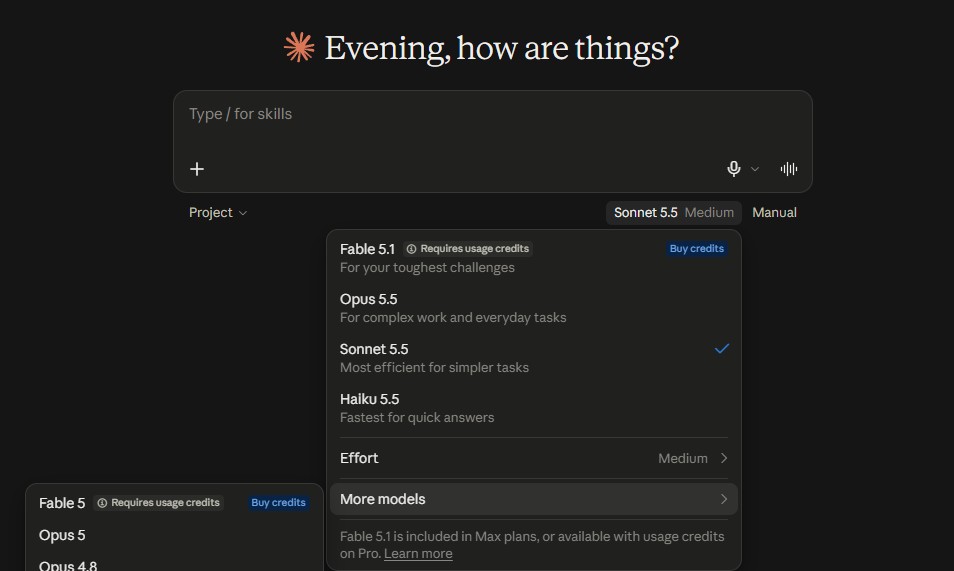
⚡ Short answer: Start on Sonnet 5.5 for everyday work. Move to Opus 5.5 when a task is long, multi-step or keeps coming back wrong. Use Haiku 5.5 for high-volume jobs such as sorting and extraction, and keep Fable 5.1 for the rare problem the others fail on. All four Claude models list a 1M-token context window.
🆕 What changed in this update (October 17, 2026)
- Rebuilt my old Claude Opus 4.6 post into a guide to all four current Claude models.
- Added cost-per-task math, a plan-by-plan table and a 10-second model picker.
- Corrected the old post: Claude Code is a separate Anthropic product, included from the Pro plan.
This guide has no affiliate links · prices come from Anthropic's own pages · Full disclosure
Which of the Claude models fits which job?
Short answer: Sonnet 5.5 for daily writing, summaries and coding; Opus 5.5 for long agentic or multi-step work; Haiku 5.5 for fast, high-volume tasks; Fable 5.1 for the hardest reasoning. Anthropic frames the Claude models the same way, so the tiers are easy to match to what you do.
| Model | Anthropic's pitch | Speed | Default effort* | Released |
|---|---|---|---|---|
| Fable 5.1 | Demanding reasoning and long-horizon agentic work | Slower | high | Not checked |
| Opus 5.5 | Long-running agentic coding and knowledge work | Moderate | medium | Announced Sep 22 |
| Sonnet 5.5 | Best combination of speed and intelligence | Fast | high | Sep 28 (news report) |
| Haiku 5.5 | High-volume, latency-sensitive tasks: classification, extraction, routing | Fastest | medium | Oct 7 |
*API default, from the comparison table in Anthropic's Haiku 5.5 overview. Opus 5.5 defaults to medium effort and Sonnet 5.5 to high, so the pricier model is not set to think harder out of the box.
A job-by-job pick
| If your task is… | Start with | Move up when… |
|---|---|---|
| Emails, rewrites, summaries, spreadsheets | Sonnet 5.5 | The summary misses key points after one clearer prompt |
| Fixing a bug or a well-scoped coding task | Sonnet 5.5 | The fix touches many files or needs a long plan |
| Multi-step agent runs and large refactors | Opus 5.5 | Opus loops or gets stuck, then try Fable 5.1 |
| Tagging, sorting or extracting from thousands of items | Haiku 5.5 | Accuracy drops on edge cases, then try Sonnet 5.5 |
| A problem every cheaper model fails on | Fable 5.1 | This is the top tier |
Key idea: Pay for the tier your hardest task needs, not your average one. Most of what people send to Claude is well-scoped work that the middle tier of the Claude models handles.
What each of the Claude models costs per task
Short answer: On list prices, a task with 20,000 tokens in and 4,000 out costs about $0.004 on Haiku 5.5, $0.08 on Sonnet 5.5, $0.16 on Opus 5.5 and $0.40 on Fable 5.1. Run it 100 times a month and that is $0.40, $8.00, $16.00 and $40.00.
| Model | Input / output per 1M tokens | One task | 100 tasks | vs Sonnet 5.5 |
|---|---|---|---|---|
| Haiku 5.5 | $0.10 / $0.50 | $0.004 | $0.40 | 0.05x |
| Sonnet 5.5 | $2 / $10 | $0.08 | $8.00 | 1x |
| Opus 5.5 | $4 / $20 | $0.16 | $16.00 | 2x |
| Fable 5.1 | $10 / $50 | $0.40 | $40.00 | 5x |
The prices are the base rates on Anthropic's pricing page. The task size is my own example, and I assumed the same token count on all four Claude models. Batch requests are 50% off, and cached input is much cheaper to read again, so real bills for repeated work come in lower.
Haiku 5.5's low rate applies to prompts up to 100,000 tokens. Above that it moves to $0.50 input and $2.50 output, which is still the cheapest of the Claude models but five times its entry rate.
Subscribers do not pay per token, so this table matters most if you use the API or buy usage credits. For the apps, the plan you are on decides which Claude models you can reach, which is the next section.
4 mistakes that make the Claude models cost more
Short answer: Defaulting to the top tier, comparing sticker prices across model generations, skipping batch and caching discounts on repeat API work, and sending Haiku 5.5 prompts over 100,000 tokens. Each one raises your bill without improving the answer.
1. Using Opus for everything
Opus 5.5 costs twice what Sonnet 5.5 does per token. In Nate Herk's seven-task test (video below), Opus cost about double per task and Sonnet still won four of the seven. Reserve the top tiers for work that fails on Sonnet.
2. Comparing sticker prices across generations
Newer Claude models count the same text as more tokens, so a lower per-token price can still mean a higher bill per word. The Opus 4.6 section runs the numbers: Opus 5.5 works out about 8% dearer per word.
3. Paying full price for repeat API work
Batch requests are 50% off. Cached input reads cost 5% of the base input price on Opus 5.5 and Sonnet 5.5, 2.5% on Fable 5.1, and 10% on most others. If you send the same long context again and again, caching is the bigger saving of the two.
4. Sending long prompts to Haiku 5.5
Haiku 5.5's entry rate stops at 100,000 tokens of prompt. Past that, input and output both cost five times as much. Split long documents into chunks and Haiku stays the cheapest of the Claude models.
Which plan unlocks which Claude models?
Short answer: Free is $0, Pro is $20 a month ($17 on annual billing), Max 5x is $100 and Max 20x is $200. Opus 5.5 and Claude Code start on Pro, while Fable 5.1 runs on usage credits at Pro and takes up to half of your weekly usage on Max, according to Lindy's breakdown.
| Plan | Price | Opus 5.5 | Claude Code | Fable 5.1 |
|---|---|---|---|---|
| Free | $0 | No | No | No |
| Pro | $20/mo ($17 annual) | Yes | Yes | Usage credits only |
| Max 5x | $100/mo | Yes | Yes | Up to 50% of weekly usage |
| Max 20x | $200/mo | Yes | Yes | Up to 50% of weekly usage |
Anthropic's pricing page confirms the prices and lists Claude Code, Projects and "more Claude models" on Pro, but it does not itemise which model sits on which plan. The model columns above come from Lindy's pricing breakdown, so check your own model picker before you upgrade for one model.
I could not confirm which of the Claude models the Free plan defaults to, so I have left that out rather than guess. If you are weighing a plan, my AI subscription cost calculator shows what the stack costs over a year.
Where Claude Opus 4.6 fits now
Short answer: Opus 4.6 (released February 5) is a legacy model. It is still available at $5 input and $25 output per million tokens with a 1M context window, but Anthropic's documentation recommends moving to a newer Opus. New work should start on one of the current Claude models, usually Opus 5.5.
The sticker price hides a catch. Anthropic's tokenizer note says 1M tokens holds about 750,000 words on models before Opus 4.7 and about 555,000 on the current one, so the same text uses roughly a third more tokens now.
I ran the numbers for 100,000 words. Input costs about $0.67 on Opus 4.6 and $0.72 on Opus 5.5, so the model with the lower list price is 8% dearer per word. Output is $3.33 against $3.60, also 8% dearer. These are estimates from Anthropic's own ratio, not a billing test.
So Opus 5.5 is not a pure saving over Opus 4.6. You are paying for a newer model, not a cheaper one. As for retirement, I found no date for 4.6; Anthropic's policy is at least 60 days' notice before a public model goes. If you came here from my earlier Opus 4.6 post, this page replaces it.
How I choose between Sonnet 5.5 and Opus 5.5
Short answer: Start on Sonnet 5.5 and move to Opus 5.5 only when the first answer is wrong in a way more detail in the prompt does not fix. Opus costs twice as much per token, so I would rather spend that on the tasks that need it.
I use both in Claude, and that rule is how I decide. A vague prompt gets a weak answer on any of the Claude models, so I tighten the prompt first. Switching models is the second step, not the first. It costs more and rarely repairs a prompt that never said what I wanted.
Signs it is time to move up
Three signals tell me Sonnet has hit its limit: the task needs a long plan across many steps, the answer keeps missing the same requirement after I have restated it, or the output has to be right the first time because someone else will rely on it. Any one of those is worth the extra cost.
When Haiku 5.5 and Fable 5.1 make sense
Haiku 5.5 is for pipelines: classifying, extracting and routing at volume. Anthropic notes it counts the same text as about 30% more tokens than Haiku 4.5, so compare costs on your own data. Fable 5.1 is a deliberate step up at five times Sonnet's price, and I would try it only after Opus 5.5 has failed.
If your main use is coding, my GitHub Copilot vs Claude Code vs Cursor comparison covers the tools around the models. For the daily routine side, see how I use Claude AI every day.
Sonnet 5.5 vs Opus 5.5 on 7 real tasks (video)
Short answer: In Nate Herk's head-to-head, Sonnet 5.5 won four of seven tasks and Opus 5.5 won three, while Opus cost about double per task. Sonnet did best when the brief was clear; Opus did best on open-ended work such as a vague 90-day growth plan.
🎥 Video credit: Nate Herk | AI Automation on YouTube · watch on YouTube
Herk scored the outputs himself, so treat the results as one tester's judgement, not a benchmark. Even so, the cost pattern matches the price list: across the seven runs, Opus took about 46 minutes longer in total and cost roughly twice as much.
The takeaway lines up with my rule above. When the spec is clear, start on Sonnet 5.5 and improve the prompt before you upgrade. Pay for Opus when the brief is open and the model has to bring its own judgement.
Which Claude model to open first
Open Sonnet 5.5 for your next task and keep Opus 5.5 one click away. If a result disappoints, rewrite the prompt before you switch, then switch. Track what you spend for a month with my AI tool costs breakdown, and you will see whether a higher tier or plan is worth paying for.
Frequently Asked Questions: Claude Models
🚀 Put your model choice to work
Once you know which of the Claude models to use, these cover the routine and the cost.