
Most free AI tools don't charge money, but they still send a bill: your chats can train the next model, sit on a server for years, or shape the ads you see. Which of those happens depends less on the price and more on three defaults most people never open. I checked the free tier of nine chatbots against each company's own pages and ranked them, so you can see the real cost before you paste anything.
⚡ Short answer: Free AI tools are fine for everyday questions once you change one setting: the training switch. ChatGPT, Gemini, Copilot, Perplexity and Meta AI learn from free-tier chats by default, and Claude's switch is pre-set to on. For anything private, Proton Lumo, Duck.ai and Brave Leo don't train on your chats at all. And paying $20 a month for a personal plan doesn't change the training rules.
🆕 What changed in this update (October 23, 2026)
- Rebuilt the guide around one question: what each free tier does with your chats by default.
- Added a 9-tool ranking and a "Should I paste this?" checker.
- Added ChatGPT ads, Claude's training switch and Meta AI's ad change.
- Moved step-by-step settings to my AI privacy settings guide, so this page stays short.
Some links are affiliate links · they support this site at no extra cost to you · Full disclosure
What do free AI tools cost you?
Short answer: Three things, and none of them shows up on a price list: training (your chats teach the next model), retention (how long a copy is kept, from 72 hours to five years) and advertising (whether what you type shapes the ads you see). A free tier can charge you one, two or all three.
Search engines and social apps have run on this trade for twenty years. What's different with free AI tools is what people type into them: unfinished drafts, symptoms, money worries, client emails. Things nobody would post publicly end up in a chat box because it feels like a private conversation.
The device data, usage logs and location signals around your chats are a separate layer, and I break them down in what chatbot data collection reveals. This page stays on the part you control: which free tier you pick and what you let it keep.
Key idea: Free AI tools aren't one thing. The gap between the most and least private free tier I checked is far bigger than the gap between free and paid on the same app.
Free AI tools ranked: 9 free tiers compared
Short answer: Among free AI tools, Proton Lumo, Duck.ai and Brave Leo come out on top: no training, little or no history on their servers, no account needed. Claude is the best mainstream free tier once you turn training off. Meta AI ranks last, because your chats feed its ad system and U.S. users get no opt-out.
| # | Free tier | Trains on chats by default? | How long chats are kept | Ads from your chats? | Account needed? |
|---|---|---|---|---|---|
| 1 | Proton Lumo | 🟢 No | No logs of your chats; saved history is encrypted so Proton can't read it | No | No (guest mode) |
| 2 | Duck.ai | 🟢 No | Recent chats saved on your device | No | No |
| 3 | Brave Leo | 🟢 No | History stays on your device | No | No |
| 4 | Claude Free | 🟡 Pre-set to on, your choice | 30 days with training off; up to 5 years with it on | No ads | Yes |
| 5 | Perplexity Free | 🔴 Yes | Kept with your account; you can't opt out while signed out | Not stated | Optional |
| 6 | ChatGPT Free | 🔴 Yes | Until you delete it; Temporary Chats 30 days | Yes in the U.S. (Free and Go) | Optional |
| 7 | Gemini | 🔴 Yes (18+) | 18 months by default; 72 hours with activity off; human-reviewed chats up to 3 years | Not announced | Google account |
| 8 | Copilot (personal) | 🔴 Yes, text and voice | Not clearly stated | Can be used for ads | Microsoft account |
| 9 | Meta AI | 🔴 Yes | Not clearly stated | Yes, no U.S. opt-out | Meta account |
How I ranked them. Defaults count most, because most people never change them on free AI tools. Then how long chats are kept, then whether your words shape ads, then whether you need an account. Where a company doesn't say how long it keeps chats, I counted that against it.
For an outside view, Incogni's latest AI privacy ranking scored 13 platforms on their written policies. Mistral's Vibe (formerly Le Chat) came first and ChatGPT second, thanks to the clearest policy, while Copilot, Meta AI and Kimi scored the highest risk. Incogni is owned by Surfshark, so read it as one input. Its order differs from mine because it grades transparency; I grade what happens when you change nothing.
DeepSeek isn't in my nine because its question is different: where your data is stored, not how it's used. I cover that in my DeepSeek review.
What changed for free AI tools recently?
Short answer: Three changes rewrote the rules for free AI tools in under a year. Claude asked every user to choose on AI training and keeps chats up to five years if it's on. Meta started using Meta AI chats to target ads. ChatGPT began showing ads on its Free and Go plans in the U.S., and those ads can be personalized from your chats.
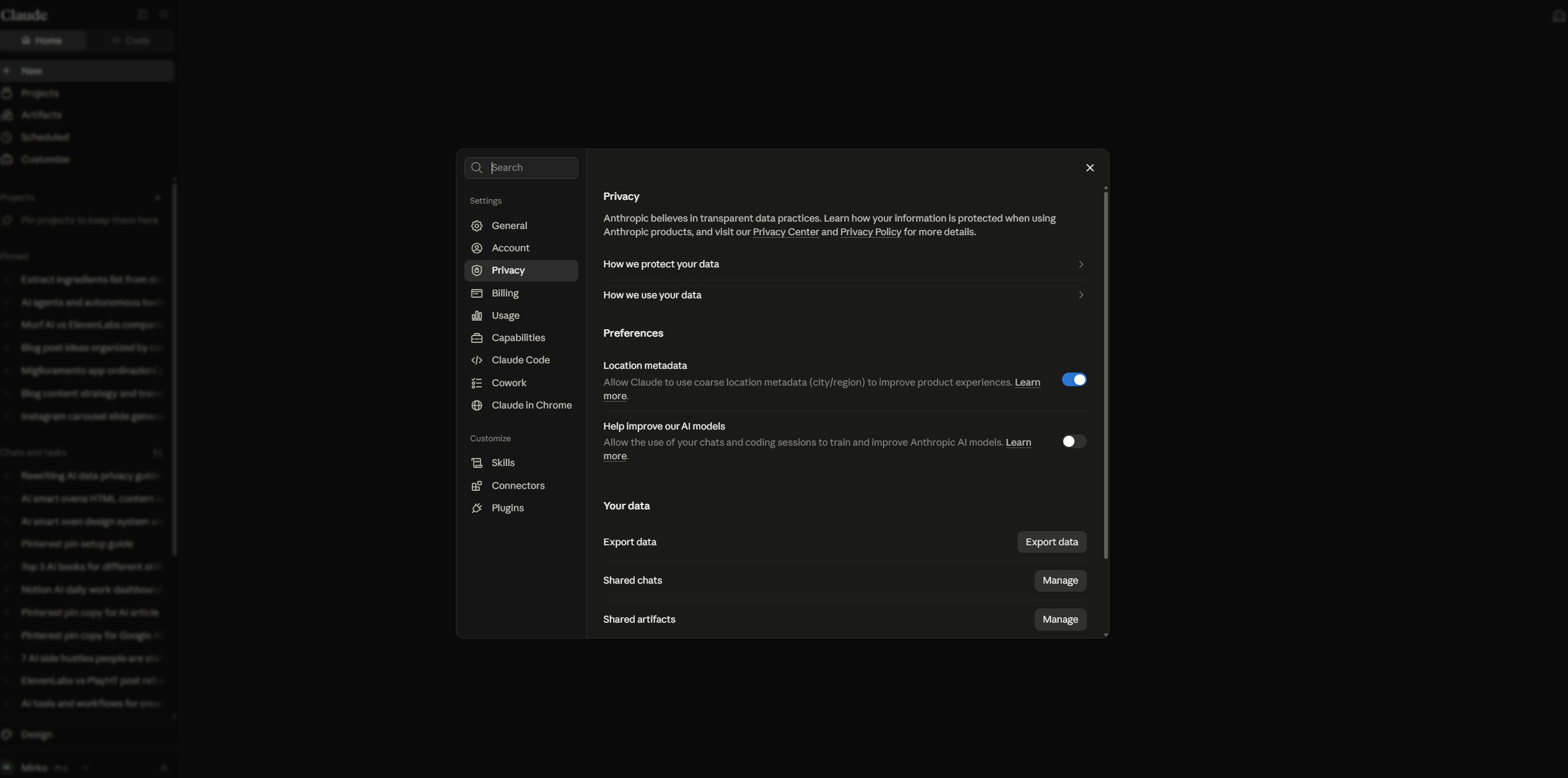
Claude: training becomes a switchFree, Pro and Max users had to pick. With "Help improve Claude" on, new chats can train models and are kept up to five years; off keeps the 30-day window.
Meta AI: chats feed adsVoice and text chats with Meta AI join likes and follows as ad signals across Facebook, Instagram and WhatsApp. No U.S. opt-out.
ChatGPT: ads on Free and GoAds appear below answers in the U.S. With ad personalization on, past chats and memory can help pick them.
The ChatGPT change is the one I get asked about most. OpenAI's ads help page says advertisers never receive your chats and only see totals like views and clicks. You can turn ad personalization off, Temporary Chats show no ads, and there's an ad-free free option with fewer messages. Plus and Pro have no ads at all.
Anthropic's own announcement adds a detail worth knowing: chats you delete aren't used for future training. For Meta, the full picture and what you can still limit is in my WhatsApp Meta AI guide.
🌍 Outside the U.S.: Meta's ad change didn't launch in the EU, the UK or South Korea, and OpenAI says personalized ads aren't initially offered in the EEA or Switzerland. Defaults still differ by country, so check the settings page on your own account.
Is a paid AI plan more private than free?
Short answer: Not on personal plans, which follow the same rules as free AI tools. ChatGPT Plus, Claude Pro and Perplexity Pro use the same training switches as their free tiers. What $20 a month buys is no ads on ChatGPT, higher limits and stronger models. The real privacy line sits at business and API accounts, which OpenAI, Anthropic and Perplexity exclude from training by default.
- No ads on ChatGPT Plus and Pro
- More messages, files and stronger models
- Longer memory and saved history
- The training switch you still have to flip
- How long the company keeps your chats
- Human review rules on the same app
So if privacy is your only reason to upgrade, the money goes further elsewhere. Flip the training switch on the free tier, and move the sensitive questions to one of the private free tools below. If you're weighing a paid plan for other reasons, my AI subscription cost calculator shows what your stack costs per year, and my best AI subscription guide compares the plans.
Key idea: For work, the plan that matters is the one your employer manages. A business account changes who controls the data; a personal upgrade doesn't.
Which free AI tools don't train on your data?
Short answer: Four free AI tools keep your chats out of training: Duck.ai, Proton Lumo, Brave Leo and a local model on your own computer. The trade-off is power. Their free tiers run smaller or older models with daily limits, so I'd use them for the sensitive 10% of questions, not for everything.
One honest limit: "no training" isn't the same as "never seen." Hosted free AI tools still process your text on a server, even when they don't keep it. Only a local model keeps every word on your device. If you want to go that route, start with my open source AI models guide, and for quick tasks without any sign-up, my list of free AI tools with no login covers more options.
Should I paste this into free AI tools? The free checker
Pick what you're about to paste into free AI tools, and where. The checker gives a green, amber or red verdict, tells you why, and points to a safer option when there is one. It runs in your browser, so nothing you pick is saved or sent anywhere.
Are free AI photo, voice and writing apps riskier?
Short answer: Often, yes, because of what you upload. A face or a voice can't be changed like a password, and some free photo and voice apps ask for broad rights to reuse what you send them. Writing helpers that run as browser extensions can see text on every site you type into, not just the chatbot.
Before you upload a selfie or a voice sample to free AI tools, I check three things in the terms: whether uploads are deleted after processing, whether the license lets the company reuse or train on them, and whether I can delete my account and media in one step. If any answer is unclear, I treat it as a no.
My Remini vs Lensa comparison covers the photo side, the AI voice replication guide covers voice, and AI voice cloning scams shows why a few seconds of audio matter. For extensions, read how browser extensions can read your prompts. And if a "free" app looks too polished to be true, run it past my AI tool scam checker first.
5 rules I follow with free AI tools
None of these needs a paid plan. Together they cut most of what free AI tools can keep about you, and they take about ten minutes once.
- 1Flip the training switch on day one. It takes a minute per app. The exact menus for ChatGPT, Claude, Gemini, Copilot and Perplexity are in my AI privacy settings guide.
- 2Use a temporary chat for one-off questions. ChatGPT's Temporary Chat skips history and training, Claude has incognito chats, and Gemini's Temporary Chat stays out of your activity.
- 3Swap real details for placeholders. "Client A", "my city" and "a family member" get you the same answer without handing over the identity.
- 4Don't rate sensitive chats. A thumbs up or down can make that conversation usable for training even with the switch off. I explain it in the feedback loophole.
- 5Route the sensitive 10% elsewhere. Private free tools, a local model or an employer-managed account. And if free AI tools ask for your contacts, photos or microphone at sign-up, say no. Here's what to check.
My verdict
Free AI tools are a good deal for public, low-stakes questions once the training switch is off. For anything you wouldn't post publicly, the price of free is too high on most mainstream tiers. Use a private free tool, a local model or a work account for that part, and keep the rest exactly where it is.