
Mirko
Founder & AI Tech Writer
Frase and Surfer both rebuilt themselves around AI search, yet most SurferSEO vs Frase comparisons still quote prices that no longer exist. The old story, Frase at $15 against Surfer at $89, is gone: both now start near $50 a month. So I rebuilt this guide around one question: which one gets you ranked on Google and cited by AI for the least money?
⚡ Short answer: Frase is the better pick for most solo bloggers and small teams: Starter costs $39 a month billed yearly and already tracks your visibility in ChatGPT and Google AI, something Surfer only adds from its $99 Standard plan. Surfer is the better pick if your job is polishing pages one by one against the search results, or tracking AI answers daily for clients.
🆕 What changed in this update (October 9, 2026)
- Replaced every old price: both tools repriced, and the "6x cheaper" gap is gone.
- Added AI visibility tracking, the new agents and AI Tracker.
- New 12-month cost table, feature scorecard and 30-second finder.
- Removed ranking-speed and testing claims I couldn't verify.
- Added a screenshot from my own account.
Some links are affiliate links · they support this site at no extra cost to you · Full disclosure
What changed for both tools?
Short answer: Both stopped being Google-only optimizers. Surfer added AI Tracker, its Surfy assistant and an MCP connection, and now sells five plans from $49 to $299 a month. Frase rebuilt itself as a content agent that researches, writes, scores for SEO and GEO, publishes to your CMS and rewrites pages as they slip, from $39 a month.
GEO, short for generative engine optimization, means shaping a page so ChatGPT, Perplexity and Google's AI answers quote it. Google's guide to its AI features says no special markup is needed: the same helpful, crawlable content earns both rankings and AI mentions.
So both tools now pitch the same promise: help you write that content faster, then show you whether AI search cites it. Where they differ is how much of the job they do for you after the draft is written.
Key idea: compare what each plan does after you hit publish, not how many metrics the editor shows.
SurferSEO vs Frase at a glance
The rows that decide most purchases are the entry price and whether AI visibility is included. Prices are US list prices from both pricing pages, checked October 9, 2026.
| Surfer | Frase | |
|---|---|---|
| Cheapest plan (yearly) | Discovery $49/mo | Starter $39/mo |
| Cheapest plan (monthly) | Discovery $59/mo | Starter $49/mo |
| Free trial | No free plan; you pay to use the editor | 7 days, no card |
| AI visibility from | Standard $99/mo (ChatGPT only) | Starter $39/mo (ChatGPT, Google AI) |
| AI engines on top plans | ChatGPT, Perplexity, Gemini, AI Overviews, AI Mode | ChatGPT, Google AI, Perplexity, Claude, Gemini |
| Content per plan | 120 docs a year to unlimited | 10 to 100 articles a month |
| Publishes for you | WordPress and Google Docs integrations | WordPress, Webflow, Sanity, Wix, FraseCMS |
| Works inside Claude or ChatGPT | MCP listed on plans | MCP server and CLI on every plan |
| Best for | Page-by-page optimization | One tool for the whole content loop |
One conflict worth knowing: Frase's comparison page says Surfer has no MCP server, while Surfer's pricing lists MCP on its plans. I went with Surfer's own page. Both bill in USD; EU and UK buyers should expect local VAT on top of these prices.
Surfer vs Frase: who wins each feature?
Short answer: Frase wins on entry price, AI visibility at the low end, content volume per dollar and fixing pages for you. Surfer wins on its page-scoring editor and on daily AI tracking across five engines for less money at the agency level. Team seats and white-label reports are close to a tie.
Score: That's 4 of 8 rows to Frase, 2 to Surfer and 2 ties, which makes it my default pick, but the two rows Surfer wins are exactly the ones an SEO specialist or agency cares about most.
How much do Surfer and Frase cost?
Short answer: Surfer runs $49, $99, $182 and $299 a month billed yearly (Discovery, Standard, Pro, Peace of Mind), plus an $82 AI-tracking-only plan. Its rival runs $39, $103 and $239 billed yearly (Starter, Professional, Scale), or $49, $129 and $299 month to month. Both drop about 17 to 20% for yearly billing.
Surfer plans
| Plan | Yearly | Monthly | Documents | AI prompts | Seats |
|---|---|---|---|---|---|
| Discovery | $49/mo | $59 | 120 a year | None | 1 |
| Standard | $99/mo | $119 | 360 a year | 25, ChatGPT, weekly | 3 |
| Pro | $182/mo | $219 | 360 a year | 50, all engines, daily | 5 |
| Peace of Mind | $299/mo | $359 | Unlimited (fair use) | 100, all engines, daily | 10 |
| AI Search Analytics | $82/mo | $95 | No editor | 50, all engines, daily | 5 |
Surfer shows yearly prices with the yearly saving next to each, so I worked out the monthly figures from those savings. On yearly plans, document credits reset once a year, not monthly. Source: Surfer's pricing page.
Frase plans
| Plan | Yearly | Monthly | Articles | AI engines tracked | Seats / sites |
|---|---|---|---|---|---|
| Starter | $39/mo | $49 | 10 a month | ChatGPT, Google AI | 1 / 1 |
| Professional | $103/mo | $129 | 40 a month | + Perplexity | 3 / 5 |
| Scale | $239/mo | $299 | 100 a month | + Claude, Gemini | 5 / 10 |
| Enterprise | Custom | Custom | Custom | Custom, white-label | Custom |
Starter stops at its limits, so there's no surprise bill. Professional and Scale offer optional pay-as-you-go: $5 or $4 per extra article. The 7-day trial needs no card and is capped at 5 articles. Source: Frase's pricing page.
What does each cost over 12 months?
Short answer: For a solo blogger who wants AI visibility, Starter costs $468 a year against $1,188 for the cheapest Surfer plan that tracks AI answers. For a three-person team the two land within $50 of each other. For an agency tracking AI search daily, Surfer Pro is $684 a year cheaper than Scale, but includes far fewer documents.
I matched each reader type to the cheapest plan on each side that covers what they need, then multiplied the yearly price by 12. This is my own calculation from the two pricing pages above.
The takeaway: Starter is cheapest at the bottom, Surfer is cheapest for tracking-heavy agencies, and the middle is a coin toss decided by which editor you prefer. Already paying for ChatGPT, Claude or other AI tools? My free AI subscription cost calculator adds either tool to the stack and shows the yearly total.
Which one tracks AI search better?
Short answer: The cheapest AI tracking is the $39 Starter plan on the Frase side. Surfer tracks more engines daily for less once you reach $182 Pro, and sells an $82 tracking-only plan if you already have an editor. Neither can promise you a citation; both only measure a sample of prompts.
| Plan | Price (yearly) | Prompts | Engines | Refresh |
|---|---|---|---|---|
| Frase Starter | $39/mo | 25 | ChatGPT, Google AI | Not stated |
| Surfer Standard | $99/mo | 25 | ChatGPT | Weekly |
| Frase Professional | $103/mo | 100 | + Perplexity | Not stated |
| Surfer AI Search Analytics | $82/mo | 50 | All 5, no editor | Daily |
| Surfer Pro | $182/mo | 50 | ChatGPT, Perplexity, Gemini, AI Overviews, AI Mode | Daily |
| Frase Scale | $239/mo | 350 | + Claude, Gemini | Not stated |
Starter, Professional and Scale prompt counts come from the vendor's Surfer comparison page; refresh frequency isn't published, so I left it blank rather than guess. A prompt is one question you track, such as "best CRM for a bakery", checked across the engines on your plan.
Treat these dashboards as a thermometer, not a scoreboard. AI answers shift from one run to the next, as I explain in why AI answers change every time. If you'd rather test by hand first, my guide on how to appear in AI search shows a free method with screenshots.
Does a content score help you rank?
Short answer: A little, at best. An independent Ahrefs study of five popular tools, both of these included, found weak correlations between content scores and rankings across the board. Surfer's own study reports a stronger link for its score. Use either score as a checklist for topic coverage, not a promise of position.
The evidence is split along vendor lines. Ahrefs compared scores from Surfer, Frase, NeuronWriter, Clearscope and its own tool and found the links weak everywhere. Surfer reports a 0.28 correlation from its own study of a million search results, and cites Ahrefs putting its rival near 0.1.
The most candid line comes from the cheaper tool itself: its comparison page concedes that no content-optimization score reliably predicts rankings, its own included. When a vendor admits that, believe it.
How I'd use either score
- Use it to spot gaps. Missing subtopics and questions are the useful part of any score.
- Stop at "good enough". Pushing from 80 to 95 usually means stuffing terms, which hurts readability.
- Write the answer first. A clear 40 to 60 word answer under each heading helps AI search quote you more than any score.
Bottom line: buy the tool whose workflow saves you hours, not the one with the higher number.
Both tools up close
Both cards start with what you get before paying, because that's where every reader should start.
1. Frase 🏆 Best value
A content agent that researches, writes, scores for SEO and GEO, publishes and fixes
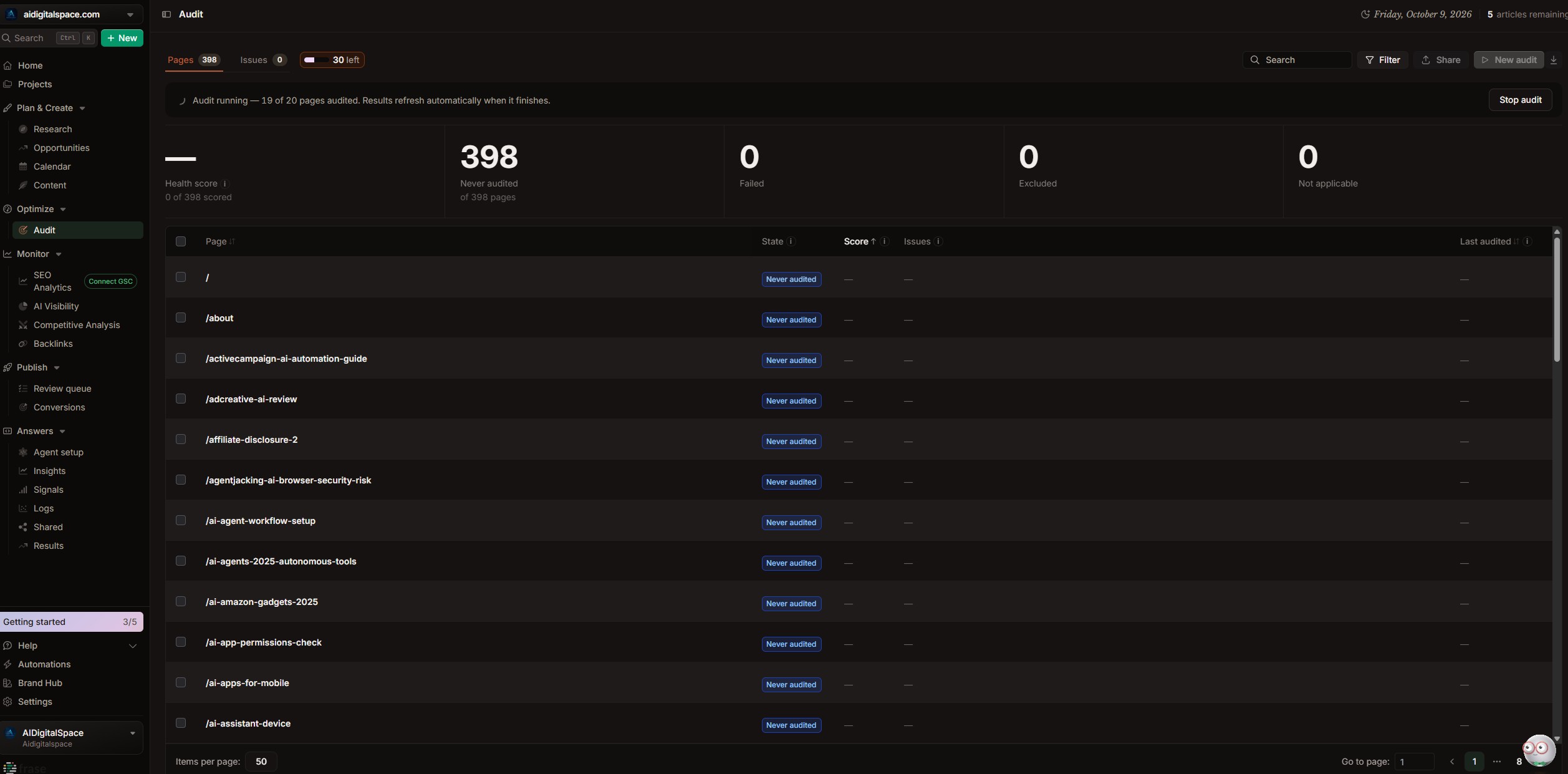 📸 From my own account: the one tool here I've used myself.
It now runs the whole content loop in one place. It builds a brief from the live search results, drafts in your brand voice with unlimited AI words, scores the draft for SEO and GEO side by side, and pushes it to WordPress, Webflow, Sanity or Wix. You choose how much it publishes on its own.
The part Surfer has no answer to is Content Guard: when a live page slips on Google, it drafts the rewrite and republishes it once you approve. It also runs from Claude, ChatGPT or Cursor through its MCP server. The catch is volume: Starter covers 10 articles a month, so a weekly-plus blog lands on Professional.
- AI tracking on the cheapest plan
- Drafts and ships page fixes
- No surprise overage on Starter
- Starter is single-seat, single-site
- Prompt refresh rate not published
- Agent output still needs editing
2. Surfer 🎯 Best page optimizer
The SERP-based Content Editor, now with AI Tracker and the Surfy assistant
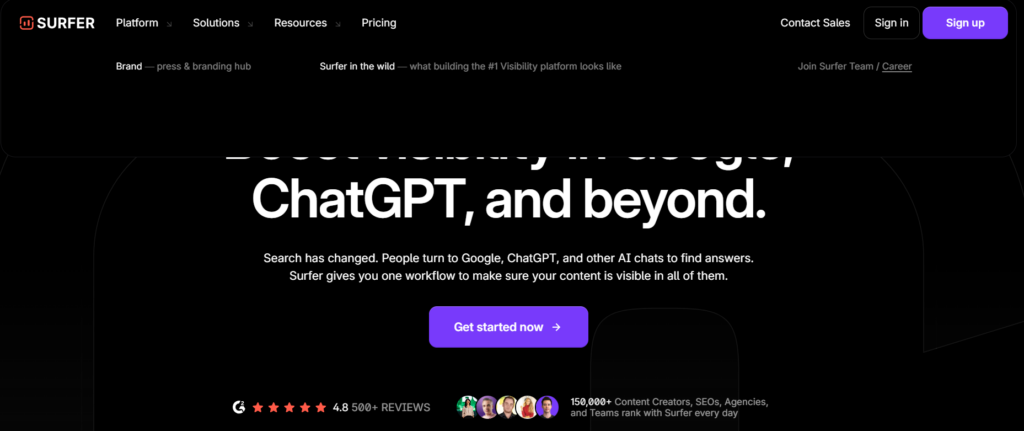 Surfer's Content Editor interface. Not my account: I haven't paid for Surfer.
Surfer's strength is still the Content Editor: write or paste a draft and it scores it 0 to 100 against the top results, listing the terms, headings and questions to add. Auto Optimize and internal-link suggestions fix much of that in one click, and Surfy, its AI assistant, drafts and rewrites inside the editor.
For AI search, AI Tracker watches your brand across ChatGPT, Perplexity, Gemini, AI Overviews and AI Mode, with mention gaps and sentiment. It only reaches all five engines daily on Pro ($182 a month yearly) or the $82 tracking-only plan. On Discovery and Standard, fixing what the audit finds is still your job.
- Mature, detailed page scoring
- Strong AI tracking on Pro
- Topical Map and cannibalization report
- No AI tracking on Discovery
- Yearly document credits, not monthly
- Fixes after an audit are manual
Which one fits you? Pick in 30 seconds
Answer three questions and the finder names one plan. Nothing is saved or sent anywhere; it runs in your browser.
Want to check the result? Each answer links to the matching card above, with what it costs and what you get before paying.
Which should you choose?
Short answer: Start with Starter on the Frase side if you blog on your own or run a small site: it's the cheapest way to write, publish and see AI mentions. Pick Surfer Discovery or Standard if page-by-page scoring is your craft, and Surfer Pro if you report AI visibility to clients daily. Scale suits agencies that publish at volume.
Should you pay for both?
Rarely. The cheapest combination, Starter plus Discovery, costs $1,056 a year and doubles up on briefs, scoring and AI writing. If one editor feels slow to you, switch rather than stack. The exception is an agency that wants Surfer's daily tracking report and the other's publishing agent side by side.
Planning the content itself? My GEO guide to getting cited by AI search covers the writing habits both tools score, and how I use Claude AI every day shows the drafting side, where either tool's MCP connection fits in.
Frequently Asked Questions — Surfer vs Frase
I write every guide on this site myself and update it when a product changes, as both of these did. Here I've used Frase lightly and Surfer not at all, so the comparison leans on both pricing pages, checked on the date above. I only label a tool tested when I've used it in depth.